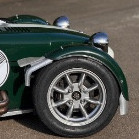
Cardboard Racer Posted yesterday at 12:32 PM Posted yesterday at 12:32 PM Hi everyone, First-time poster here under the handle Cardboard racer. I wanted to share a little garage experiment I’ve been working on, which ended up making a surprisingly big difference to my car's top-end speed and cabin comfort. As most of us know, driving a Caterham with a full glass windshield fast can feel like pushing a brick through the air. Once you get close to 200 km/h, the wind resistance usually creates a massive parachute effect inside the cockpit, causing a lot of noisy buffeting and shoulder-slapping. Recently, I managed to hit a GPS-verified 221 km/h (137.3 mph) on a quiet stretch of highway. I was running a completely open-top setup with standard doors, but the most amazing part was how peaceful the cabin felt. There was no neck buffeting, no booming noise, and no wind tearing at my shoulders. It felt incredibly smooth and serene. My Car's Setup: Engine: Wesmo 2.4L Duratec Gearbox: Stock Caterham 360 5-speed transmission Tyres: 195/50R15 At 221 km/h, the engine was revving happily right in its sweet spot around 6,400 RPM. Instead of trying to force the car through the air with raw horsepower, I decided to see if I could play around with the airflow using a homemade cardboard prototype and some careful geometric modifications. Here is the simple geometric layout I put together, along with what I saw during some simple Tuft Testing from 70 km/h all the way up to top speed: 1. The Four-Wheel Outwash & Foam-Sealed Fenders To clean up the airflow before it even reaches the bodywork, I addressed the biggest aerodynamic trap on a Seven: the open wheels. I completely filled the gap between the inside of the fenders and the tyre treads with foam on ALL FOUR WHEELS, achieving a near-zero clearance seal. For the front wheels, this stops high-pressure air from getting trapped under the arches, eliminating lift and forcing the wind to cleanly "outwash" around the suspension. For the rear wheels, this seal prevents the rear fenders from acting like huge air-catching parachutes, keeping the side-flow incredibly attached and smooth as it heads to the back. 2. The Front Intake (Bernoulli Effect) My windshield is tilted forward/downward by about 5 degrees, and I left an open gap at the bottom. As the car moves, air gets compressed and speeds up through this base gap, creating a smooth, high-velocity stream entering the cabin area. 3. The Invisible Side Walls (Delta-Wing Air Curtain) The bottom corners of the windshield act like little vortex generators, creating two energetic spinning air streams (delta-wing vortices). Guided by the clean air from the front wheel outwash, these run right along the top edge of the stock doors, effectively acting like a pair of invisible side windows that seal the cockpit from outside crosswinds. 4. The Under-Deck Pressure Chamber (UDPC) I made a 20cm high chamber out of thick cardboard that sits right on the trunk lid, tucked underneath a 15° sloping rear deck (which extends 7cm past the rear chassis). The sides are blocked off by high-profile Stealth shark-fins, but the chamber is completely open at the front (right behind the driver’s seat) and at the back (flush with the bottom Diffuser). What the Tufts and Road Dust Showed Me: The tuft inside the cardboard tunnel pointed straight FORWARD: Because of the pressure differences created by the fast air passing over the car, it creates a gentle siphon effect at the back. It actually pulls low-pressure air forward from the Zone 4 Diffuser exit into the cardboard tunnel. I know this because the tunnel catches road dust from underneath the car, which proves the air is traveling from back to front! The tuft right behind the seat pointed 90° straight UPWARD, then rotated around the roll bar and flowed cleanly rearward: When this reverse air stream traveling forward through the cardboard meets the central wind coming from the front windshield gap, they meet right behind the driver's headrest. Because the sides are sealed by the windshield's vortex "air curtains" and the bottom is solid, these two air streams gently collide and turn 90 degrees, blowing straight UP. Interestingly, as this upward jet hits the roll cage, it wraps and rotates right around the tubes (thanks to the Coandă effect), before flowing smoothly rearward along the 15° Flow-Feeder rear deck. This actually helps clean up the messy turbulent wake usually caused by the round roll bar tubes! How it all comes together: This vertical air stream behind the seats acts like a "virtual roof line." It gently lifts the rushing overhead air up and away, preventing it from crashing down into our laps. The heavy drag inside the cabin completely disappears, and the air flows smoothly over the rear deck and drops back down into the diffuser area. Nature doesn't really care if a part is made of expensive carbon fiber or simple garage cardboard—it only cares about the shape and how the air moves! This little paper prototype completely reshaped how my Seven cuts through the wind. I'll attach the tuft testing photos below so you can see the airflow direction. I'd love to hear if anyone else in the club has played around with shifting airflow or managing cabin drag on a full-windshield setup! Cheers, Cardboard racer 1 1

Recommended Posts
Create an account or sign in to comment
You need to be a member in order to leave a comment
Create an account
Sign up for a new account in our community. It's easy!
Register a new accountSign in
Already have an account? Sign in here.
Sign In Now