.png.10e302571d0a4cd53670cb63897157a4.png)
Bruce K
-
Posts
498 -
Joined
-
Last visited
Content Type
Profiles
Forums
Store
Articles
Gallery
Events
Library
Everything posted by Bruce K
-
Very nice, and looks very much like my first Cat: Non-FIA rollbar, exposed aluminum skin, BRG nose and fenders, Minilite-style wheels, Ford cross-flow motor, chromed headlight buckets. The only discernable difference is my first Cat wore clamshells, which I never owned again - aerodynamically speaking, how do you make a brick worse? Add clamshells! I looked again at your commemorative Elise - exceptionally pretty.
-
Nice story. You neglected to include photo(s) of the Caterham. The evolution of your Lotus Elise is something I understand. The earlier, pre-Chinese Loti are wife material - cars with whom you want to establish a lifelong relationship. You end up not caring much about the extent of your investment, because you believe you will be together forever. As with human relationships, sometimes things fall apart, or other interests intervene, but we seem to return to our original loves again at later points. Sevens are Loti under the skin, and I've owned four. I would have stayed with the first, but I kept following the power, like a breast guy going up in cup sizes. The formula is responsible for this loyalty - light weight, big power, instant yet predictable reflexes, the ability to steer with the throttle, boat anchor brakes, and more.
-
ANY CAR is fun to drive. If our only choice was between horses and Trabants, every guy on this forum would be driving a Communist piece of crap around on two wheels. And your Nissan Versa is amazingly better than than any Trabant or Yugo - plenty peppy, with 122 horsepower. Lots of traction with FWD. Light weight. Relatively wide track. Cars are like women - endless arrays of virtues in different species and quantities - curves of every imaginable variety - some individually easier to get along with than others, but all are attractive to somebody - and so much better than a horse, for almost every purpose!
-
Terrific article - I had no idea such a model existed. IMO an iconic V12 with these capabilities is a keeper, although I do not believe such beasts will entirely disappear from new production anytime soon. As Mark Twain commented regarding certain false news, "Rumors of my death are greatly exaggerated." I believe the same will be true regarding the internal combustion engine. Battery tech is at the stage of Stanley Steamer tech 100 years ago, and requires major evolutions in weight, power density, availability of scarce raw materials, fire resistance, required charging time, recycling ability and more. And then our power grid must multiply itself by3 or more times to handle the load. Once fusion power is upon is, and electricity plummets in cost, and once battery tech has resolved these current huge problems, electric cars will come to dominate. But until then, there are 1.2 BILLION IC cars on the road, millions more are being produced each year, they are getting cleaner every model year, gas stations exist on every next corner, and there is enough fuel in the ground for a couple centuries - so ride the wave!
-
Ha! I enjoyed that rant. Actually, my Alfa has provided over 20K trouble-free miles so far. I built it below maximum specs for that reason. But it's still fast as hell. In a stoplight drag, I pulled better than a car length on a Ferrari 458. The Alfa is my only DCT, and driving it is a bit like playing a video game. The other two cars have 5 speeds, and it's great to swap seats among all three. The involvement with the manuals is deeper, requiring advanced skills like heel-and-toeing and rev-matching while downshifting, but the DCT shifts faster than any human in the history of humans.
-
I apologize for inspiring envy of any sort. An outlaw Miata which has dirtied the owner's hands for years can provide just as much fun, and instill the same justifiable pride of ownership. By sharing the development details of my cars, I hope only to inspire fruitful conversation, and perhaps help others navigate their upgrade path. Not every change is an upgrade. I had to perform months of research to separate the good from the bad, with all three of my cars. As I explained to Bill S (@mrmustang), I performed little of the actual work (except during Covid), but I am responsible for all of the research. I wish I could have laid hands on more often, as it bonds an owner to his car in special ways. Every time I see that seat-mounted extinguisher in my Porsche 935, I am reminded that I modified it to fit, and installed it. Every time I adjust the driver's seat, I am reminded that I rebuilt the Brey-Krause slider system. Those unique connections provide a special satisfaction every time the key is turned. I would like to hear more from other owners regarding their ownership journeys.
-
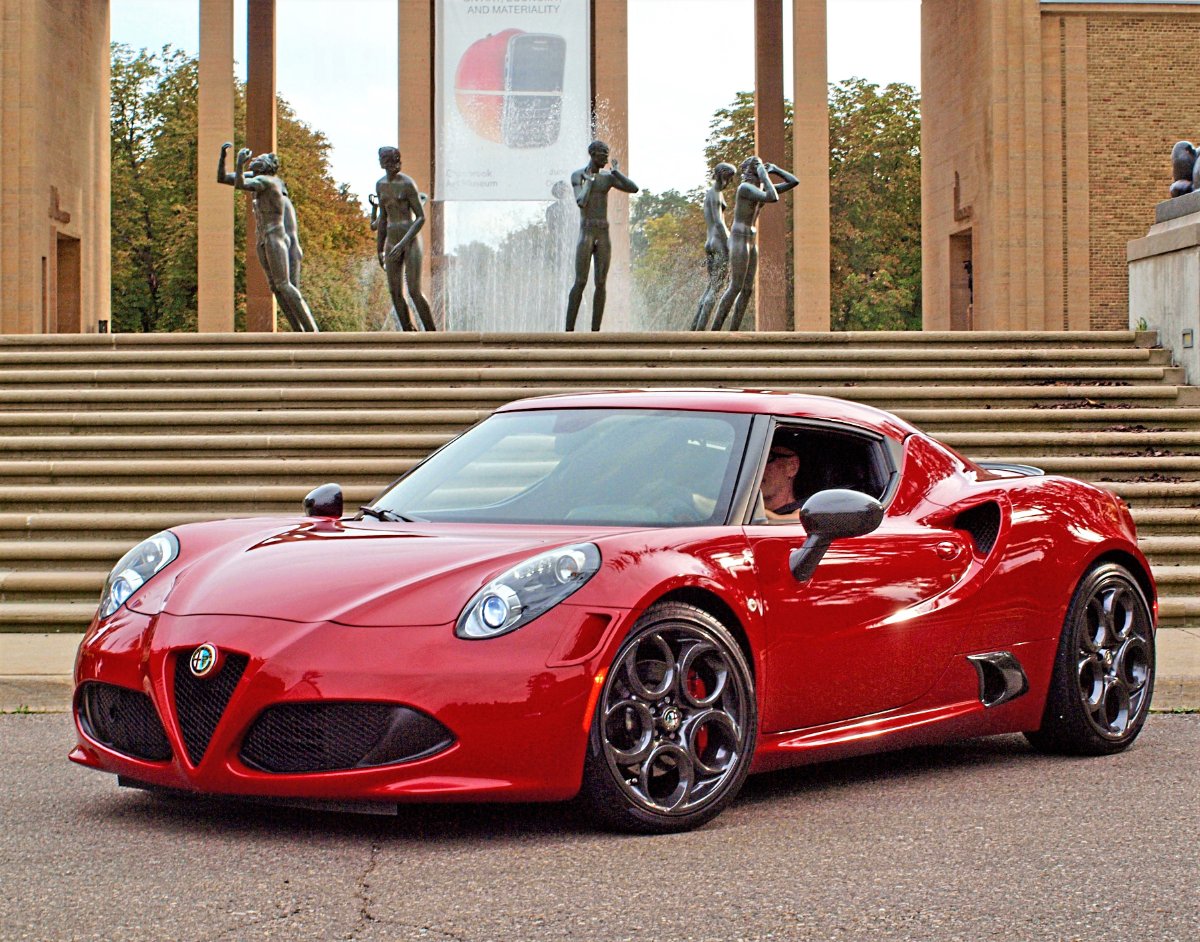
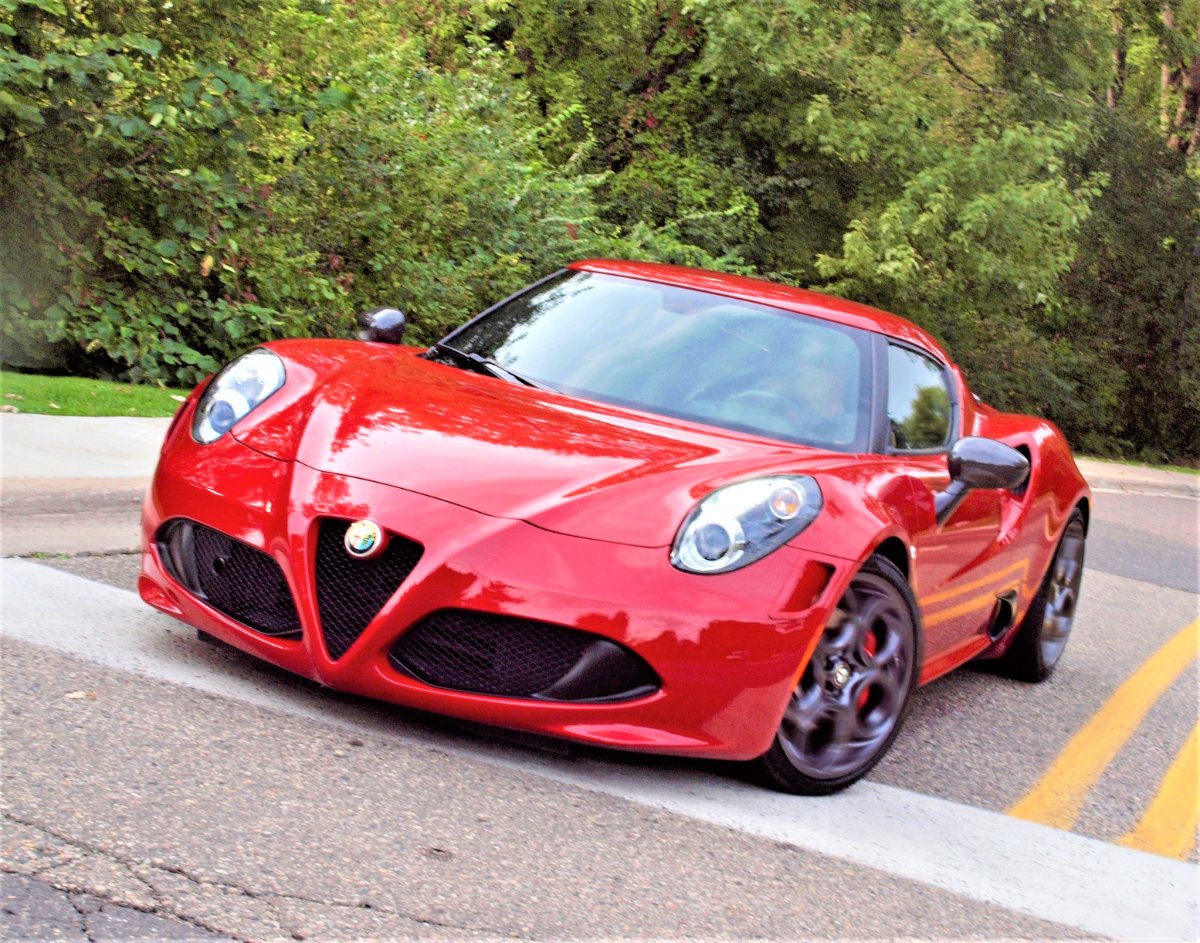
Thanks for the insights, @mrmustang. I haven't received any notices regarding this thread in about a month. That is a shame, because this thread has been so interesting and so much fun. Therefore, I will introduce for consideration another vehicle: My 2015 Alfa Romeo 4C Launch Edition. This car has received a full Stage III power and handling upgrades. Stage III ECU plus a larger Garrett air-to-air intercooler and larger, smoother, non-collapsible silicone intake tubes and airbox. Larger air filter and Brisk racing plugs. Exhaust is 1/4" wider with one muffler deleted and thus a shorter run, and the new Scara73 cat is substantially wider with only 200 larger cells. Stouter anti-sway bars were fitted, and a semi-solid motor mount. 4C Suspension Blocks were added to the front suspension, which permits more camber and finer adjustments. The rubber rear suspension bushings were exchanged for stouter nylon versions. Tires were upgraded to larger Bridgestone Potenza RE-71 R's, 215 x 40 front and 245 x 35 rears. For appearance and greater stability in crosswinds, I added wheel and hub-centric billet aluminum wheel spacers, 1/2" front and 1" rear (no rubbing). The final step was replacement of the stock coilovers with an excellent Nitron 2-way package which significantly improved handling, in part by reducing weight by 8 pounds per corner. The car also sits about 1/2" lower now. The results? I wrote the following description for an article in "Alfa Owner" magazine: The Results Everything affects everything else in complex projects like this, so it is not possible to fully define improvements provided by any single 4C upgrade. But if you think of an IC engine as an air pump, my Stage III motor now pumps a lot more air a whole lot faster. The engine spools much quicker now, as if I’d removed the flywheel. When pushed hard in race mode, the car accelerates through gears with manic intensity, and I have difficulty pulling paddles fast enough to prevent rev limiter intervention (after so many years of saying “Put it away”, I’m the one who needs more video game experience). Instead of leaning and squealing, the car remains flat, oversteering at the limit and correcting with a stab of the superpower switch (AKA the throttle). Gator teeth at some tracks, including my native Waterford, have unsettled several cars I’ve driven, but not this 4C: Tires follow pavement as though quantum entangled. When challengers finally catch up, the uninitiated want to know the size of my V8: When apprised of the 1.7 liter capacity of the car’s I4, various states of wordless catatonia ensue. My 4C is earthy, close to the ground, full of pregnant scoops and breast-like fenders. She got her sultry supercar silhouette from the sheet metal sex hustlers at Centrostile. Since Imperial Rome, Italians have been deficient at war-winning, but weaknesses often induce compensatory strengths, and Italians create cars that seduce like Sophia Loren in her prime. The beating heart of this 4C is everywhere: In the air, in the wheel, in your seat, in the pedals, just like it was in your chest the first time you fell in love. And, yes, Roberto, when you lay on her throttle, the earth does move. I am thrilled and privileged to own and drive this timeless exotic. I said it earlier, and it bears reiteration: My name is Bruce, and I’m an Alfaholic. Images:

-
Bill - you are definitely an enormously experienced custom car BUILDER. I am absolutely not, and my comments originated from my perspective as an experienced custom car CONFIGURATOR. As a configurator, I would not specify an older conversion - too much opportunity for used parts to fail, to little recoup of the investment. You, on the other hand, have many options which are unavailable to me. In retrospect, I wish I could have invested more time into actual mechanical repair and assembly over the years, to gain your skills. Instead, my business was like a bitchy wife, always nagging and dragging me away from anything avocational. On the other hand, my businesses eventually gave me ownership of the cars I wanted, so I have at least been partially successful. But I still envy your skills.
-
The weight gain resulting from a 2016 Miata to a Chevy LS3 crate engine conversion is 250 to 300 pounds, so you gain a fat passenger or a big NFL middle linebacker. But power is up an over-compensatory 240%, and the total package is still well under 3,000 pounds. Without flares, there's not enough tire to really grab n' go, but the car is still fast, handles well and was lauded by the reviewer in the ATTACHED Motor Trend article. Cost of the complete installation (all-new parts) was $55,000 in 2019 plus the car, so a complete all-new Flyin' Miata would cost well over $90,000 today - yes, the package includes Wilwood 6-pots and custom-valved Fox shocks, but still hard to justify for any Miata, especially one that has lost a lot of its Lotus luster. For example (unmentioned in the review) the conversion includes lots of belching heat, driveline shudder, a stiff clutch and sub-12 gallon fuel tank (my Lola's smallish fuel cell is more than 2 gallons larger). Resale is also a bit dicey. IMO a nice used low-mileage 911 would prove itself a better all-around sports car and superior investment. NOW, if you buy only parts, including used, and provide all remaining equity with sweat, and then install these in a used but fairly new Miata, the proposition changes. You may be able to build the car for a bit over $50,000 - but that is used Superformance or Backdraft Cobra territory, and more than the resale value of even well-assembled Factory Five Cobras. Once again, its a value versus desire proposition: https://www.motortrend.com/reviews/exclusive-first-drive-flyin-miatas-v-8-powered-2016-mazda-mx-5/
-
Your observation about the slant six engine weight is correct - 475 lbs raw vs 535 raw for a much larger displacement V8 SBC Chevy. However, for reasons unknown to me, Chrysler built tremendous torsional rigidity into the motor, which evidently required some mass. I'll bet that rigidity is part of the reason slant sixes had a reputation for longevity. This special property was important for the Valiant Eleven, which required a torsionally rigid motor as a stressed frame member. I couldn't find torsional rigidity stats for the SBC as a comparison, but I do know it's crank deflects 1/3 of a degree at 8,000 rpm, so it may not be structural material for a chassis (a weakness of most older motor designs). The slant six was one of the first modern torsionally rigid engines - pretty remarkable for a long motor, plus it was capable of excellent power and torque. My cousin had one in a sweet old Barracuda, in which he set a number of dragstrip records in his class. I was in a passenger when he took down a number of different V8 cars on the street. Regarding Cobra motors, you are correct again. Many replicas are running around with Chevy power (not my cup of tea). But the AC Ace was selected by Caroll Shelby because of the long, wide engine bay, which could ingest a small block Ford motor with room for dessert. As a result of that inviting bay, fitting a Cobra with almost any motor is NBD - never seen one with a Viper V10, though!
-
Please explain your observation "An iron 8.8 helps offset the v8." I understand the 8.8 diff to be fairly lightweight - in what way, then, does it counteract the weight of a heavy V8 motor in a Miata installation?
-
@MV8 Indeed, our great minds think alike! I always enjoyed the Old Yeller saga because of its up-from-dust, Amercan ingenuity aspects. I was surprised to learn that a racecar so famous gathered dust in a backyard for 3 years before being purchased for restoration. It now competes regularly at Goodwood, other vintage races and numerous concourse, frequently winning in various categories. Many people agree with you regarding the performance of the 289 Cobras vs the 427's. I prefer the 427 body because of its bodacious and (IMO) sexy appearance. I also prefer the big block cars when they are fitted with upsized Windsor motors (especially the 302W), because they are significantly less nose-heavy than the original 427 side-oilers. They remain real sports cars unafraid of the twisties, whereas 427 side-oilers were most comfortable in the straights. If you are only stoplight-racing, or want authenticity, go with the original 427 big block. If you want a balanced sports car with solid stoplight ability, you can upsize a 302W to 363 CI and get good life out of the motor. A 351W (IMO) should not be upsized to a full 427 CI because of concomitant dependability issues. An original 427 CI side-oiler can can bored out to about 480 CI, and tuned for monster power, yet still enjoy a long life. I agree with your Miata V6 vs V8 comment, as well. Instead of a drag car only, you get a sports car that still handles and stops. The chassis can handle the V6 power and slight weight increase, and still hang in the corners nearly as well as the 4-banger version. All the virtues of the Miata, with just a bit more excitement. If I was building it, I would build the motor for power and revs. Starting with a base Acura V6 as suggested by Mrmustang sounds like a winning solution.
-
@panamericano- thanks! ATTACHED is a blog by the creators of the Valiant Eleven. Evidently, there was real science behind their venture. The cars used the straight six motor as a stressed chassis member, with which they created the first and probably only rigid Elevens. But this was only because of another fact: Many engines were big, heavy hunks of iron or aluminum, but WERE NOT RIGID. They experienced lots of torsional flex under duress. These motors made for horrible-handling sports cars when incorporated into the frames. The slant six was one of the first torsionally rigid motors of the modern era. In fact, it was the experiences of the Valiant Eleven men, imparted directly to Colin Chapman, that made possible his V8 DFV Indycars with engines as stressed chassis members - the cars that elevated Indy into the realm of modern motorsports: https://www.lotuseleven.org/DarkAges1/LVnotes.htm
-
IMO, autocross and track days are the closest most Caterhams come to authentic track competition, though they can be made into penultimate track monsters (see "CROC" on this forum). Speaking personally, racing capability was never my primary motivation regarding a Seven purchase. I was looking for that inimitable lightweight driving experience for the road. I imagine a modern Morgan trike to be a quite similar experience to a Caterham, minus a measure of traction - another ultra light-weight. Hyper-powering lightweights like Sevens by inserting heavy 6 and 8 piston motors reduces the wonderful fingertip control, the incredible chassis dynamics, the rev happiness of small oversquare four bangers, the tossability resulting from reduced mass, and the bottoming-anchor brake response. Adding pressurization to the motor, like the Cat 620R, can be a great compromise, which amps power and retains lightweight benefits. However, too much power can overwhelm a lightweight chassis - the 620R rides the razor's edge with its conventional S3 chassis - right at the limit of beneficial power. I agree - there is pleasure to be found in most motorized conveyances not appellated Trabant - I think I would have fun driving a vintage Porsche ag tractor. But we all have limited choices. For myself, light weight, proven handling, substantial power and pleasing appearance have been the determining factors in my most of sports car car purchases. .
-
Lots of heavier Sevens, but none very successful, including the Westfield SEight. It turns a formerly lightweight Seven into a weird sort of touring sporter - call it an Eight or a Nine. From lotuseleven.org: "the fastest Eleven ever built. It was fitted with a Valiant slant-6 engine by a group of Chrysler factory engineers, using the engine as stressed member. Even Colin Chapman was impressed. Top speed was over 170mph." I can't imagine laying down 170 mph in a little bag of bones like the Lotus Eleven! Even with the larger slant six motor (a torquey, low-profile unit that was nearly indestructible), that test car could not have weighed much more than 5 sturdy men - which would have been the minimum crew size required to extricate you from the ball of metal staves the car would become in a crash. The Eleven was not built like a modern radical, with a strong roll hoop, modern belts, fuel cell, huge brakes, and aero to handle 150 mph +.
-
Ah! Porsches can roll up the miles, for sure. Of the cars in my experience, Porsches, old Supras and Vettes are sporters that can pile on miles like a conventional sedan, and still keep performing. I don't, for example, expect 100K longevity out of my Alfa Romeo 4C drivetrain, whereas a well-maintained Porsche would just be marginally past its prime.
-
Geez! But don't quite understand - the first car (the bird cage Viperati) looks like something completely different than the Seven - is that a correct assumption? Is it your reaction to Chapmanesque torque-free motoring? Did the blue car inspire Darth Vader's black Death Seven?
-
Yes, and the toll is turn your wallet inside out, dump out all the cash and then hand over all your credit cards! Too bad you had to sell the plane - looks like a positive blast to pilot. Did it have carbs? If so, does it lose power in negative G dives? And did you ever pull close to 10g's in it? I would weigh an exact ton at maximum G, and my arms would weigh close to 200 pounds each, meaning I could not lift them to fly the plane! Remember to purchase only the HARD memory foam. Under the original soft cushion, it acts like a shock absorber, cushioning the jolts to your derriere. I've used it for years - does not disintegrate, will handle paint or stain, and reinflates within 30 seconds of the person vacating their seat. Wow - wild looking! But for such a lightweight car, you will need more rear tire. And what is the weight balance - 60 front and 40 rear? I can see that the car is front-mid engined, but just barely - most of the weight is up front. This could be Beelzebub's own drift car.
-
Sweet-looking Viper in a classy color. During the car seasons, I cruise Woodward (M1) through the heart of the custom and exotic car strip at least every 2 weeks, so I meet plenty of Viper owners. They all voice the same complaints about heat, and several have remarked upon the difficulty of sliding across the sidepipe covers when hot. Vipes are not GT's, and most owners do not expect a compliant ride, but they all share your lust for the locomotive-like torque. To improve ride quality without suspension work, talk to your interior man about adding 2 inches of stiff memory foam to your seat bottoms. Must be the stiff stuff, that is hard to deform - the stuff suitable for pillows won't work at all. Put it on the bottom, under your regular padding. I have Recaro Profi seats in my 935, and a suspension similar to your Viper. I obtained 3 inch sections of hard memory foam, used an electric carving knife to shape it, spray painted it black, and placed it under the Profi seat bottoms. Voila! Comfortable ride, and the extensions sink away into the blackness of the seat, so they cannot be spotted. And when I want need to improve fanny sensation, as when tracking the car, I simply remove the cushions for the afternoon. Here's an image of the front edge pf the driver's seat - the extra cushions are invisible: I like that biplane - is that yours? Is it on old warplane or trainer? crop duster? aerobatic plane? Looks beautiful, and evocative of days gone by.
-
I know you were fighting for space, but I didn't expect this sale. From your descriptions, I understood the car to be everything you were looking for, and that Interlagos Blue hue was like frosting on an apfelkuchen. It couldn't have been the shifter - what provoked you to accept that check?
-
Gorgeous! An essential tool familiar to most men of our greatest generation. I ran CJ's equipped with front-mounted rotating brushes to remove snow from public sidewalks for years. Indestructible little bastards!
-
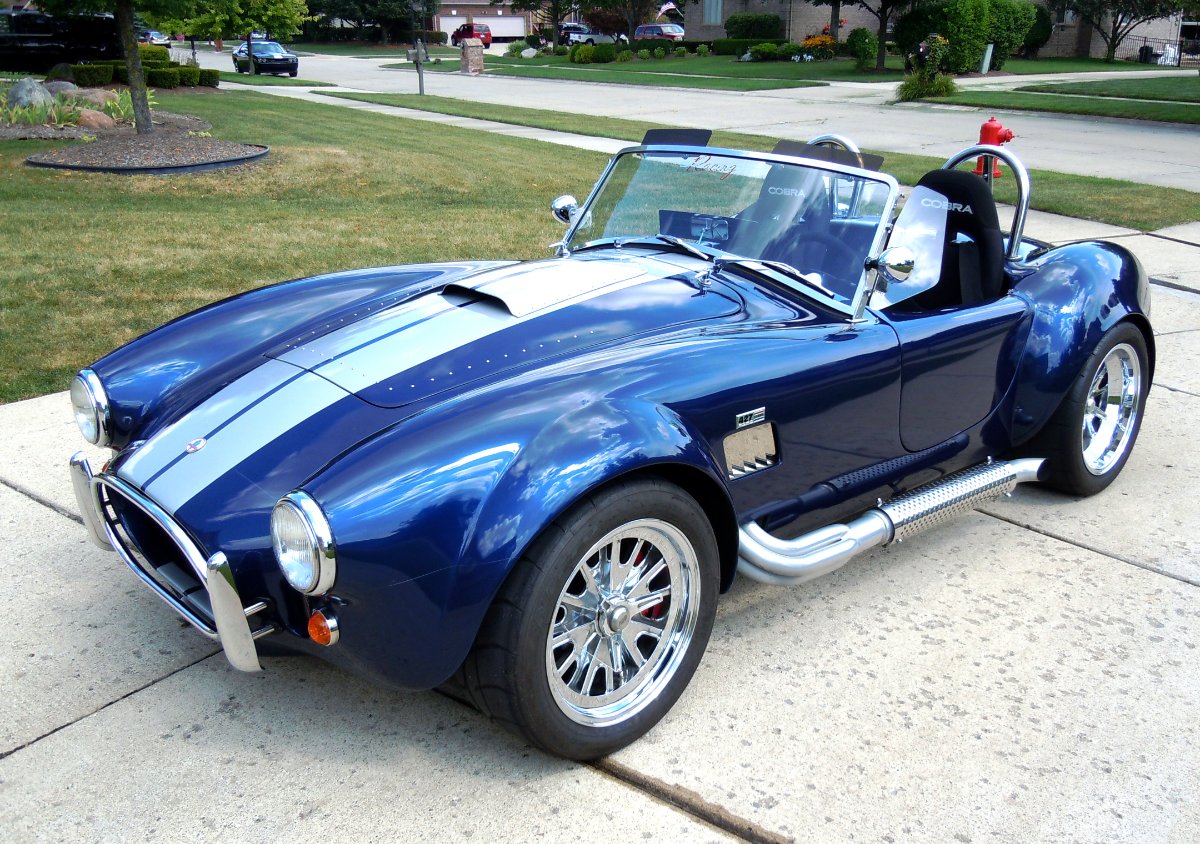
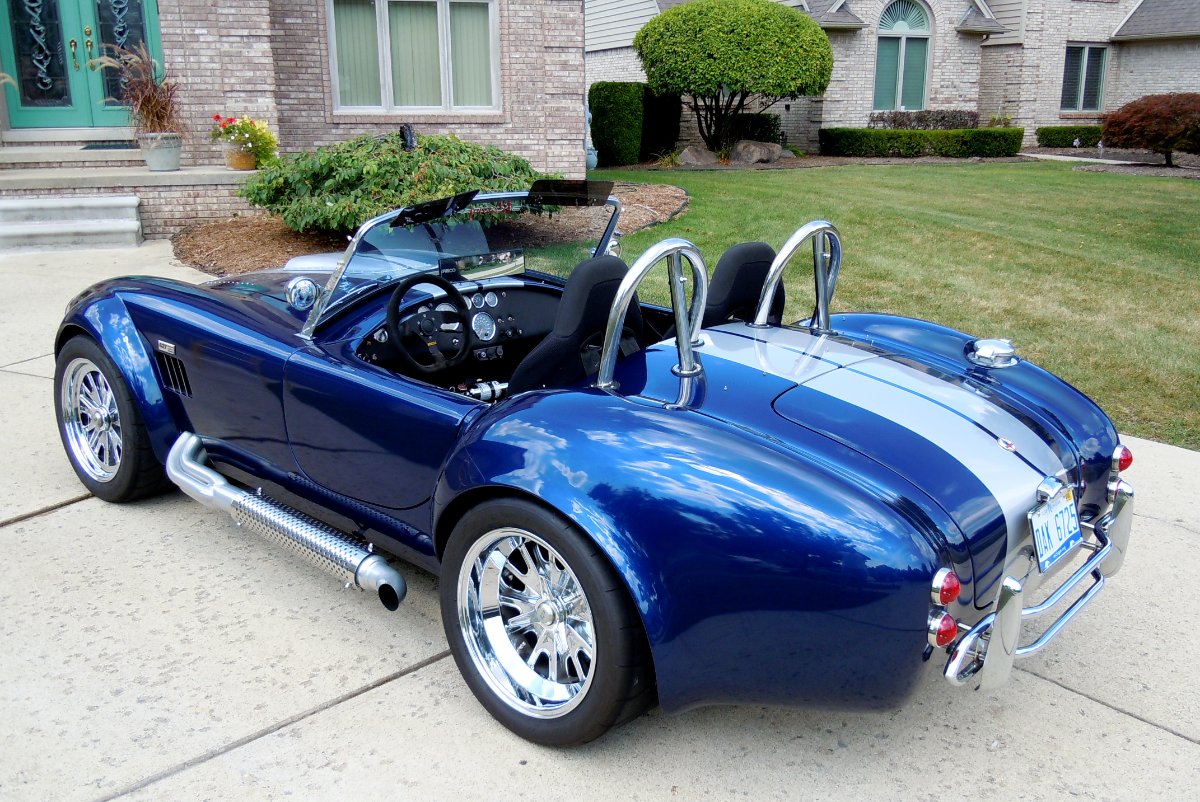
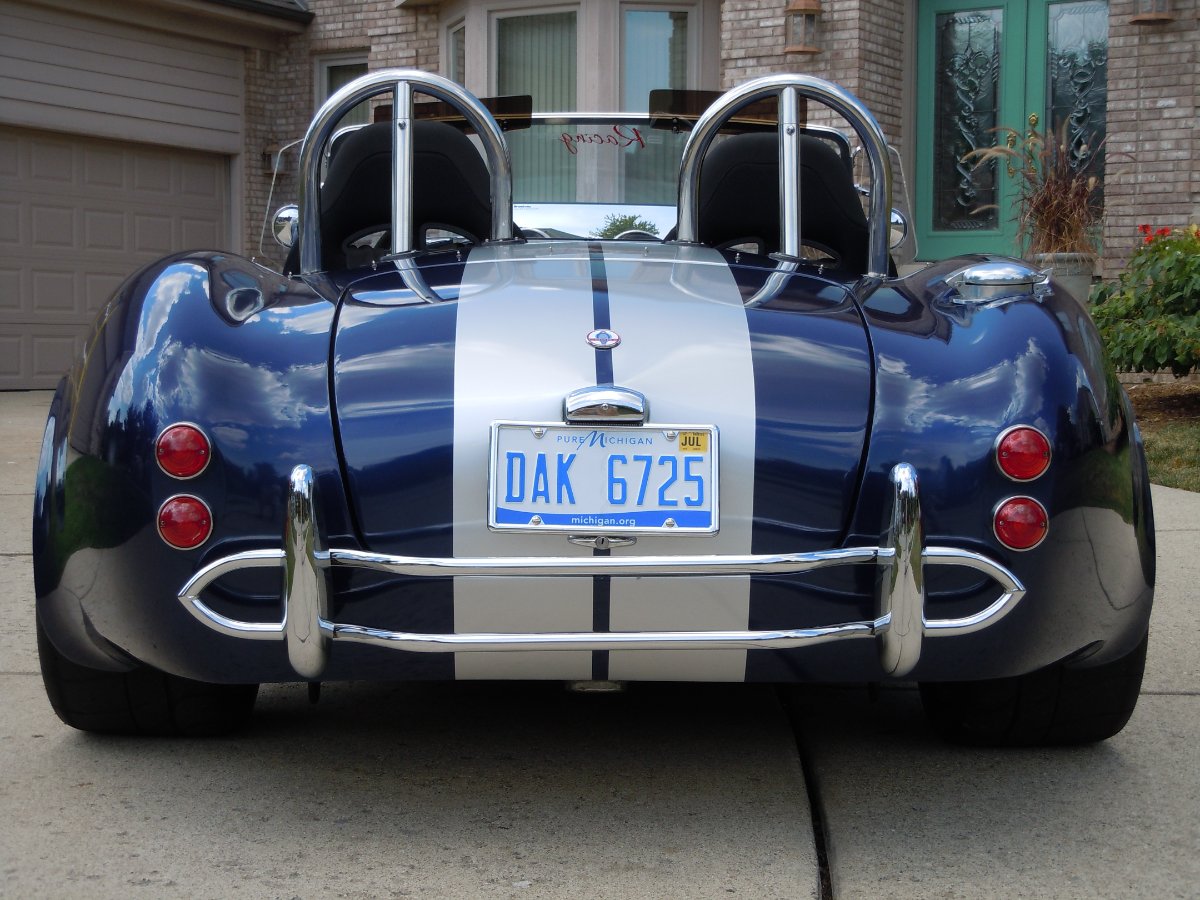
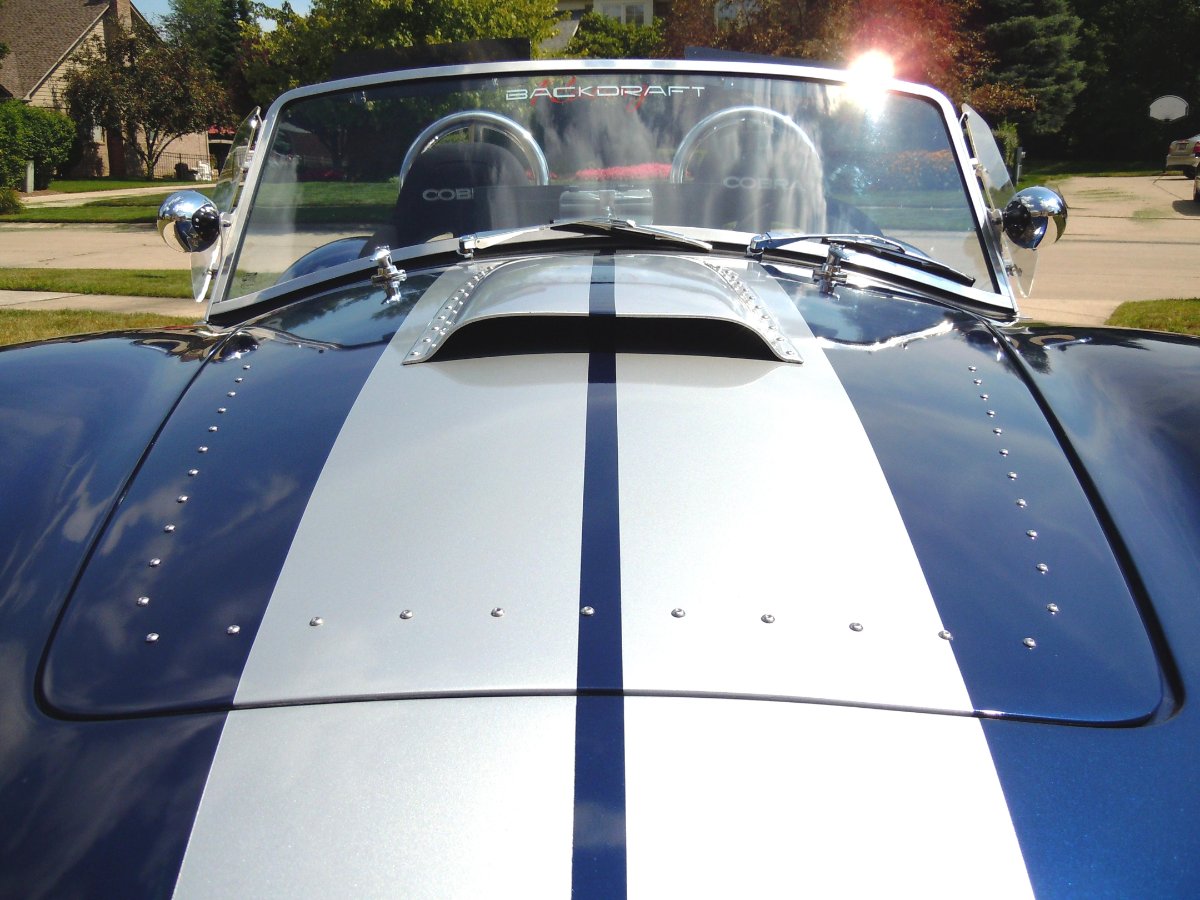
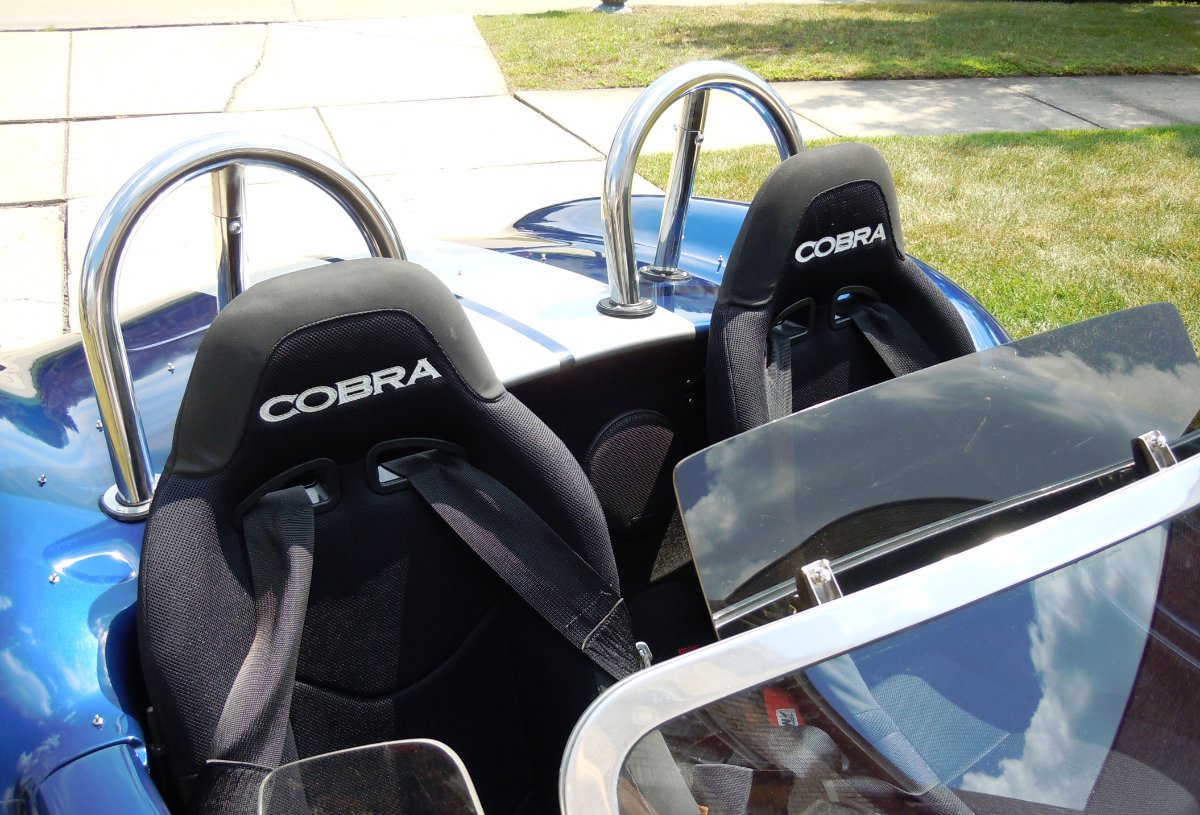
Yes - Your beautiful car looks a lot like the South African Backdraft Racing Roadster. Similar weight, with more voluptuous appearance and superior accommodations compared to original Shelby Cobras due to the lengthened wheelbase. I owned a Backdraft several years ago and have similar fond memories. Backdraft offered a full racing suspension including six-pot Wilwoods, heims and double-adjustable shocks, and I added the package to my car. After that, it became my best-handling sporter to date. A change I recommend for you is Cobra Racing seats with headrests (to prevent broken necks in the event of a rear collision) and a second roll hoop to protect the passenger. The Cobra seats come with appropriate "Cobra" logos stitched into the seatbacks. I sold my Backdraft to a deserving veteran in New York (who still proudly drives it today - hello, Michael Earl) to make room for my 935. Images below:
-
@speedwagon and @CarlBConnections! I read Rob Schreiber's article in Hagerty.com (cited above by bball7754) with similar interest, as I also raced slot cars as a kid. A great Italian family down the street (VERY Italian - their entire back yard was a vegetable garden, and once I opened up a closet in their house because I'd heard a noise, and discovered a GOAT!). The father was a fully westernized professional musician, and he wanted his sons to swing with the newest things, so he built a gigantic 4 or 6 lane slot cart track that encompassed the entire basement. I remember a transformer the size of a microwave oven. Any time I was invited into that basement, it was an eight-year-old's equivalent of passing through the pearly gates. I had to cut their front lawn for an entire summer to afford an appropriate car for that track - some swoopy Ferrari that I can't recall any more. More connections - last year's Speedfest at M1 Concourse - I attended it! Perhaps more accurately, my car invited me, because my car was politely invited to attend, and someone had to drive her. One of the organizers had seen my 935 Porsche cruising M1, and extended an invitation. I saw the Can-Am cars up front, nearer the entrance. They were marvelous - brought back images of Watkins Glen, along the Back Straight, tight against the rail, getting my eardrums thwacked by dopplering straightpipes. Also saw the old Indy roadsters - I remember listening to men die on the radio during Indy 500 broadcasts, and those old roadsters with single belts over the lap and inadequate short roll hoops gave silent testimony to the reasons why. Brave, foolish men, with F1 drivers succumbing at a rate of one per race at the peak. The Speedfest was great, and I hope to go again this year, and bring my own Can-Am car! One oddity: The author of the article stated that M1 declined to call their track a "race" track, preferring the appellation "performance". I cannot find that reference anywhere in the M1 literature. They claim to have hired renowned track architect Martyn Thake to design it, and also state that their new track belongs with the best "circuits" and "road courses" of similar length in America. Based on the speeds and competition I've witnessed on that track, it is, indeed, a "race" track, with lots of runoff, armco, tire barriers and so forth.
-
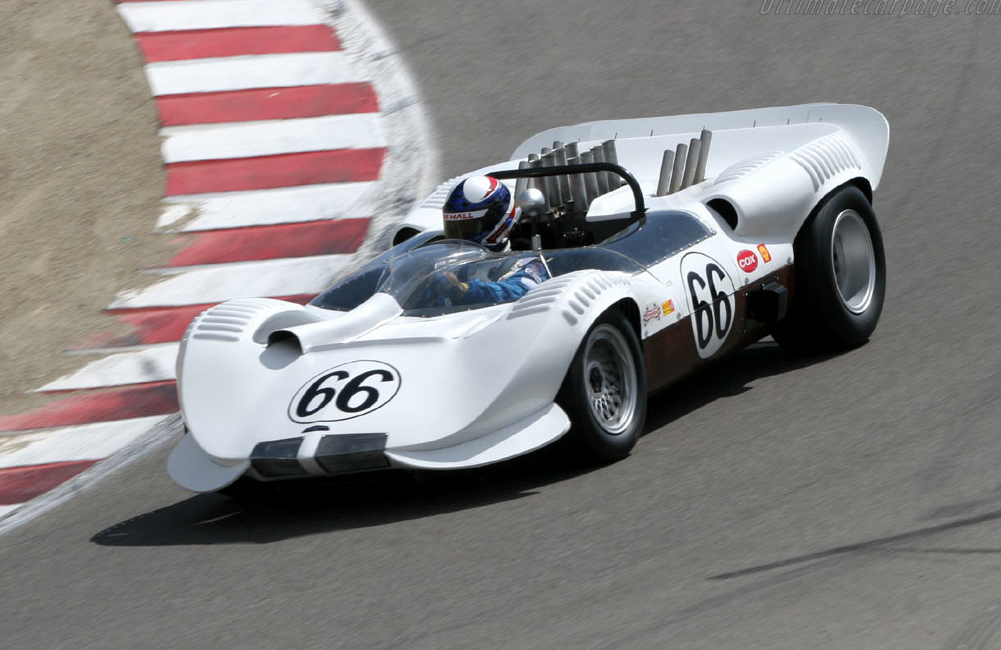
You did you research more assiduously than me - the exhausts of that particular model of Chaparral's were indeed vented in the depicted manner, and the depicted car appears to be a Chaparral. The fact that this exhaust routing did not become commonplace verifies my observation - all those short pipes exiting behind your head would be intolerable for any protracted period of time. I think yours and CarlB's point is also taken regarding the timeline of sports cars, though the artist's intent was concealed from me by the imprecise chronological order of the cars - the two newest up front, the two oldest in back, and a mish-mash in-between. Still, a timeline of sorts, and commendable forensic work on your parts. I wonder why Jim Hall went with those short dragster pipes in that particular evolution of the Chaparral? It seems a formula for reduced power due to insufficient back pressure, as well as premature valve burnout:
-
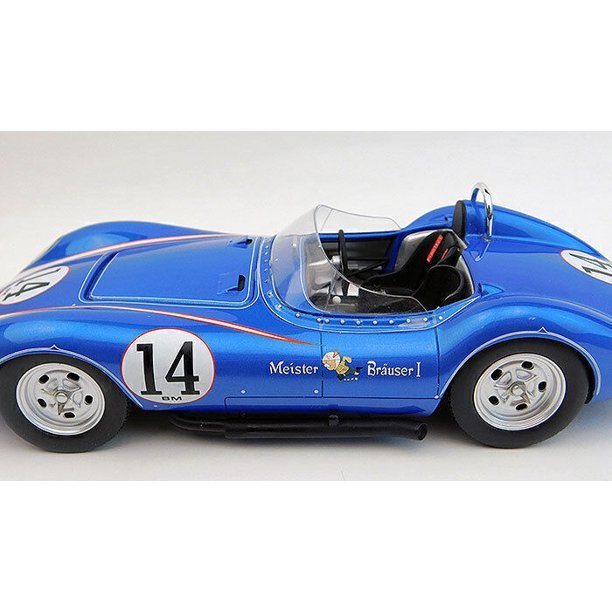
I think you meant Scarab. The # 1 car has a shape similar to both a Lola T70 and a Scarab. I mentioned the differences between the captioned car and T 70 in my last post. Regarding Scarabs, every image I can scrounge up shows elevated bodywork behind the driver's head (I am forgetting the precise name for this hump). The protrusion I refer to may have been just a stylistic element, of a method of managing air flow. This "nacelle" is missing in the poster image of car # 1. Again, I think the artist wanted to capture the emotion, the excitement, the awesome sound and fury. It was not a historical record.
.thumb.png.902b4b1e564bc89b66557a601da61d57.png)
.jpg.6c867033c4aca9050cdf842403d3755f.jpg)
.jpg.a1796e6b1d1489fcc964d17a413536d3.jpg)

.jpg.cd5815b8d62bd4db39df67db5da43f77.jpg)