
Andy69
-
Posts
90 -
Joined
Content Type
Profiles
Forums
Store
Articles
Gallery
Events
Library
Everything posted by Andy69
-
wow that's super low. but if that's what enables to you use all the tire surface, it is what it is
-
The general consensus seems to be 18 PSI for these tires as a starting point. I had it out at the track yesterday and didn't get anywhere near the diamonds, of course I wasn't trying to find the limit as I had my 14 year old with me. If anyone uses these tires for autocross, what pressures do you run? It may very well be 18 psi and I just need to be more aggressive :-)
-
Trump Rallies and the misunderstood First Amendment
Andy69 replied to Kitcat's topic in Politics, Religion and Controversy
That's true. It says "Congress shall make no law", and that is understood now to also apply to the states. IMHO one of the biggest failings of libertarian theory is the treatment of private entities when they become de facto governments. Libertarians believe government should be tightly constrained (or absent entirely in the case of libertarian anarchism), and businesses/corporations should not be regulated beyond making sure they do not violate the non aggression principle. But what happens when a corporation becomes so dominant that it itself begins to encroach on what are commonly considered the rights of individuals? Google, FAcebook, et al have the power to pick and choose who gets to speak freely and who does not on their platforms, which is not a big deal when there is sufficient competition, but what happens when those companies reach a position of dominance in social interaction and begin to have an effect on the ability of people to express themselves? A good example would be FAcebook or Twitter blocking accounts that certain groups use to coordinate meetings, demonstrations, and the like. Stuff like that is just starting to happen. I don't think the Googles of the world have quite reached the point where the government needs to step in (and the staunch libertarian in me hates that idea), but we are approaching that point, particularly in light of how other entities such as banks and payment processors are refusing to do business with entities engages in perfectly legal endeavors such as gun sales. That door is already open WRT so called public accommodation laws that force businesses to cater to everyone, not just those they want. My feeling is that is a violation of association, so it's not a simple answer. -
Trump Rallies and the misunderstood First Amendment
Andy69 replied to Kitcat's topic in Politics, Religion and Controversy
One person's rights end where another's begin. As that pertains to the First Amendment, you are free to say anything you want in response to someone else's speech. However, once you start drowning them out or otherwise preventing them from speaking, you are no longer within the right of free speech protected by the First. -
Took Mrs69 for a spin and she burned her leg on the exhaust getting in :-/ She says she likes it but she hasn't asked to go for another ride. Girl69 loved it. She's usually upset by loud noises but not car noises this time so there's hope for this one yet We were also the first ones to drive on the new road in a local housing development Boy69 started screaming as soon as we hit 30 mph - this car is insane! you're insane! it's so loud!! ahhhhhhh take me home take me home take me home! But then when I got him home he said he didn't mean take him home he was just singing a song. lol. I'm taking this to the MS SCCA autocross in Columbus next weekend, should be a blast.
-
Thanks for the info. Carbotech has them too (from the other thread)
-
Those should work nicely. One of the only catalogs I've seen where you can actually search for Caterham. Are the rears from the front or rear of the Sierra? Is it the regular Sierra or Sierra Cosworth, or are they the same?
-
I'm trying to make sure the brakes are up to snuff before taking this to the track night. I'm no stranger to wrenching or setting up a car for track use, I'm just new to these cars. OP said the front brakes were from a Spitfire, and he didn't know what the rears were. Rear pads are larger than the front and I assume they are the stock brakes. Is this a swap that is common for these cars or did they use these brakes as stock? I have absolutely no idea what the brakes should be, if this is a common upgrade, or if I need to replace them. any input is appreciated.
-
My car currently has EBC Green Stuff. I’ve never even heard of EBC, but perusing their website it looks like those are not suitable for track use. I’ve run Hawk and Porterfield in the past on my Honda. Does anyone have any suggestions for either aggressive street pads or racing pads? Sent from my iPhone using Tapatalk
-
Limited selection in 13". In addition to the Avon, you have Toyo RA1, R888, or Federal SS-595 for road tires, and if you want DOT slicks, you have Hoosier A7 and R7. I've had 13" on my autocross Honda for 5 years, selection has been dwindling. Currently I use Avon slicks I get used. A7s stick better but I can buy 4 sets of Avons for the price of one set of Hoosiers.
-
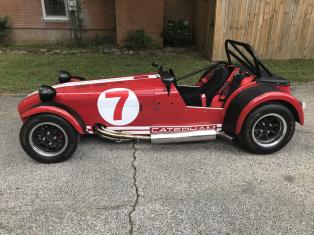
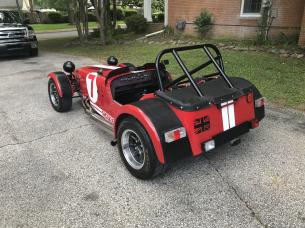
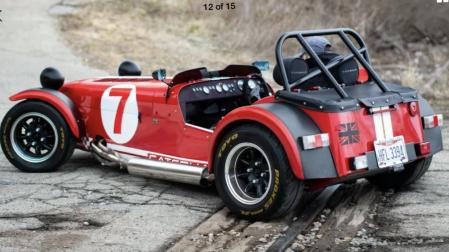
More pics. Off the trailer, waiting for insurance and title.

-
I just loaded it on the trailer to bring it homr
-
Funny bit of totally useless information: My only experience driving on the left hand side of the road was in Jamaica, Turks and Caicos, and St. Thomas. Cars there are mostly LHD. So, a mirror image of what I'll be doing with this car, so the island adage of "ahm in de bush" still applies
-
Thanks guys. Thanks for the resources Croc. I'll check those out. You're correct, it wasn't the BaT car. I was looking at it but decided I liked this one better even though it's RHD and has an engine that will make the guy at Autozone stare into space. I ended up spending a bit more but I'm happy with it. I've got a 1000 mile round trip and unfortunately all I have available is an open trailer, so I have to wait for the weather. Looks good for next week though. Hopefully I'll get it here in time for Track Night in America on the 11th. I've been trying to con my 8 year old into going with me on the trip. Maybe I can bribe him with Subway and pizza
-
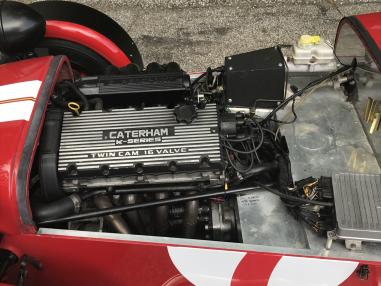
I just bought a 1992 Caterham 7. RHD, with 1.4 Rover fuel injected K-series. It's my first Caterham but not my first British sports car. I have a BJ8 Healey in the back of the garage that's next in line for restoration when I finish my 69 Chevelle convertible. I've always been primarily a muscle car guy, but in the last 10 years I've gotten into other stuff. In addition to the Healey and Chevy, I've got an 80s Honda that I race locally. I was supposed to pick the up this week but I only have an open trailer and the weather is not cooperating. Rrrg. Anyway, I'll have pictures and probably a lot of questions once I get it home. Cheers Andy