
w650gb500
-
Posts
53 -
Joined
-
The Regular Summary of Classified Ads of Se7ens Found For Sale
w650gb500 replied to Croc's topic in Cars For Sale
Honestly, depends 1000% on the driver. 200hp in a 7 is an experience in itself, but outright horsepower isn’t what these cars are about. Once a driver gets comfortable with the unique handling characteristics and braking, then HP comes into play. I’ve tried to explain to people that a 125hp 7 is all one really needs. 150hp begins to exceed the performance potential of the tires. Beyond that, it’s tough to extract everything out of the motor, except on the straightaways. It seriously takes hundreds of hours of seat time and learning suspension tuning before anyone needs 200hp. Even then, a good driver in 150hp will run circles around an inexperienced driver with 200hp under foot. My experiences and opinion, yours may differ. -
If you can’t find a bolt-in bar, I’ve fabricated several roll bars and roll cages for members here. I have a small race-prep & fabrication shop here in PA and can build whatever you would like and to your spec. Just an offer if you can’t find what you’re looking for. A cage will take a week, but I can do a roll bar for you over a weekend.
-
The Regular Summary of Classified Ads of Se7ens Found For Sale
w650gb500 replied to Croc's topic in Cars For Sale
-
The Regular Summary of Classified Ads of Se7ens Found For Sale
w650gb500 replied to Croc's topic in Cars For Sale
Manufacturered by Chris Williams and EVA Motorsports. Chris is from Vankleek Hill, Ontario and first built the BEVA which was a 7/Dutton-ish tube frame car using Toyota donor parts. We’ve had a few Beva’s listed here in the past. -
The Regular Summary of Classified Ads of Se7ens Found For Sale
w650gb500 replied to Croc's topic in Cars For Sale
Raceline
-
The Regular Summary of Classified Ads of Se7ens Found For Sale
w650gb500 replied to Croc's topic in Cars For Sale
The blue-ish one on the left is the RM-8 and the maroon one on the right is the turbo rotary Rotus that Mark now owns. I wish I had a picture of my other light blue RM along with those 2. -
Sorry if this has been posted before but it’s the first time that I’ve seen it. Wow, here it is!
-
The Regular Summary of Classified Ads of Se7ens Found For Sale
w650gb500 replied to Croc's topic in Cars For Sale
The Beva and Eva were made by Chris Williams up in Vankleek Hill, Ontario Canada. Really nice guy who based them off a Dutton not a Lotus 7. He also built Cobra replicas and others. It was a huge fiberglass shop with lots of different moulds out back. Very talented guy running a one-man shop. I still have a Beva kit sitting on a shelf in the warehouse that I bought 35 years ago.
-
The Regular Summary of Classified Ads of Se7ens Found For Sale
w650gb500 replied to Croc's topic in Cars For Sale
It’s an RM-8. -
The Regular Summary of Classified Ads of Se7ens Found For Sale
w650gb500 replied to Croc's topic in Cars For Sale
If the “7” is too much of a project for you, she also has a ‘58 Bugeye for sake. https://www.facebook.com/marketplace/item/555947843970903/?ref=marketplace_profile -
The Regular Summary of Classified Ads of Se7ens Found For Sale
w650gb500 replied to Croc's topic in Cars For Sale
Here’s a “project” in San Jose. Yikes! -
The Regular Summary of Classified Ads of Se7ens Found For Sale
w650gb500 replied to Croc's topic in Cars For Sale
https://www.facebook.com/marketplace/item/1169730547710612 This one is an RM-8 “wide-body” . -
The Regular Summary of Classified Ads of Se7ens Found For Sale
w650gb500 replied to Croc's topic in Cars For Sale
That newly listed Toyota-powered custom Lotus 7 boasts of having “north of 200hp” from a 4AG. That would need to be a Formula Atlantic spec motor to get that kind of power. If it is, that would make for a fun ride, but I would suspect it’s probably 150+/-. Would love to see what’s inside to support the hp claim. -
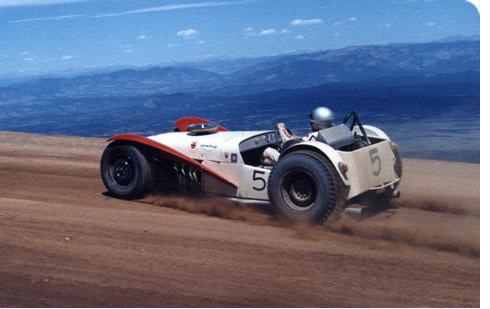
Anyone familiar with this photo?
-
Good evening all, Dan Lipperini Jr here. I am the one who fabricated the cage for Jon’s car. I’ll give you a bit of info on how it was accomplished. The entire cage is made from 1.50” x 0.125” DOM tubing. The mounting slugs which attach the cage to the frame began as 1.50” solid bar stock which are cut to 2” lengths and then have the center milled out 1.0” x 1.75” leaving 0.250” walls. The frame inserts are 3/4” OD with 1/2”-13 threads. I figure out where the cage is going to be located and on this case which original rivet holes were going to be used. I drill a 1/4” hole through both sides of the 1” frame tube as close to centered as possible. I then use a 1.5” hole saw to cut through the aluminum skin almost all the way and the piece of aluminum removed. Then a 3/4” hole gets drilled in the outer frame tube followed by a 5/8” hole in the inner frame tube. I take the frame insert and turn the one side down to 5/8”, measure it to length(approx 1.25” and cut/face to length. This makes a shoulder and a nice fit in the both sides of the frame tube. It then gets welded in place. Then repeat another 5 times. The main roll hoop uses the original mounting location threaded inserts(3 per side) onto a 3/16” plate. The rear down tubes now go all the way to the bottom rear rail instead of to the rear vertical support tubes. I welded a plate between the fuel cell mount and frame rail which uses 4 3/8” bolts per side to hold it as well as the new rear bumper. Now comes the fun part, its time to grab some tubing, a tape measure, a Sharpie and figure out what it’s going to look like and where it’s going to mount. Then a bend here, a weld there and PRESTO, an SCCA legal rollcage is born. The nice thing about these cages are that they are totally removable in about 20 minutes. You just need to find someone else to help lift it off the car. That’s an overview of what’s done, but if anyone has specific questions, please feel free to ask. Thanks, Dan