
IamScotticus
-
Posts
2,380 -
Joined
-
Last visited
-
https://www.robush.com/products/bush/
-
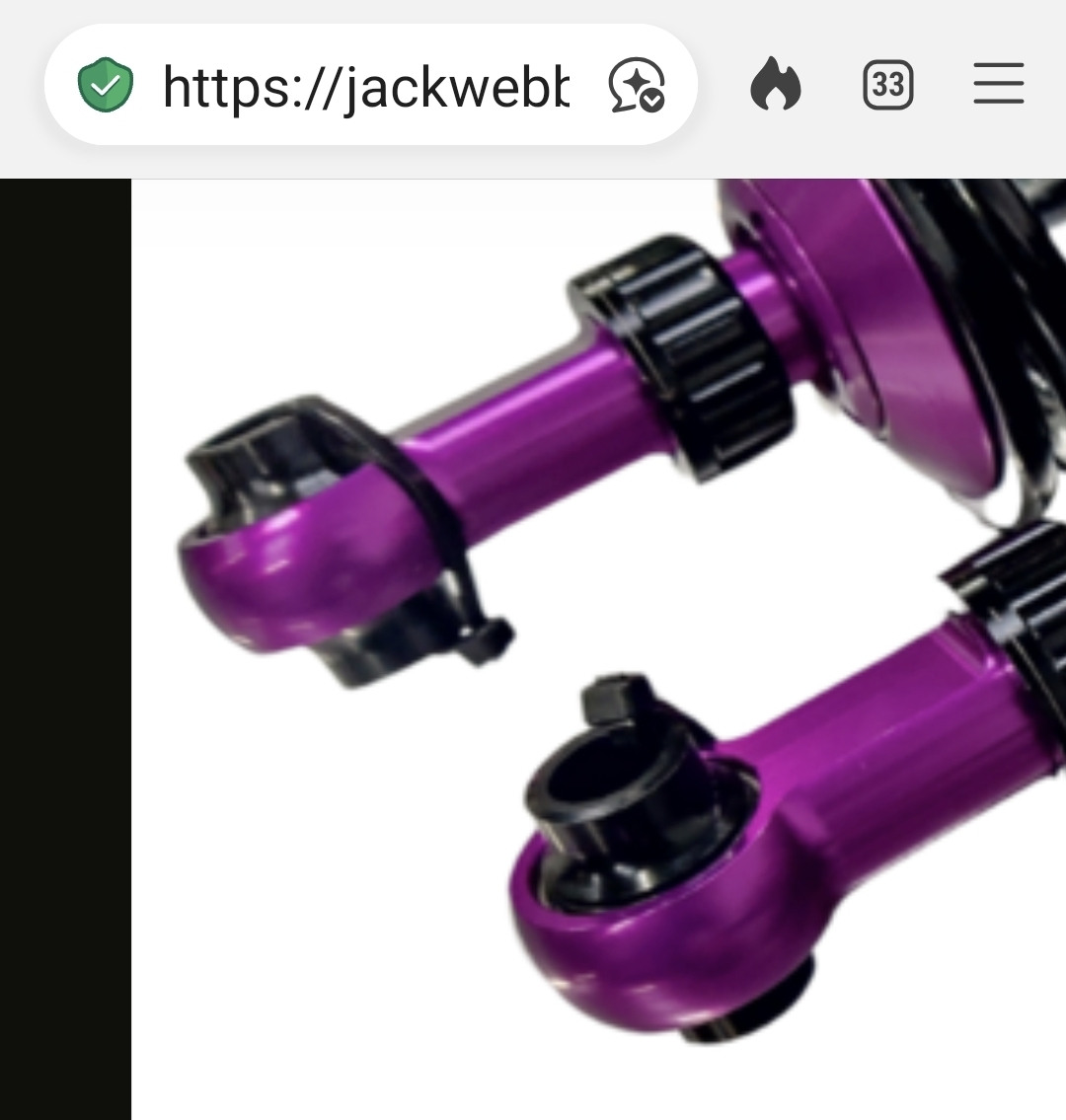
some fine fellows at Jack Webb, They know this stuff as they specialize in LA Sevens, and have the best dampers $$$. although I'm sure adjustable SPAX G978 or GAZ GP6-2037 will do. however I believe what Webb and others have found to benefit the LA rhe most is are spherical bearings on the lower damper mounts. this will go a long way in keeping the bampers straight and not rubbing on the springs. to replace the bushes on your dampers you have to press out the bushes and replace. I think the efforts are better rewarded with sphericals spaced with nylon bushes. gawd....I'm starting to sound like MV8....omg. but he did have good contributions. Anyway, here is a closeup of what JWM is doing. you can see the sphericals encased in the lower stems, wirh spacer sleeves held by zip-ties. https://jackwebbmotorsport.co.uk/Caterham-Quantum-One-Zero-by-JWM-Road-Track-Live-Axle-Calibration-p613809851

-
please remind us what displacement and compression?
-
Will you baffle the case? They are walls at the entrances of the tubes to keep oil from collecting at the ends during extended cornering, unless your end bearings are case oil lubricated, but I don't think that is common. Another mod is to tap in grease zerks to feed the outter bearings, if they are grease lubricated. This may involve making a hole into the bearing race. I don't know the particulars of doing this, but it will simplify maintenance.
-
I copy info I find on the net, use at your own risk. Some of this may be incorrect. But I try. I have not seen a complete list of the donor vehicles. BUSHES GENERAL ********************** Y16 (tapered)Front Suspension Link Bush AUSTIN FROGEYE SPRITE MG MIDGET & 3000 equiv: MRM220 03471R MGB AH SPRITE MK3 AH 3000 MK3 AH SPRITE MK4 CROSS REF: 2A4027 2A4163 330-520 88G274 Rover 88G274 Length: 17mm Wide end diameter: 29mm Narrow end diameter: 23mm Centre hole diameter: 12mm Fitment to wishbones and anti roll bar (8 per car) MOSS pn 330-520 *********************** Y9 (Tapered)Control/Trailing Arm Bush EAN# 5016593126077 Cross Ref: Rover 8G621 281-405 MG Midget 1/64-12/79 MG MGC/GT 1/67-9/69 MGB all TAXI FX4 1/59-12/89 TAXI FX4R 1/82-12/85 ROVER A60 CAMBRIDGE 1/62-10/69 AUSTIN HEALEY BN 1&2 53-56 BN 4&6 SPRITE MK3 3/64-10/66 SPRITE MK4 3/66-10/71 3000 MK3 3/64-10/71 Length: 23mm Wide end diameter: 29mm Narrow end diameter: 23mm Centre hole diameter: 12mm Fitment to wishbones and anti roll bar (8 per car) MOSS pn 282-305 ************************* 636 (B636/2) Length : 3.5mm (1 3/8") Total diameter : 2.7mm (1 1/16") Opening diameter : 1.3mm (1/2") ************************** B636/2 Short (S636/2A) Internal diameter: 13mm External diameter: 27mm Length: 26mm ********************* B6362 Short (B*636/2A) Internal diameter: 13mm External diameter: 27mm Length: 26mm *same as S636/2A with a "B". Typo?) ************************** RB636/2 Wishbone, A frame, Radius arm Internal diameter: 12mm External diameter: 27mm Length: 34mm **************************** BP636/2 Top Link Peened Length : 3.5mm (1 3/8") Total diameter : 2.9mm (1 1/8") Opening diameter : 1.3mm (1/2") ***************************** E2030 Radius Arm Small Length: 31mm Centre hole diameter: 9mm Outer diameter: 19mm ***************************** E2030 Short (S2030A) Length: 26mm Centre hole diameter: 10mm Outer diameter: 19mm ***************************** Bush Eyelet Front (E4-B46-608C) 35MM ***************************** Steering Column Bush (B8466) ***************************** Caterham suspension Bush Kit Live Axle (BU03K) ****************************
-
yes, but then, are we really concerned about that in a 7? lol
-
I knew that. I believe if you angled those wings out more, they are more effective.
-
are "wind wings" a thing available for sale somewhere?
-
Keep it. It makes a good bumper. Maybe not a good bumper, but at least a sacrificial tube structure.
-
A bit large. The block footprint is only around 16 x 1o or so. The hight is the thing. need a bag able to withstand some sharp edge scuffing and moving around.
-
Thanks guys for the responses, I never expected it. I have only used WD40 for an initial light dressing on the machined surfaces, for lack of having anything better and not ready to get it messy. In the bag I will give it a proper fog and passage flush. And a proper cleaning before any build. Its going on top of a steel cart and i will be able to keep basting it as necessary. Yes, mice will chew on almost anything.
-

So, tell us a little about yourselves
IamScotticus replied to slngsht's topic in General Sevens Discussion
I do consider the Lotus 7 a piece of art. I believe the visceral appeal, is difficult to explain, but appealing to the eye. It appealed to Patric McGooham to use the 7 in his TV series, when other beautiful and advanced vehicles were made available to use. Only the Seven would do. The seven was art for his canvas. I believe many 7 owners consider the 7 to be art for the street on a landscape of boring machines destined for the crusher. Sevens don't get discarded, they pass from owner to owner like cherished heirlooms . Like valuable works of art. -
the PEZ Caterham dispenser Nice 13 year bump!
-
So, tell us a little about yourselves
IamScotticus replied to slngsht's topic in General Sevens Discussion
Sergio's thread is now more appropriate in Membr's Cars https://usa7s.net/ips/forum/30-member-rides/ -
So, tell us a little about yourselves
IamScotticus replied to slngsht's topic in General Sevens Discussion
I see a spacer in there so you should have a T9 5 speed. These were often standard w DeDion axles but your front is uprated narrow live axle type. Do you have an Triumph Ital/Marina live axle?