
Timothy Keith-Lucas
-
Posts
284 -
Joined
-
Last visited
1 Follower

-
Hmmmm. I cut my "spear aimed at chest" steering shaft in half and then inserted a collapsible section in the middle so that it would at least telescope six inches before it hit me in a head on collision. That allowed adjustment of the overall length, so my steering shaft may be longer than stock.
-
OK. Let's try again. Your steering shaft is 3/4", and this adaptor can be welded onto it. The shaft slides out easily once you release the semi-universal joint down at the steering pinion. But then, the hub on this quick release is only about 2.5" while center to center across the screw holes on your wheel is 2.6", so you'll need to get your friendly local machine shop to make a plate that adapts your wheel to this hub, complete with threaded holes. I think there is enough space to put it together without moving the wheel into your ribs, but before you pull the shaft out take some measurements because you might want to trim the shaft. need to https://www.speedwaymotors.com/Aluminum-Quick-Release-Steering-Wheel-Hub-Splined-3-4-Inch,29178.html?_gl=1*1vk549l*_up*MQ..*_gs*MQ..&gclid=Cj0KCQjw--7UBhCpARIsAGJBptjYwhL47QqsrRSfCRHUv5uSe4V5NUse8GXgNZzVW7r0CTqpy-Z3c8EaAmyDEALw_wcB&gbraid=0AAAAAD8-Mcm9VL9IJkvpcn9i4Ts_oR_Vp
-
Joe, I have the same situation. I'm 81 and have a 1962 S2 with a standard wheel. I researched putting a quick release on the steering last year and never found a solution that would work - there is so little space between the wheel and the panel, and the adaptor would be a challenge to mount. This car was designed for English men who were malnourished during WW2, not post-war 73" Americans. I gave up. Upper body strength is one clue. One hand on the transmission tunnel and one on the "door" and lift. I'm sorry that I cannot be more encouraging. If you find a way, please share it.
-
You are not a pest. Let me see if I can comment, being a Series II (1962) owner and beginner restorer. Your goal is a seal between the various parts behind the carb such that the engine vacuum does not suck air, thereby leaning your mixture. Do whatever you need to achieve that. Yes, two O rings do not face each other. You've got two opportunities for fans on a Series II, one on either side of the radiator. The front fan is electric and mounts on those fingers. The other mounts on the front of the engine. Being in Florida and dealing with a car designed for England I used both, plus adding an oil cooler. I don't recommend modifying the mount for the electric fan - the space available is pretty tight as is. Just as important is putting a baffle between the top of the radiator and the under side of the snout. That assures that all the ram air goes through the radiator rather than around it. I used closed cell foam from an Amazon box for this task. Then, flush the cooling system really well and add both coolant and a wetting agent such as this stuff from Amazon. https://www.amazon.com/Hy-Lube-HPC100-3PK-Performance-Fluid_Ounces/dp/B07F13298S/ref=sr_1_6?crid=Y5Z5FXFFYLPS&dib=eyJ2IjoiMSJ9.KUJvx1JhLbhPP46nMzu3GP3W_14-HWKRC1rJFXmHhg9-B2xJUIRdJgDibAJQyyaHu-_ToM68xLySWeiYO4BCYDo41-4L-pl13ZqZzNvP-_tm1TBNoOdWw3ygdTLCzwYXiRbReWrLmHx6qTHseZdUpeN_oP3D3zhoX84MEgMR8B3Y7XgiLonAmRTsQdV1gqfTNjsyv0QcETg0KCUX6FcIPK--QLTh2NlymjcWCaCh9XL1MCDp-7plCvr0b-pUkY9JHfVuFltUIDegHh2m4R9Q1G6oBq-60GNH26eT496GKAo.n-GBcM01D9511fwKI06Ovv4Ql_8vmt2eq6zF-L2d4EQ&dib_tag=se&keywords=automotive%2Bwetting%2Bagent&qid=1786190617&sprefix=automotive%2Bwetting%2Bagent%2Caps%2C254&sr=8-6&th=1 Do all that and you should not have cooling problems. For matching paint I recommend that you find an automotive paint shop that owns a spectrophotometer. This device takes multiple readings from a sample of your existing paint, averages them, and with the help of software spits out the correct paint mixture. That's far more accurate than matching chips with paint samples. Welcome to the world of messing with Sevens. They will keep your brain active with endless challenges.
-
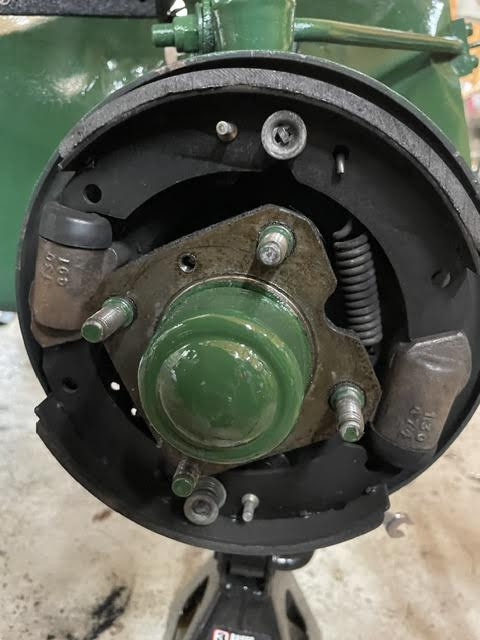
Hmmm. Those are the screws that I tried to use to adjust them, but your "backed all the way off" suggests that they are not 1/2 turn cams but expanding bolts. I'll try, as you say, backing them all the way off. The master cylinder reservoir is not over filled. My guess on the condition of the shoes is that they were replaced when she was brought out of 56 years of storage and sold to me. Thank you. I've got another avenue to explore.
-
The front brakes on my 1962 Series 2 have started dragging, which is strange in itself, but try as I may I cannot find a way to adjust the shoes so that they don't touch the drums at rest. There is a small bolt that exits to the back of the brake about midway along the shoe, but turning it does not seem to solve the problem. Could someone who knows more about these brakes than I do let me in on the secret? Or, is the problem within the hydraulics such that I need to lightly bleed them?

-
Here's the link to your fire suppression system. http://www.essfire.com/2_3_liter.php
-
Meanwhile, back at the original concern "I suspect that there may be a transient that is blowing the fuses. These are the blade-type fuses in the color-coded plastic housings. Does anyone make slow-blow fuses in this format?" I doubt that this is a transient and somewhat cynically think that moving to larger and slow-blow fuses is a risky substitute for correcting the problem. The 15 amp fuse successfully supplies the pump in thousands of cars every day. It could be intermittent as in a bare wire touching the frame and hard to replicate, but tracing the hot wire looking for burnt insulation would let you find that problem. An ohm meter across the fuel pump could also detect the problem without your first disassembling everything. I guess my central recommendation is that you find the problem and correct it as a minimum standard for the repair. Best of luck chasing it down.
-
https://www.amazon.com/TOPDON-BT100-Automotive-Alternator-Motorcycle/dp/B07Z67MMGC/ref=sr_1_5_sspa?crid=1HXMOBZ7LJD4Y&dib=eyJ2IjoiMSJ9.aUiPv_ji7h02o1mkedvn3H6xk8UvazBllIquLnC4qGK-Eka6Iw1Z7uae6Ha4SSC2yd7Ia9qIi_QzN1w11fO-c8Bfq-BML2KPghZBTaHyJ2HZNiiw19WMLn8IfV6HeLEIb-CvPiTzYgqAgtL36qezH42jq0NKp7mbwDQ1eJdxWzgq17InOo5Y3vaJ1YFjDGGYuq-CBfi8fxd3ySudiLW7Xkgt0Fzq9C6Eb_GZvyDeECBo1POZzCoKuvFaOjK93k9Zp3-EEI180dKQ4ZnVGbxezN6rt33b0gFpOdbyACE8JNE.Zd11ZCgBU-QL7JeBquSFZgPJbOUq6fOy8eY2ZhXJ7_w&dib_tag=se&keywords=battery+tester+12v+automotive&qid=1782597938&sprefix=battery+tester%2Caps%2C412&sr=8-5-spons&sp_csd=d2lkZ2V0TmFtZT1zcF9hdGY&psc=1
-
Wonderful that you came to a happy ending. Welcome to the world of wacko battery chargers. Yes, do watch it like a hawk, and buy yourself a $52 digital battery tester like this one, which I use both for our fleet (4 antiques, 4 road vehicles, 2 drivers) and a county emergency management fleet that I monitor. Realize that just because the battery charged does not mean that it is any good - it may flop as soon as you put a load on it. Keep it charged! If it sits, disconnect it against hidden tiny drains that will flatten it. Best of luck to you.
-
OK, ways of minimizing poured gasoline on our cars and motorcycles. But all of those methods introduce more hydrocarbons into our atmosphere, overcoming the fuel recovery efforts to keep that stuff out of our lungs and air. I'm going to stick with pumping from closed container (gas can) to closed container (gas tank) and minimize the spills rather than cleaning up afterwards.
-
There is no better Plan B than the modern Lithium battery jump-off boxes. They are small and light, hold their charge, and will start your car (or your generator) when you err (as in, being human). We are blessed by modern technology.
-
It is evident that this is a VERY common problem. We've all done our best to find ways to keep out of spilled gasoline. So have the people who design filling station pumps. Long ago, the problem was worse - you came away from filling your car with white powder on your hands. The powder was lead.
-
Hmmmm. Automatic battery chargers require some charge to even work, so keeping a manual charger or a jump-off box around is a good protection. But then, the real question is why is your battery going to zero? It sounds as if your car is using a small current when sitting in the garage. Determine if you have such a drain by running the positive side of the battery through your multimeter set for amperage (sorry if I'm being pedantic here). Wdb shares wisdom in saying that your first defense against such a drain is disconnecting the battery. Another approach is leaving the car on a trickle charger when it is sitting. Actually solving the problem involves finding the drain and stopping it, which is the usual process of tracing backwards until you find something that is "on" when the car is "off." Consider doing that before you ruin another battery. Any of your battery options will work after you stop that leak.
-
Nice technique, Pethier, and thank you for describing it. Do you manage to keep the can from leaking at the can/nozzle gasket? Fortunately for these sorts of approaches, Amazon has various nozzle options that bypass the horrid safety valves.