
jmaz
-
Posts
62 -
Joined
-
Last visited
Content Type
Profiles
Forums
Store
Articles
Gallery
Events
Library
Everything posted by jmaz
-
So you're finding that, with a half-hood and no doors plus the rear shield, you get much less buffeting than with a half-hood and no doors alone?
-
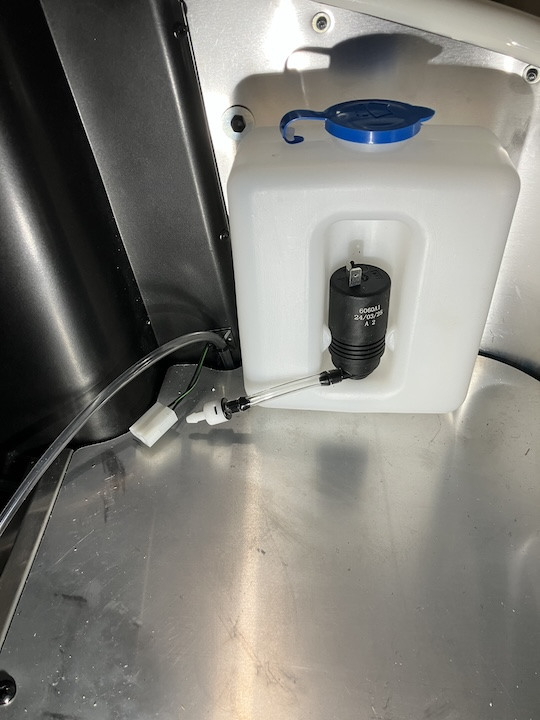
I've been told that the two-wire connector is most likely an (unused) connector for a power outlet that can be installed in the rear bulkhead. Here's the connector for the washer fluid bottle. It comes up through the boot side, next to the bottle:

-
I'll test the brake-light possibility. Chrisp993 had noted that there are also two unused spade connectors bundled in with the rear light wiring on the RHS inside the wheel well that can be used to operate a high-level brake light. I had trouble finding these, since they were surrounded by the larger black connectors, all zip-tied in a cluster.
-
Unidentified Connectors at Rear of Transmission Tunnel Can anyone confirm the purposes of these two spade connectors? These were zip-tied to the frame at the rear of the transmission tunnel, near the brackets for the handbrake cable. As was done in one of the build blogs, I decided to cut them loose before pop-riveting on the tunnel cover so that they'd be available for whatever. The 2-place connector has a purple-and-red wire and a black wire. That pairing corresponds to an optional connector labeled "Power Socket" in the main wiring harness diagram. The other, single, connector has a red/white wire, which mightbe consistent with being a 12V+ line that's live when the parking lights are on. However, with ignition on, I get no (multimeter-measured) voltage with the single-wire connector grounded to the frame, and connecting between the purple/red wire and the black wire results in a strange-to-me cycling between roughly 0, 3 and 6V.
-
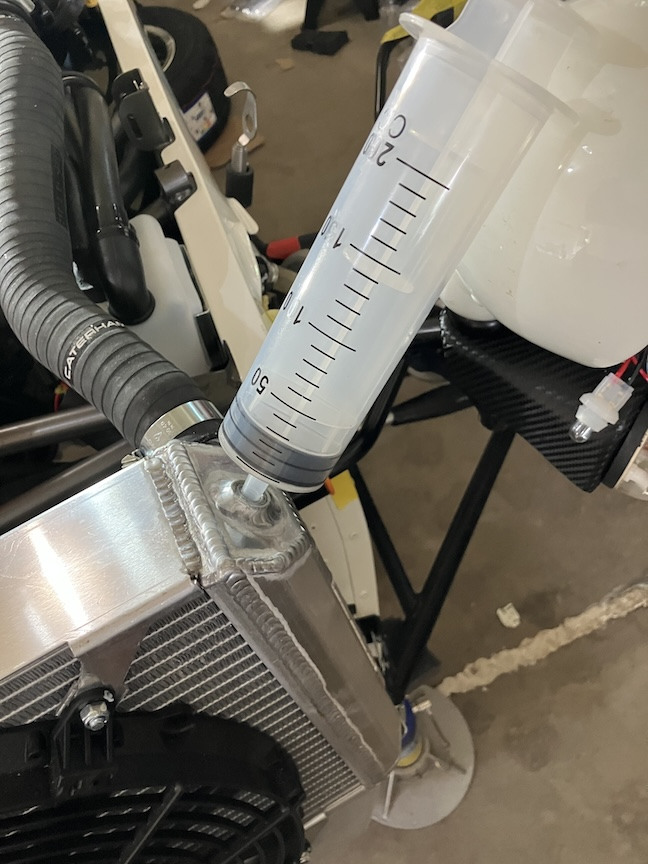
A simple "vacuum assist" for coolant fill When adding coolant, I was finding that the rate at which the system was filling was going REALLY slowly. This was after having disconnected the top hose connected to the heater manifold piping and having remove the plug from the top RHS of the radiator. I could track the fill progress by running a long zip tie into the radiator plug opening, in dip-stick mode. I decided to try to speed things up by sucking air from the radiator plug opening using this large 200cc syringe. It worked well. (The syringe isn't as giant as it looks in this pic. It's about 8" long.)
-
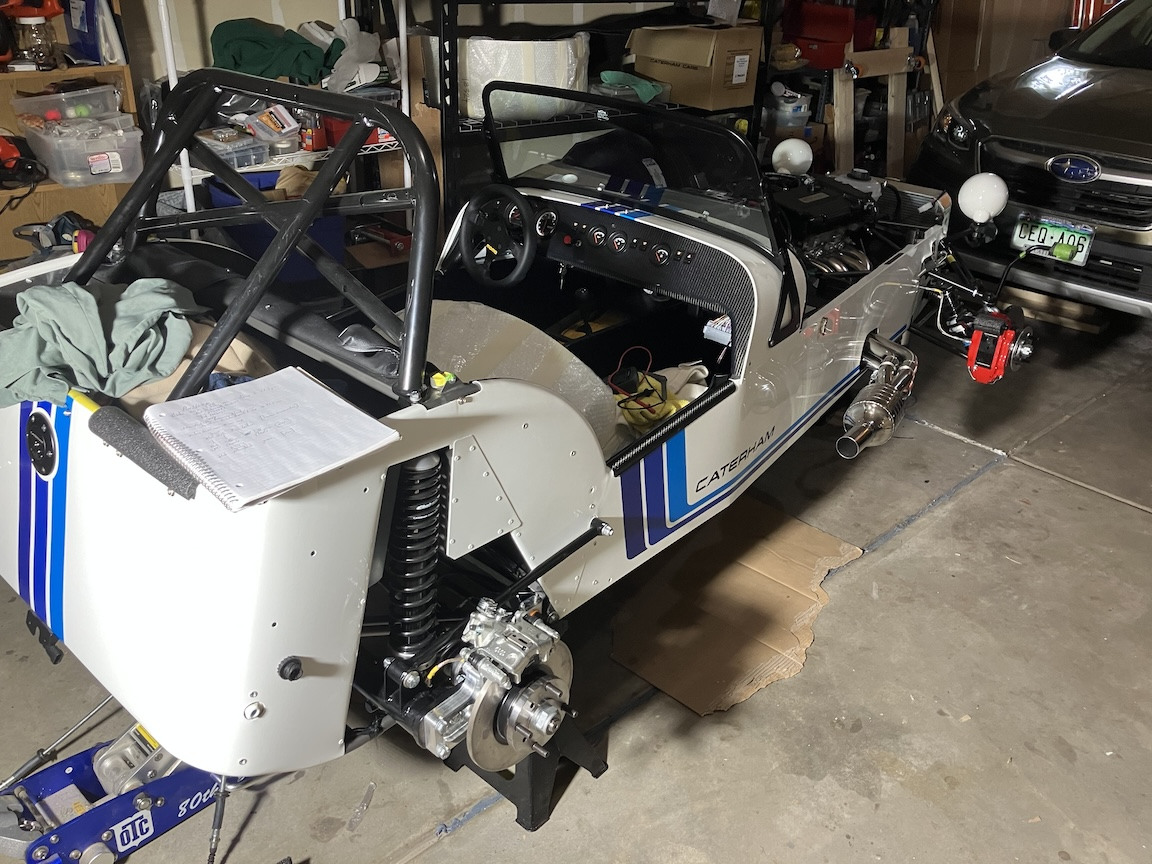
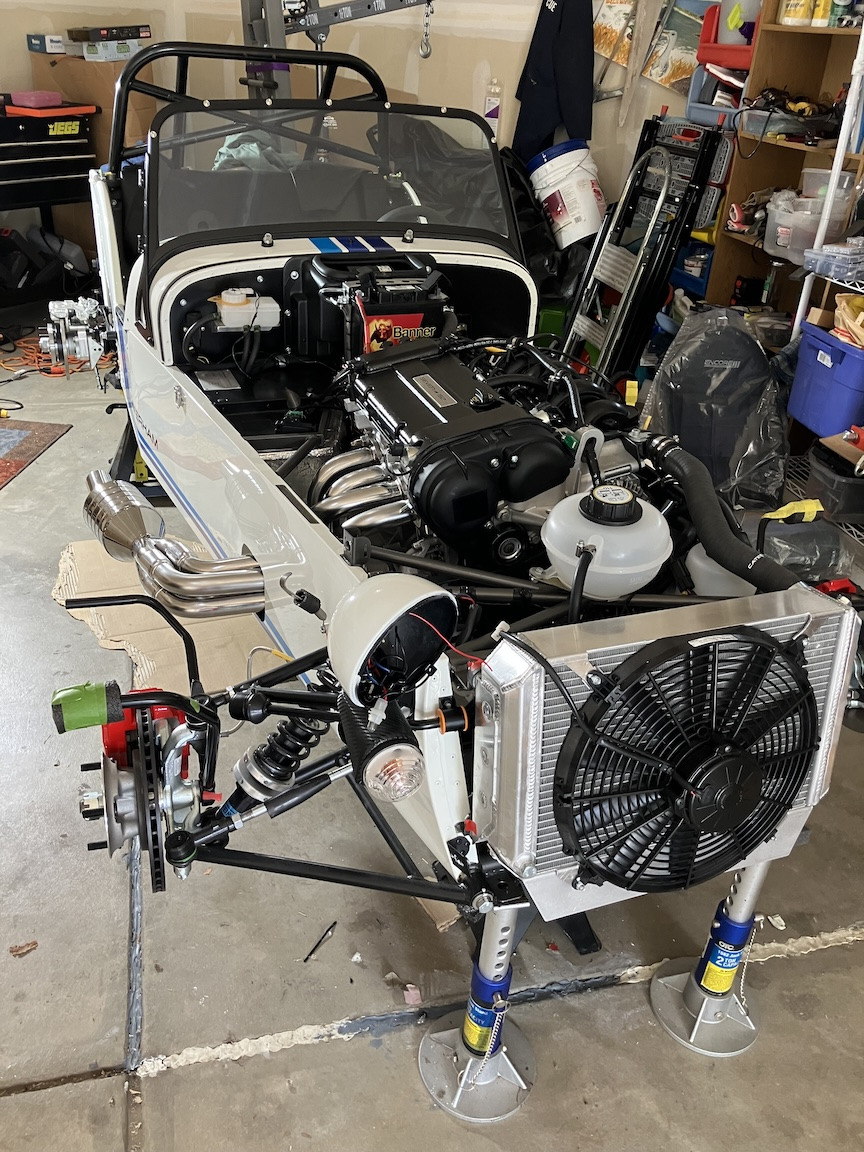
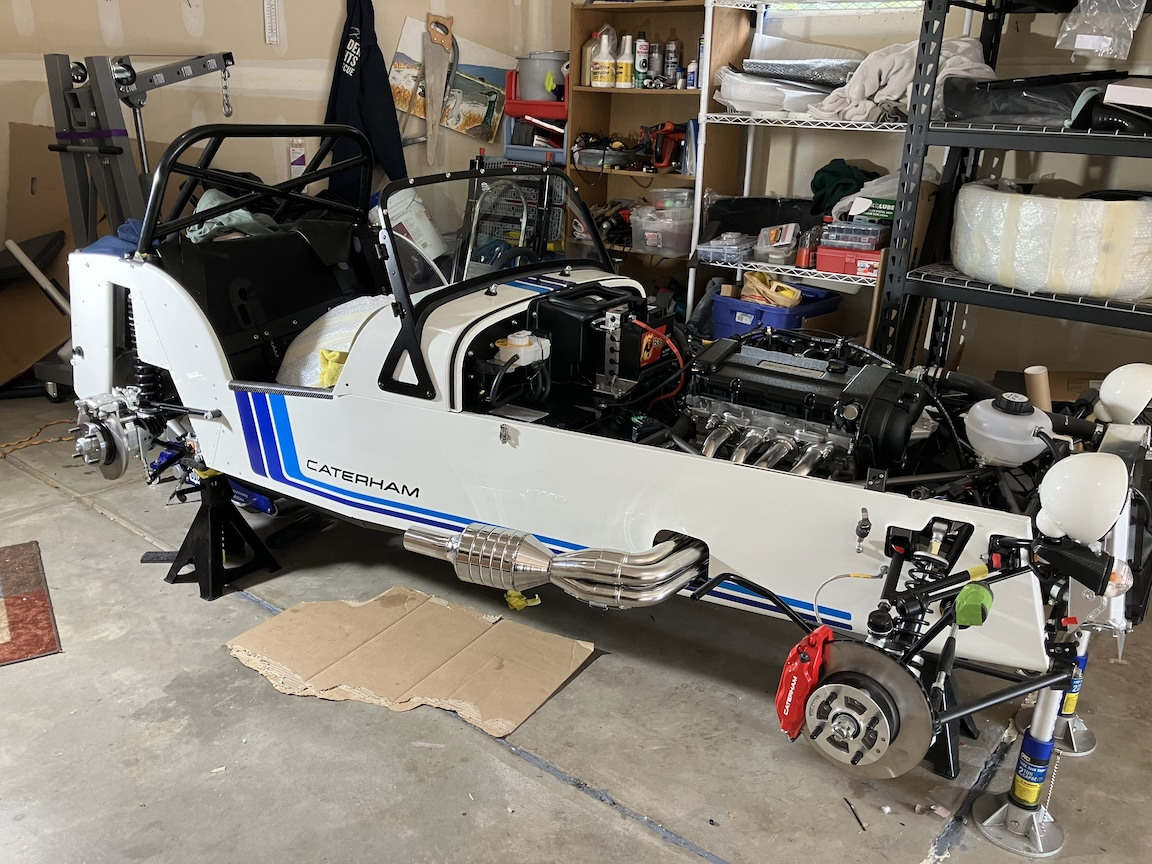
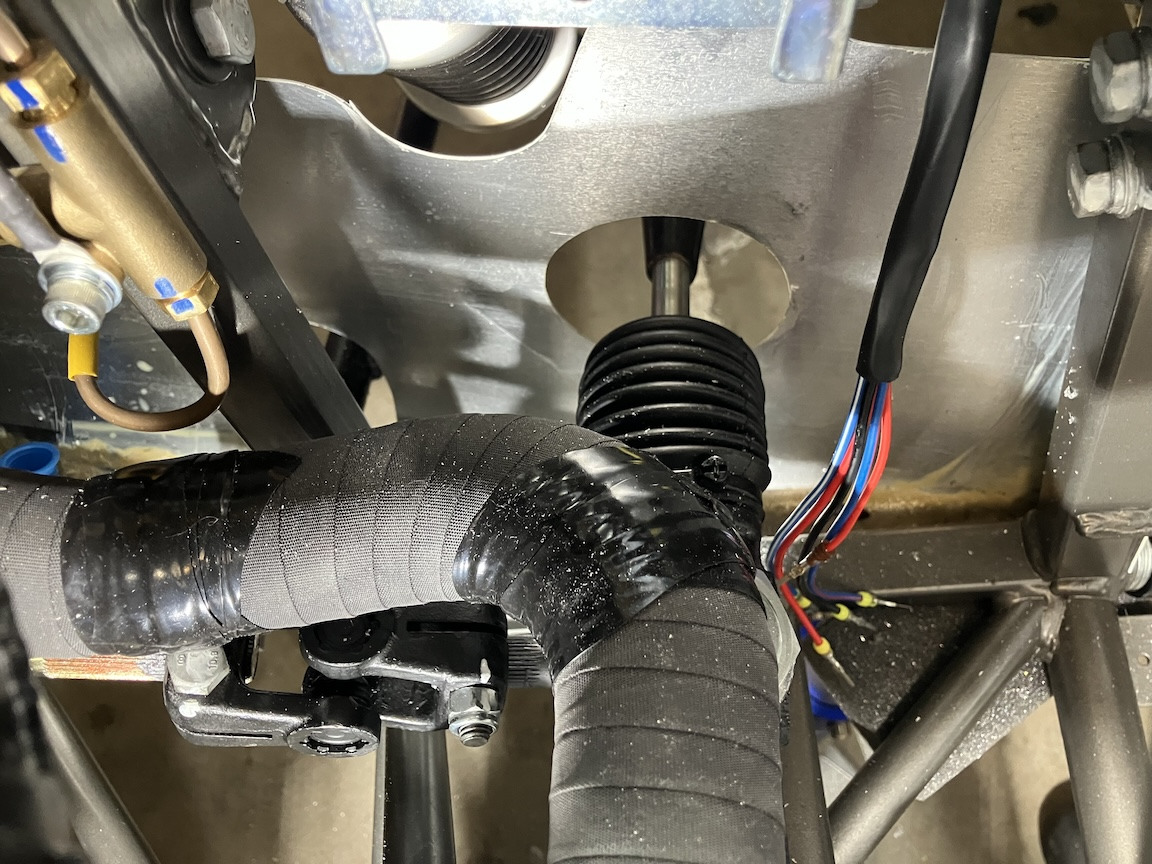
I've finally gotten all the major mechanical stuff done. Fair amount of head-scratching moments but no real problems. I'll list some of the challenges, etc. at some point, but nothing that others haven't already written about in the various build blogs. The only issue that might be unique to the Encore is the radiator hose routing, since the Encore uses a 420 radiator but has the Sigma engine's intake and outflow locations. The hose to the bottom of the radiator runs right underneath the overflow bottle. Without doing something to lift the hose, it would rest lightly on the steering arm U-joint. I managed to lift it to rest just slightly clear of the U-joint using zip ties and a P clip, and I added some silicone tape around the hose to avoid rubbing if the hose sags. The top radiator hose is squeezed tightly up against the top of the bottle, so there's not room to pop-rivet mount the bottle any higher. I'd considered moving the overflow bottle to the RHS of the engine bay to free up clearance for the radiator hoses , but didn't like the idea of a plastic bottle with oil in it being that close to the headers.
-
Affect of Steel and Aluminum Tariff on New Caterham Kit Pricing?
jmaz replied to Rustler's topic in General Sevens Discussion
Has anyone managed to get an IEEPA refund yet for any kit or parts purchased during the past year? -
Thanks. The remote, single reservoir that’s serving both the clutch and brake system is a different arrangement compared to older cars I’ve had. Re. the vent hole, should that be in the cover plate over then pedal box? Is the pedal box itself a location for corrosion?
-
As far as I know, there’s nothing unusual about them on this car other than having an up-rated brake master cylinder.
-
Thanks. I was originally thinking of using one of these types of brass fittings but began wondering if galvanic corrosion between aluminum and copper content in the brass might be a concern, at least over the long term. However, since the temperature sensor "submarine" is brass, as is the fitting for the heater, maybe the addition of one more brass components wouldn't matter. The Gates T-piece has only one barb on each of the arms, so the pex version's additional and probably stronger barbs would be an advantage, as you note.
-
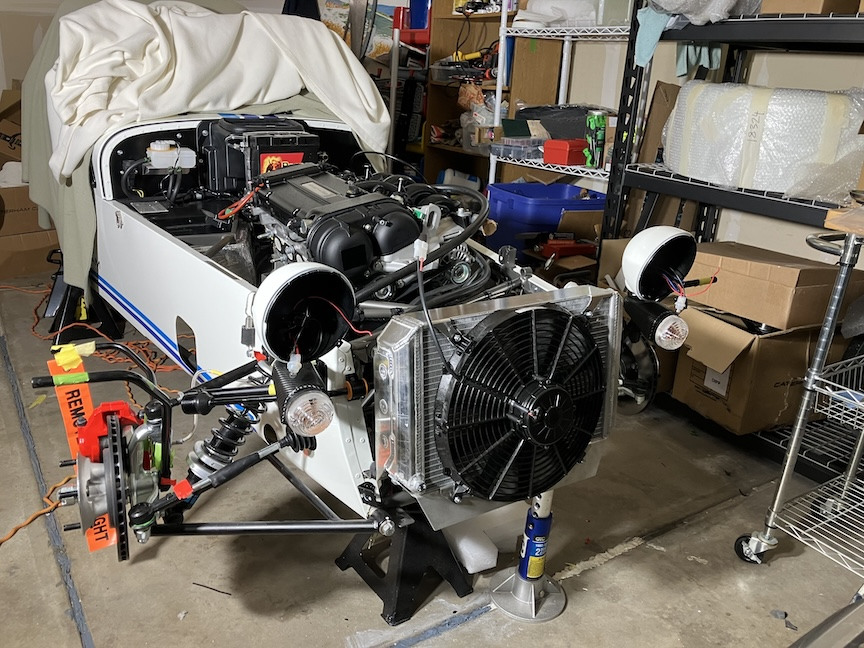
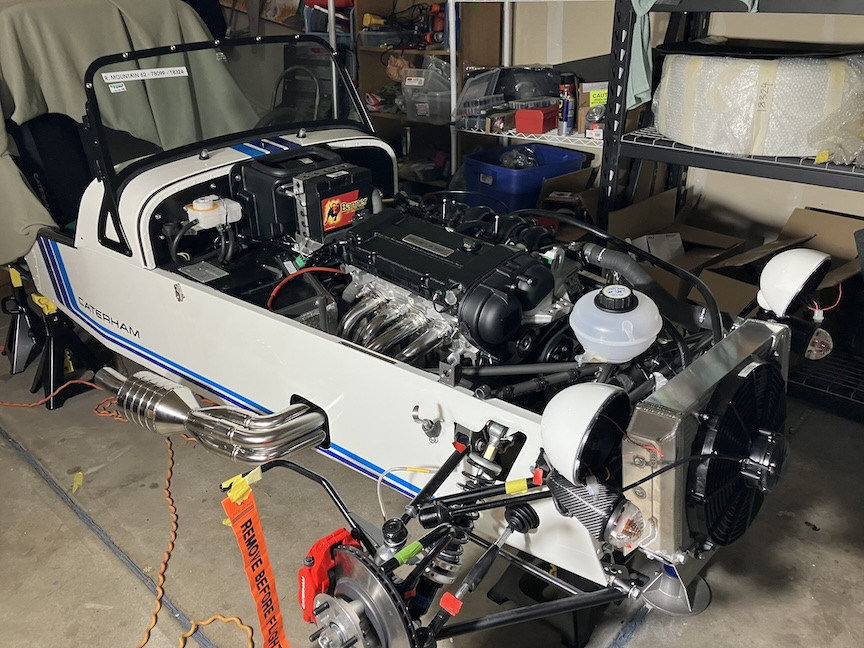
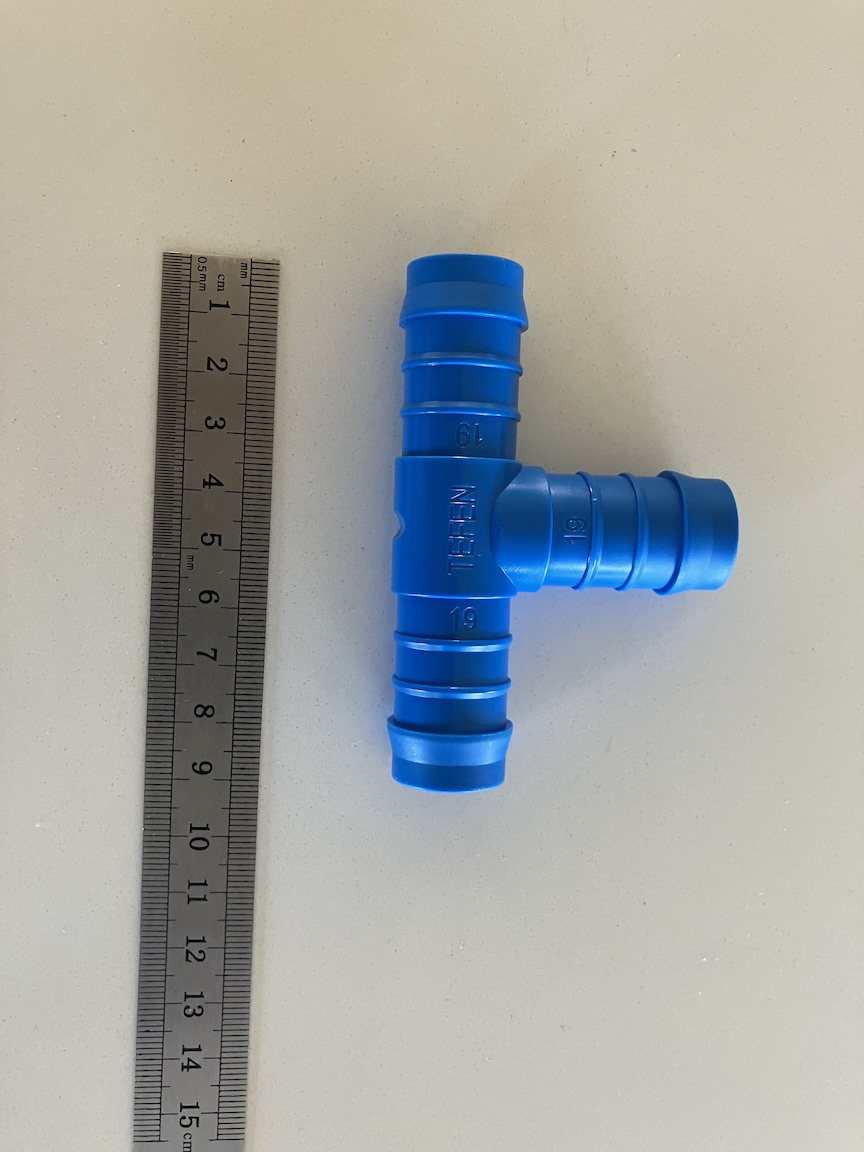
I'm continuing to make slow-but-enjoyable progress on the 310. Some of the more noteworthy things include: Radiator and fan: The 310 Encore uses a 420 radiator with front-mounted fan, with an aluminum deflector plate that gets attached to the base of the radiator. I had to make some modifications to the deflector to make extra clearance for the lower two fan mounting bolts. Engine plumbing: Still not totally done since I decided to upgrade the blue engine-to-modine-to-expansion tank T-piece, and will use a Gates 28635 nylon-reinforced plastic T-piece, following a couple of recommendations received. I appear to be short one hose clamp so bought a replacement from NAPA. The Caterham-supplied clamps have noticeably thicker steel for the clamp band, which maybe yields less stretch over time. Ideally, I'd like to get replace the NAPA clamp with the Caterham version at some point. I'll also go back through the plumbing and wiring to add spacers, zip-ties, adel clamps, etc. where warranted. Headers and collector: This was an easy job, and a treat to add the fun visual aspect to the car. Other issues: The shorter of the two ground cables that Caterham had supplied is too short and won't reach from the battery ground to the mounting point on the top of the passenger footwell. They sent the version used on RHD cars. Rocky Mountain Caterham is sending the correct-length cable. I'm also waiting to get a set of crutch straps (again to be provided by RMC), which I'll install before putting the seats in.
-
Thanks for that kind offer and suggestion re. the pex version. I'd gotten another recommendation for the Gates 28635 T-piece (from Josh Robbins at Rocky Mountain Caterham), so I've ordered one for around $8.00 from Amazon. It seems like one of those strange ways in which Caterham does things, where they could easily and cheaply upgrade a part but choose not to.
-
For my 310 Encore build, I'm considering replacing the supplied, blue-plastic T-piece that connects the engine, modine and expansion tank with the one recommended here (Gates 19mm T-piece, part # 28635) (https://caterham420detailedbuildblog.co.uk/2019/12/19/engine-plumbing-part-1/) or a stainless steel version. The Gates one (nylon-reinforced plastic) is designed specifically for auto use and might be more durable overall. Any suggestions or experience re. this t-piece would be welcome.
-
Thanks, this is useful info, for sure. It's a bummer that a LHD pedal box has limited adjustment. I haven't gotten to the point yet in my build where I'm fine-tuning the pedal situation, but I'd gotten the impression from build blogs, etc. (mostly, if not all, UK blogs maybe, and thus RHD) that there was a fair amount of adjustment possible.
-
Are you satisfied with the CaterLED 3rd brake lights? Any issues with the installation?
-
Your Spitfire's got a carburetor, not fuel injection, right? I'm trying to remember all the things that would go off on my former carbureted cars - TR4 and BMW 2002. Clogged jets and fuel filters weren't unusual. You note that the car had been sitting for a few years. Had the old gas been drained? The other common failure source was burnt or out-of-gap ignition points. Thing about the old technology is it was usually possible to get the cars to run, even if poorly. My newer (former) fun cars (Alfa Spider and Ferrari 328) were more of the "either runs or doesn't" mode. I'm hoping that my Caterham will be more predictable and easier to diagnose/fix.
-
Was it the pins that weren't fully seated in the connector body, or was it a problem with the connectors themselves?
-
What 3D print model did you use for the Spa mirrors? Is it one that you can and are willing to share? What type of print filament did you use? I figured I'd try to get the Eccles version mounts from somewhere, but no idea how long that might take. Ordering anything from the UK these days seems to be a crap shoot, what with tariffs, backlogs, etc.
-
A black stripe + nose band like the old Lotus would look very slick. Wasp-like.
-
I really like how your car looks in solid yellow/gold with no stripes. I didn't notice if you're planning on adding any, but it's a cool look as-is
-
The build continues to progress at a very gradual (comfortable for me) pace. No problems so far. Steps completed to date include front suspension, engine+trans, roll bar, steering, heater, throttle cable, front lights (although not yet connected to the Econoseal connectors), other engine electrical connections, 4-point belts (will install crutch straps when I get them from Josh at RMC as part of my original order), Next on the list is radiator+fan install and engine plumbing. Here are a few things I've noted with some of the recent work: Headlight Wiring: I could have done a much better job of making the wires a more even length prior to heat-shrinking everything. At some point, I'll probably re-do the pins to shorten and even out the wiring into the Econoseal connectors. I'm debating whether to put the stock headlights in place or spend the money now for LED upgrades before final headlight assembly (I'm considering the Morimoto Sealed6 lights, wired for turn signal + DRL function). Steering Centering: Trying to center the steering (in the process of installing the steering column) by counting steering U-joint rotations between full left and right lock didn't seem precise enough, so I used the method shown in https://www.youtube.com/watch?v=HEPW0Zz8qoU which involved sliding the boot(s) off the steering rack, and then measuring the distance between the steering rack stops. It might be enough to measure the distance at full stop in one direction and then just divide by two, but I measured both sides of the steering rack to play it safe. The maximum travel was 10 cm on each side, so I set a distance of 5 cm per side to center the steering. U-joint and Steering Column Alignment: It's recommended that, if necessary, the steering rack be rotated on its long axis to get as straight as an alignment as possible along the steering rack U-joint and the lower steering column. Even with the rack mounting brackets very loose, I was having trouble rotating the rack until I realized that I also needed to loosen the lock nuts at the tie-rod ends so that the rods could rotate along with the rack. Probably should have been obvious, but I'm finding that, for me at least, I'm saying "duh" to myself quite a bit during this build. Upper Steering Column Bush: Most people note that it takes some force to push the rubber bush with its white insert into the dashboard opening for the upper steering column. I struggled with this for awhile until I noticed that there were some small spikes of powder coat in the dashboard's bush housing. After lightly sanding those off using a Dremel with a drum sander bit, and also using the suggestion of inserting a 1/2" ratchet extension through the bush to provide something to push against, the bush went into place with moderate force applied (https://caterham420detailedbuildblog.co.uk/2020/01/29/steering-column/) Battery Cables: the kit came with two black (ground) battery cables of different lengths. I wasn't sure which was meant for which grounding point, but only one of the cables (the longer one) has a fitting with a big enough hole to fit one of the transmission tunnel bolts through if you decide to use that as a grounding location.
-
A good thing to keep in mind is that on most types of pins, the rear "wings" on the pin are intended to grip the wire insulation and serve to anchor the pin, while the front wings should grip just bare wire. This helps when looking at how much insulation you want to strip off, and how you want to position the wire in the pin when the pin's being held by the crimping tool.
-
Yep, your blog's definitely a help. The level of detail (including obscure stuff such as the part numbers for the Econoseal pins) is spot-on, and there aren't many blogs on LHD cars. I also found that the 5 wires wrapped in flexible, tight heat shrink to be pretty easy to get through the bracket. Shouldn't be hard to re-do if desired.
-
I wasn't aware that you've got a new blog going. You're doing a very nice job with it! The option of leaving off the indicator pods entirely hadn't occurred to me. It's definitely something to consider.
-
The wire bundle is routed into the headlight mount through the mount's opening+grommet, then down through the mount and into and through the bracket on the forward upper wishbone mounting point (also with a grommet in that opening), and then into the chassis.