

lowflyer
-
Posts
213 -
Joined
Content Type
Profiles
Forums
Store
Articles
Gallery
Events
Library
Everything posted by lowflyer
-
Depends... April is a little early, I think, but ya' never know. Right now I'm looking at a couple of days in early October for my "annual" run from Prescott, through Jerome to Sedona, and then on to Flagstaff - lunch - then return. I also spend some time in the Prescott area which has some "dandy" roads. I normally try to make my trips during the week, which limits the amount of tourist traffic I have to deal with. Being an old codger, I try to limit my trips to around 100 miles, one way. I think if I spent as much time in the car as your suggesting, I'd need an engine hoist to get me out!! Getting back to April, the altitude of most of the places you're talking about is around 5-7000 feet. Most of the time that would give you temps of 60-70 during the day and 35-40 at night. I've also seen snow in Prescott in April, having lived there for 10 years. A couple of years ago we went to Prescott in March and ended up being quite bundled up for our rides. I would say, make your plans but keep a sharp eye on the weather before you set out. Keep me advised as your plans get closer, I may join you for a leg or two. Ken
-
It's British, it's supposed to leak! How else can you prevent rust from attacking the backend of the car, if you're not going to spray oil all over it?
-
re: tie downs. On my Haulmark, the factory motorcycle tie downs are located in a metal piece that's part of the frame. If you choose to locate yours somewhere else you will need to create your own reinforcement panels. The normal recessed D-rings are often available with a 1/8" steel plate which sandwichs the floor. Ken Edney Chandler, AZ
-
The advice I got about leaving it in gear is - don't. The car will move slightly when you go over bumps and the motion will cause pressure on the gear teeth faces. It's also tough on the bearings in the gearbox. If you tie down each corner, where is the car going to go? But that brings up another area for discussion. When you tie the car down by the suspension, you are creating pressure on the bottoms of the wheel bearings, especially as the trailer bounces up and down. Since, you already taken up most of the suspension travel, but pulling the car down snug, all of the weight is transmitted into the spindles, bearings and such. In the front of my trailer, I use tie downs going through the wheels, which leaves the suspension free to move. In the rear, I'm forced to tie down the rear axle, but I try to make the pull at a 45 degree angle, so there is still a small amount of up and down suspension travel. Just a thought.
-
There's more to the "Edge" than chrome wheels and LED lights. The front corners of the trailer are cast aluminum pieces vs. the stamped aluminum ribs used on the non-Edge. Also, the Edge has a smooth exterior rather than a riveted one. Both are supposed to make for a stronger trailer - can't vouch for this, just repeating what I was told when I was looking. The reason for the lower hitch and rear floor are the frame design. The frame is dropped from the hitch and by using the torsion axles vs. leaf springs the entire unit sits closer to the ground. If you have a lifted truck, or just one that sits higher than stock, you may need an extended drop hitch. On the positive side, the lower rear floor area, along with the slight beaver tail make for a fairly shallow ramp angle, given that the ramp door is only about 5' feet long vs. the 6'+ on a standard height trailer. This makes loading a car such as a "7" fairly easy, even with their low clearance. I don't use any additional ramps to load mine. One point about the V-nose, many of them come with cabinets along one side of the V. They can be a real "head knocker" if you're not careful. Which brings up one more point on the "low hauler" family. The interior height is only about 5'4", so unless you are fairly short, you will bang your head at least once every time you use it! Trust me, I know of what I speak!
-
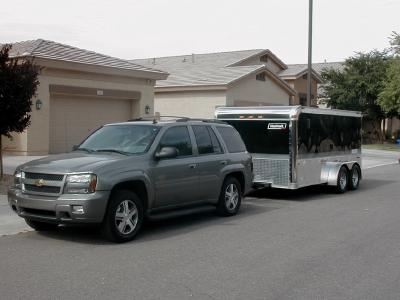
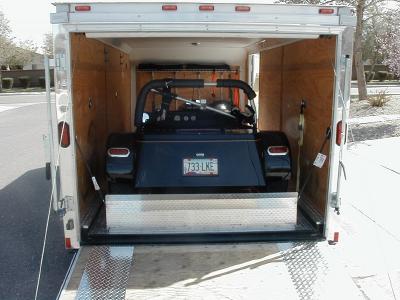
Another vote for the Haulmark "Low Hauler" here. I picked mine up used, so the choices were more limited but I got it at a very good price. Mine is called the "Edge", which doesn't come in a V-nose. They used a cast aluminum beam at the two front edges, supposed to make it much more rigid, and therefore, last longer. It comes with a small beaver tail, so loading is no problem. I did lots of measuring before buying and, as you can see, my Stalker (which is larger than most LSIS's) fits fine. One point about putting it in the garage.... the angle of your driveway will have a large effect on whether you can get it into the garage. The fellow from whom I purchased mine intended on storing it in his garage but was unable to clear the garage door in its up position. All about the angles. The top of the trailer, at the rear, was hitting the edge of the garage door due to the angle of approach. I keep mine in the side yard and it's low enough not to be seen from the street. It tows very nicely, but I did just pick up a weight distributing hitch for it to take some of the weight off of the tongue. I tow with a Chevy Trailblazer, which is a little low on torque when towing in the mountains, but does fine "down on the flats". Ken Edney Chandler, AZ

-
I agree with Skip, it sounds like your timing is retarded. Normally, if it were too advanced you would have the reverse situation, hard start buy smooth at higher revs. If, after you have checked that, you want some help on going through the carb set up, holler at me. I'm on the road until next Sunday and will be checking email sporadically. Ken Edney Chandler, AZ
-
Someone smarter than me once said, " About 80% of all carburetor problems are electrical". I guess we can make that 81%. Glad you found the problem.
-
There are a number of screws that can be adjusted, but once adjusted they don't change their setting by themselves. About the only thing that could effect the running (assuming that the carbs are set-up right in the first place) is a piece of dirt coming through the fuel line and either blocking the float needle open or blocking off a jet somewhere in the system. A good reason for an effective fuel filter somewhere in the system. BTW, I've done this (on and off) long enough that I can use a stethoscope that was made from a pair of airline earphones to listen to the airflow through the carbs to balance them, when I don't have a Unisyn. The last guy I lent my Unisyn to never returned it, and that was in the late 1990's! The sound is quite easy to hear, changes are obvious so getting the individual mixture screws adjusted is easy. On a similar note, a lot of people try to balance the carbs without disconnecting the linkage between the carbs first. If the linkage is wrong, the balance of the carbs will almost never be right. Still betting on an electrical problem.
-
I've been playing with Weber side drafts (40 DCOE's mostly) on and off for about 40 years and have never seen the "adjustment go off". How exactly would that happen? Ken
-
Sorry for highjacking the thread, but... Let's be honest here, if we actually thought we were going to be in any kind of accident, would we ever get into our 7 type cars? There's a great line in the movie Grand Prix, where the character says that race car drivers have very poor imaginations, for if they truely thought about what would happen to them if they hit a tree at 150 mph, they would never get into their cars. I certainly wouldn't. When your head is about the height of the door handles on a Taurus, and your butt is 4" off the ground, and the only thing between you and the tire on that Ford F150 in the next lane is a 1 1/4" tube and a piece of aluminum there isn't much hope of "walking it off". Many of my compatriots with Stalkers have added removeable pieces to their rollbars to provide a "roll cage" feeling. It offers no additional side intrusion protection that I can see, and only limited additional inversion protection. I would certainly not go wheel to wheel on a track with that type of minimal protection, but then again I'm old (plus I did all that crazy stuff when I was much younger). An autocross is a good, safe way of enjoying a "7", without much risk other than some paint damage from a "rogue cone". And the type or size of a rollbar shouldn't be much of a consideration. I do drive my car on freeways, when necessary, but with a "heightened sense of awareness" of all the other cars around me - much like riding a motorcycle. I'm much happier driving around on a two lane back road, at about 40-60 mph (depending) and staying in my own lane and just enjoying life. Ken Edney Chandler, AZ
-
I agree with the last posting. If it came on suddenly, I would suspect a timing issue. Perhaps the distributor has moved slightly or more likely something inside the dizzy is causing the problem. You don't mention what kind of ignition you have, whether it has points/condensor or a Petronix type of pickup or something else. I had a very similar problem years ago with a car equipped with a dual point ignition system when one of the sets of points became loose. If the car is equipped with Weber 40's the only thing I can think of there would be a stuck float, perhaps caused by some dirt/debris in the fuel. The timing is easiest thing to check. Good luck, and don't overlook the really simple things - like a spark plug wire burning through or coming loose. Ken Edney Chandler, AZ
-
At the risk of highjacking the thread.... the "broomstick" test doesn't mean much if you're going to measure to the top of the windshield. In any kind of "inversion" the windshield is going to fold back into your lap, or be torn off. The only meaningful test is to take the broomstick from the top of the rollbar to the top of the frame at the rad support, or perhaps the top of the engine, since both are likely to remain in their original location. The rollbars are mostly a joke in a "7", IMHO, without a full cage. Ken Edney Chandler, AZ
-
You're right, I missed the valve covers. The oil filter could have been added to a VW, but the larger valve covers are Porsche for sure. Also, the oil filler is late model - more likely 1963 or later, and again Porsche. Good catch!
-
Am I the only one that also noticed the mid-60's Marlboro Maroon Corvette with the side pipes in the background? The pair would be a nice set to have in the garage!
-
Not as hot as it will be here! Ken Edney Chandler, AZ (115 today)
-
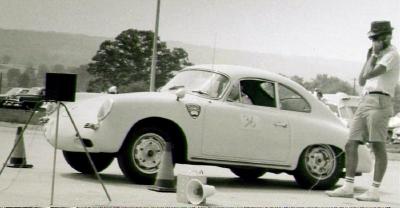
The transmission could very well be Porsche, since there wasn't much difference between the two back in the '50's. The breather shown is an added piece since the stock one is just a small metal tube. The biggest difference was inside since there were lots of choices of gearing for the Porsche boxes. What makes me think that it's VW, and I could easily be wrong, is the axle boots which are a later style split type which allows them to be installed without pulling the axle tube. You can make out the small nuts/bolts holding the boot together. Once he's done, he may or may not want to drive it on the street, since it will be so valuable. Sadly, I passed on a Porsche RS60 Spyder which was offered to me for $1500 back in the mid-60's. The engine had been blown up and it had some body damage, therefore, it was "too expensive" for me! Another one that got away. I did end up with one of the 12-18 1961 Porsche S90 GT coupes that the factory built. I sold it for $1200 to a buddy, who rolled it into a small ball at the Reading Airport Road Races in Pennsylvania. It would be worth around 100K now!
-
It probably wouldn't take much to make the "race car" street legal, depending on which state you are trying to get a license in. One of the cars was built by Dennis Brunton (the father of the Stalker), the other two were built by the shop that is now trying to sell them, so there may or may not be quality issues. Not to mention, how much were they "beat on" as a rental race car? You could probably buy one cheaper, or even build your own for less.
-
I think the car is actually a Porsche 550RS, otherwise known as a 550 Spyder. The Speedster was a rear engined car, not a mid-engine car like this. Also the Spyder came with a twin overhead cam engine, the last of which was the 1500 cc version. All but the super rare Carrera (which used this engine) came with a pushrod 1500 cc engine and later a 1600 cc pushrod. Sadly, the car pictured is powered by a VW engine and transaxle. You are right about the rarity, the last one I saw sold at Barrett-Jackson about 8 or 9 years ago for something around $600K. And I believe the production of 90 is about right too. These are reproduced by several kit car manufacturers, probably the most famous was Beck, which is now Thunder Roadsters. Beautiful work.
-
Always hard to put a value on someone elses car, but that never stopped me before! A couple of "regular" Stalkers (non-supercharged) have sold recently in the $15/18K range. The supercharged version should be worth a few thou more, if you want one. Also, don't know if the cars offered are "street legal", which could make it more difficult for them to be sold. I have about 15K in my standard Stalker, just in parts and paint. Hope this offers some insight. Ken Edney Chandler, AZ
-
Two quick comments, if you don't mind... First, good choice in using the steel braided, teflon hose. Second, be really careful where that hose comes in contact with other bits and pieces, as it will saw right through anything it touches. From your photos it looks like you zip tied it to a rubber hose, and what looks like your battery cable. You may want to cut and slip some pieces of rubber hose over the braided stuff, zip tie them in place, then zip tie the whole deal back to a support. I have seen this stuff cut into steel frame tubes on formula cars if there's any movement at all. Ken Edney Chandler, AZ
-
Hey Southwind, I like your flywheel, but thought you might like to see a "lightweight one". This is milled from billet steel and weighed 5.5 lbs! I put it into a formula car which ran in B/mod in SCCA Solo events with a Ford Crossflow engine. It wouldn't work in a "heavy" car like a 7 since there was no stored inertia in the spinning weight of a normal flywheel to help launch the car, but it reved like a motorcycle and pulled off of corners like scalded cat.
-
If you don't find one locally, try the Ebay UK site. They are still available from some UK hotrod sites as well. Ken Edney Chandler, AZ
-
Like most things in life, you can make arguements for both sides of the question. The Miata is a bulletproof engine, which can be upgraded for more power, the 5 speed is a plus, and the parts are easy to find. Downside, cost of buying new drivetrain (even if purchased used), hassle of fabbing up motor mounts, rad hoses, throttle cables, etc. Not to mention the wiring issues of converting to a computer controlled engine. The crossflow is a great engine, and if you're only getting 100 hp out of yours there is something wrong. A good Formula Ford engine with a stock cam, and single two barrel Weber 32/36 will get around 108-112 hp. Add in a good head clean-up, a cam and a set of Weber 40's and you should be getting around 130-140. Parts are getting to be a problem, but still available in Jolly Old England. No costs for a new power train, no conversion headaches, and the simplicity of a wooden mallet. It all depends on your desires, and your budget but either one should provide lots of good fun.
-
Best bet for ignition timing is to set it for the maximum setting you want at full advance. To do this you need a timing light with an advance meter on it, where you can dial in the degrees of advance that will still show the light at top dead center. Normally, total timing is in the 32-36 degree range at 3500-4000 rpm, which should give you about 8 to 12 degrees at idle. This is also a good way to make sure that your mechanical/vacuum advance is working properly. It is a good idea to have someone else handle the throttle while you concentrate on the timing. If you see any sudden "jumps" in the timing light while making the run it should cause some concern about the advance mechanics. It is not unusual to have some "shaking" in the timing light at 4000 rpms as this is normal "slack" in the cam/drive gear/distributor. Have fun!

.jpg.c5c0427a13c65503f98b28ade33e8e1b.jpg)