
Timothy Keith-Lucas
-
Posts
278 -
Joined
-
Last visited
Content Type
Profiles
Forums
Store
Articles
Gallery
Events
Library
Everything posted by Timothy Keith-Lucas
-
As soon as I fallowed Iamscotticus's recommendation by asking for a new specific photograph, two supposed owners ghosted me. Thanks for the help, guys.
-
Damned good ideas, folks. Thank you.
-
Aa soon as I expressed an interest, an advertised Seven moved from Kentucky to Oregon. By itself, am I right in suspecting a scam?
-

How to free frozen threaded rod ends?
Timothy Keith-Lucas replied to mccasksl's topic in General Tech
Oh. Threaded stud. Tighten one nut against another nut at the top, or weld one on. -
How to free frozen threaded rod ends?
Timothy Keith-Lucas replied to mccasksl's topic in General Tech
Not a new issue to anyone who owns a steel boat. It's a graduated system. First, penetrant overnight (I use Knock'er Loose), Then slightly tighten before trying to loosen, with a 1/4" impact driver being a helpful tool. Then a torque wrench so you don't shear that sucker, then propane-level heat to burn off sticky stuff, then oxy/acetylene level heat to a dull red. I haven't met one that didn't yield by then. Just be careful that you don't heat it too much - you don't want to melt it. -
Push-button replacement for Dzus fasteners on Caterham nose.
Timothy Keith-Lucas replied to pethier's topic in General Tech
This is a very informative thread. Thank you. I'm going to try one of the alternatives when I do a rebuild this coming winter. My attachments for the snout are so worn and damaged that at present the entire molding is held in place with wire ties. -
As Carl says, there aren't that many made. If you don't find the one you want here, back up to "U joints" and try again. https://www.mcmaster.com/products/u-joints/high-torque-single-u-joints-8/
-
collapsible steering column for 7 S2?
Timothy Keith-Lucas replied to Timothy Keith-Lucas's topic in General Tech
After comparing the two, I went with the Borgeson collapsing section. It was a fight to get that section into the middle of the original shaft and properly aligned, because the Borgeson is a "double D" shape and the shaft a variety of round rods of different diameters. It will have to be inserted from the front, with the brake fluid distributor being moved out of the way. Next is devising a collar that will stop the collapsing shaft at the firewall, so my chest doesn't have to be the stop that collapses it. -
Here's a $20 set of marine grade heat shrink spade connectors that should do the job. https://www.amazon.com/Haisstronica-Connectors-Electrical-Connectors-Quick-Disconnect-Electronics/dp/B07RT4RSGJ/ref=sr_1_15?crid=2VU0UQ2ZH0I0U&dib=eyJ2IjoiMSJ9.S0q9wGvmhOi7e9QA-LmCiOEIDrFVP12m5s5KzjQoTjYHNIVVRrxjqho_TYlCi6hduUklbaix1Ahd-ad2gTJpiQiD7uex4nLs11gbpsDfOxl2qK6B_F9fj0Cr4EY40XJmmdrqlpsRq-XQVIjm_89Ekpm8teZpTsDtxwUaj5hQfrGeTZ3H6z8TfRDb-rpfMIR4lkTsBrnVmWXTiY4U87KZHCvhZE_VeD6aEL9AyNPE4zY-KgJNWzBSkaMWlOTnbEXJhOZcejY8nES97s4TKtwbZAh36fIm7rFe1U7NSxXSn7s.zS10j8mMaxJ9fI50H5nNNgVZ3QsZsTmYVc43rv5sIOk&dib_tag=se&keywords=marine%2Bcrimp%2Bconnectors&qid=1720357163&sprefix=marine%2Bcrimp%2Bconnectors%2Caps%2C173&sr=8-15&th=1
-
collapsible steering column for 7 S2?
Timothy Keith-Lucas replied to Timothy Keith-Lucas's topic in General Tech
Thank you, MV8. I have some steel coming to play with. Ironically, this all started with my being annoyed by the play in the steering, which turned out to be the link between the steering shaft and the rack and pinion box having rubber bushings that were beyond repair. I have a new link coming from Moss. I certainly would prefer to use the professional collapsing shaft. At the moment I'm thinking that I could align the Borgeson shaft with the two ends of the cut off shaft and weld it in. So, two possible designs, and fun pursuing the best answer. It keeps my brain active. -
collapsible steering column for 7 S2?
Timothy Keith-Lucas replied to Timothy Keith-Lucas's topic in General Tech
Certainly, MV8. I am always ready for your words of wisdom. Speak. -
collapsible steering column for 7 S2?
Timothy Keith-Lucas replied to Timothy Keith-Lucas's topic in General Tech
OK, I believe in simplification, too. Two square tubes, a 1" with an inside square of 0.76", and the other with an outside 0.75". Weld on the ends from the old column. Turning torque is taken up by their being square, and a little silicone between them will cushion it and keep the wheel from moving in and out. I'll let you know if it works. -
collapsible steering column for 7 S2?
Timothy Keith-Lucas replied to Timothy Keith-Lucas's topic in General Tech
Thank you muchly, MV8. I ran into no end of trouble mating the Borgeson shaft to my 9/16 shaft - adaptors are not available in those sizes and I don't have a lathe. I'm thinking of a 5/8" inch ID tube pinned to top and bottom stubs. I can get 12" of collapse from that. The available free shaft, from the splines at the steering pinion to the frame that mounts the master cylinders is (surprisingly) only 25". A collar around the shaft just below the mount for the master cylinders should make sure that it collapses, without transferring the thrust to my hands or my chest. Mr. Chapman certainly believed in simplification, but having the steering column anchored only at the steering pinion is impressive. Release that clamp, and the entire shaft slides out the back, with only a bend in the steering wheel as it goes over the seat back.
-
The solid steel steering column on my 1962 S2 scares me. Any frontal impact and that sucker is aimed at my chest. I'm thinking of designing and fabricating a collapsible column, but am wondering if anyone has already got a design, or if there is a substitute column on the market. Thoughts?
-
Thanks. Interesting approach. At the moment I'm trying to resurrect my positive ground original. I would prefer a mechanical unit, for simplicity and accuracy. The electrical unit has lots of problems, but re-wiring may solve them. I have not found a generator with the mechanical take-off, complicated by my 7 being positive ground.
-
Ooops. No joy. No threads under the cover. Sounds like a new generator is in my future if I want a mechanical tach.
-
Wonderful! So it's under the projection out the back end labelled "OIL". I will pursue said, and thank you.
-
Is there a port for a mechanical tachometer, or a way of rigging one, on the Austin etc. 948cc engine? I've got a digital run off a spark plug lead, and the original electrical tach which I've modernized, but the plain reliability of a mechanical tach is appealing. Any ideas appreciated.
-
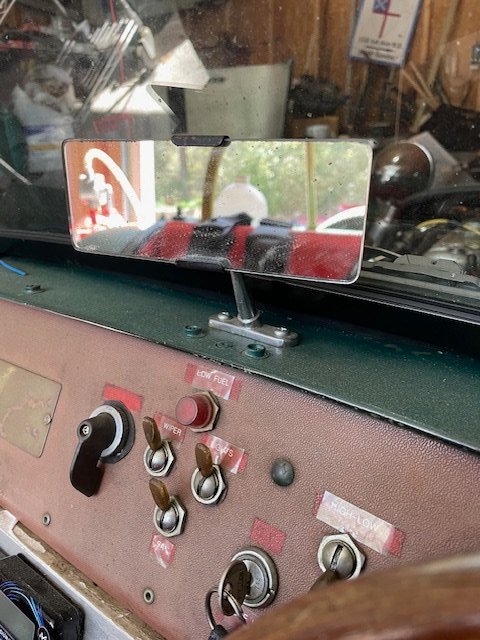
My S2 1160 America has an even simpler mirror, with a clamp holding mirror glass. It's possible that the previous owner, who raced the car extensively in the 1960s, went minimalist with the mirror. It is at least the mirror it had back then.
-
Found it! The problem went back to my buying a set of thin wrenches that inexplicably lacked a 5/8 inch open end. The locking nuts on the jets were as a result not as tight as I should have made them, and the two carbs self-adjusted to the lean side, particularly the rear one. Too lean to fire. Setting them back to two turns from the top wasn't enough either; these carbs need 2 1/2 or so. Thank you for all your suggestions - they were not wasted, because I now know a bunch about SU carbs that I didn't know before I started. It is a bit of a challenge to master this car when there is no nearby source of expertise.
-
The engine acted like it was running out of gas and then died. Spark plugs are the right shade of brown but dry after attempts at starting. Spark is present on all cylinders. Fuel level is correct in both bowls, and the electric fuel pump is delivering fuel to both bowls. Compression is above 150 PSI on all cylinders. I'm down to suspecting the jets are clogged. Yeah, I delayed putting a filter in the line and one is now on order. If I've made the right diagnosis, what is the easiest way to clear clogged jets? I could come from the top, remove the needles, and run a fine wire through the jets. I could detach the fuel feed at the bottom of each carb and blow air upward while holding the needles up. Maybe there's a standard way of doing it and you folks know the secret. Is must be a pretty common problem, but it doesn't earn any comments in my SU carb manuals. It certainly is on other small engines. Some mechanics just blow carb cleaner up the jets and hope for the best.
-
I Got it! Typical "I'm new to this piece of machinery" mistake. I followed your instructions (all of them, THANK YOU!). No joy, so something had to be wrong beyond adjustment. I took the anti-bird nesting screens off the carbs to watch the throttles rise and fall. Both throttles were stuck in the full-up position..... I had not noticed the tongue and grove on the sides of the piston and the dashpot case. Locked them full open. Runs one hell of a lot better with working throttles. Still needs some tuning, but that I can do. So thanks to all, and to all a happy holiday season. --Tim.
-
Thank you, all. I'll get back to work on it in the morning. The central problem is that this is a new installation, so a cold engine, rather than tuning existing carbs on a running engine.
-
Two turns was from the point of the jet adjusting nuts fully compressing the springs. It's acting like it really isn't getting any fuel from the carbs, just starter fluid. Perhaps open the jet adjusting nuts some more?
-
I've got a beautiful rebuilt set of 1 1/4" SU carbs on my Austin 948 engine. I've been following the step-by-step in the Street Sport "Tuning SU Carburetters" guide that MV8 recommended. I'm on page 26, step #19, with the choke and throttle disconnected and the jet adjusting nuts two turns out. The problem is that the engine is cold and even with starter fluid and holding one choke in place I can't get the engine to run long enough to warm up so I proceed to actually tuning the carbs. Any advice on the next step?