
EdWills
-
Posts
275 -
Joined
Content Type
Profiles
Forums
Store
Articles
Gallery
Events
Library
Everything posted by EdWills
-
Hi @jmaz. I have a few of these that I would be willing to send you for free, but the complicated postal system these days is too much to contend with. You don't mention the o.d. of the fittings required, but go to your local big box hardware store and look for 'Pex' fittings. They should be made of brass (sometimes chrome over brass?) and normally come manufactured for 1/2" pex pipe or 3/4" pipe. You may require metric size for your car, and if so, some Italian manufactured pex fitting may be available, but not sure. Here in Canada, although mostly metric, we rely on Imperial fitting sizes along with many other construction items also in Imperial measure. Cheers W.
-
Not particularly Lotus/Caterham related, but on holiday on Kauai, Hawaii last year, I needed to fill up our rental car before returning it to the airport. As a Costco member, I made use of the great prices and shopping available. At the Costco gas station, I tried 3 cards (one in U.S. Dollars) in order to pay for the gas. None of them worked, and I couldn't pump any gas. I noticed that an entirely different type of pump nozzle was attached to the hose of a type that I had never seen before. I returned to the store, and they confirmed that all of the cards were up-to-date, and should work. I tried again with no luck and even a very helpful lady customer also tried to help with no success. I went to the nearby Costco attendants booth, where a young 'surfer dude' Costco employee was keeping cool in his air conditioned cocoon. He came out to the vehicle, tried the cards - as I had done - which still would not allow him to pump any gas. He looked at the pump nozzle, and then gave it a very hard shove into the gas tank filler neck. He told me "Your nozzles not in far enough". I replied "My wife often tells me that"! He stared at me for a few seconds, then went back to his air conditioned comfort. I was then able to pump the gas. It appears that the 'new' nozzle has to make a very firm contact with the filler neck of a vehicle to allow the gas to be pumped. It cannot just be left loosely in the filler neck to work correctly. Not sure if this type of nozzle will become standard in the U.S. and Canada? I have not seen this particular type of nozzle since then, but our local Costco has fitted newer types of nozzles, but they are still of the type that the nozzle does not have to be all the way in to pump the gas. W. Tommy Cooper: "The local police arrested two bank robbers at their hide-out recently. One was drinking battery acid, and the other was chewing on a firework. They charged one, and let the other one off"
-
Thanks Scott. It's amazing to find that a number of car owners have asked this question on the web and there seems to be no conclusive answer. Even Ai suggests on older (vintage) cars, valve stem seals are not necessary, but it doesn't mention bronze guides. "I took a drive the other day, and parked the car to take a stroll. Came back to my car and a note on the windshield said "Parking Fine". It's great when someone congratulates you on your driving abilities".
-
At the risk of answering my own question, (but to put this post to bed?) I have checked a further couple of books by U.K. Ford Crossflow tuners, and the consensus seems to be that valve stem seals should be placed on the inlet valve at the very least, (to prevent carbon build-up in the head and inlet manifold), but on both valves is preferable. In my small collection of Ford Crossflow reference books, these stem seals are hardly mentioned, if at all. With double valve springs fitted, the original Ford factory 'umbrella' stem seals will not fit, but with single springs - which they were designed for - they will work as they were meant to. David Wallage in his book on tuning the Crossflow noted that some tuners install rubber 'O' rings on the stems for double springs, but he was not fond of this practice, although they will probably work o.k. I also found the 'Felpro' site and it shows the 2 main types of valve stem seal. I plan to stick with the Ford 'umbrella' stem seals (unless someone has other ideas), as they will help to limit too much oil going down the guide, but still allow some oil to splash on the stems for necessary lubrication. Cheers, W.
-
The web has a few car forums where owners of cars from small European sports cars to U.S. muscle cars inquire about using valve stem seals with silicon or manganese bronze valve guides. Some say yes, you should fit them, and others say no with a mix of reputable car mechanics advising either way. I have a Holbay Ford cylinder head that some describe as Stage II - fitted with larger 1.6" inlet valves, but not so large as to cause possible cracking between the inlet and exhaust valve seats. The head was new and based on an 1100 c.c. flat cylinder head as there is/was more metal available to grind away for porting (Note: recommendation of David Vizard many, many years ago to use an 1100 uprated flat head on the 1600 c.c. 711M Crossflow which I will be rebuilding). Holbay fitted harder exhaust seats for unleaded fuel, stainless steel valves, and silicon bronze valve guides. Double springs are fitted, but I am thinking of using singles. Holbay did not fit valve stem seals to the double springs. I checked with Burton a couple of years ago as I was considering using 'special' stem seals on the valves (with single springs), but Burton did not recommend using stem seals, as they believe that the valve stem and guide would not receive sufficient lubrication. Some say there is burnt oil smoke on start-up with no seals, and that this goes away quite quickly. Also mentioned was valve stem seizing if there is insufficient flow of oil due to the seals doing too fine of a job. I have read that tuners installing stainless valves fitted in silicon bronze guides normally specify minimum clearances from new, thereby requiring a good flow of oil. Has anybody with road or racing experience seen premature wear with stem seals fitted to bronze guides? I don't want to be trailing smoke and polluting the neighbourhood - even with a car that has no pollution control to speak of - so advice would be much appreciated. W
-
Hi @Rodnok. I have a pair of Lotus Seven windscreen stanchions made out of 1/8" steel exactly to the shape of the Lotus originals for free which you could use as a pattern, but I think that it may be a hassle for both of us to ship them from Canada to you unless you know of a way? All I would ask for is shipping cost. EW
-
@anduril3019 and @skou. I wondered where page 2 was, as I could never find it, guessing that the person who posted the drawings had omitted page 2 in error. I also found a set of drawings in 8.5" x 11" posted on the web courtesy of a company called 'Fisher and Paykel Ltd', (Laundry Division!?) for a Lotus Seven Series 3, metric measurements, with top and bottom front wishbones looking more like a Caterham or perhaps a Locost? George Cushing also provided a drawing for a Seven Series 2 on his site, and his Imperial measurements very closely match up with the ones I took from my old Universal Radiator frame. There are also a couple of pages of drawings on the Locost site with no credit provided for the person who drew them. They show all of the brackets required on a Seven frame, along with the necessary radius bends for the frame members, but again metric measurements. Just in the miscellaneous (useless?) information category, but in the mid 1980s, Lotus - in their official club magazine - were offering factory drawings for sale of a number of their sports and racing cars (I can't remember which cars, but from the Lotus 20 possibly up to the Lotus 77? John Donohoe may still have the copy of the magazine I sent to him?) The Seven was not included because Caterham had purchased the rights to the car (Series 3 and 4) in 1973. Even the 37 and the 7X were not included as the 37 frame would be almost identical to a Series 2/3 frame, and the 7X was a design by Mike Pilbeam, head draughtsman/designer of Lotus at the time, with the car based on a Series 4 with considerable modifications. Mike Pilbeam has retained the drawings in his personal collection. He was very helpful describing the frame, but could not locate the drawings when I inquired a few years ago. When it was realized by Lotus Legal Department that unlawful copies of the drawings could be reproduced, Lotus withdrew the offer on advice from their legal department. I also read in the magazine about a purchaser who complained about the cost of postage to send the drawings in a mailing tube to his U.K. address (12 shillings and sixpence at the time I seem to recall - probably less than $2.00 U.S. in today's money?). Lotus promptly refunded his payment and the drawings were not advertised again as far as I can determine. The Lotus Club magazines I had were published in 1983 and 1984, as one included the commemoration of Colin Chapman (following his death in December 1982), and Lotus at the 1983 Silverstone GP, when a number of different models of Lotus Cars completed a circuit of the track prior to the G.P. I was fortunate to obtain a pit pass at this race, and took photos of many of the different Lotus Models lined up at the end of the paddock. W.
-
Scott. As you know, I'm as vintage as the Lotus Seven, so I did wonder if these pdfs would work! I can send them to your email if you want them? W.
-
Pat Prince Lotus 7 S2_Sheet 3.pdfPat Prince Lotus 7 S2_Sheet 1.pdfHi Scott. There was a similar set of drawings on the Facebook Lotus Historic Register. A contributor on Locost USA downloaded a similar set from Pat Prince, who dissected a Series 2 frame, and took as many measurements as he could. Pat Prince took over the work of DSK when the owners folded the company. I'll attach the files here and hope that they download? With thanks and recognition of the locost usa forum. W Pat Prince Lotus 7 S2_Sheet 4.pdf Pat Prince Lotus 7 S2_Sheet 5.pdf Pat Prince Lotus 7 S2_Sheet 6.pdf Pat Prince Lotus 7 S2_Sheet 7.pdf Pat Prince Lotus 7 S2_Sheet 8.pdf Pat Prince Lotus 7 S2_Sheet 9.pdf
-
10 Of The Least Aerodynamic Cars Ever Made
EdWills replied to CBuff's topic in General Sevens Discussion
That's why Rob Cox-Allison named his racing 7 in the U.K. 'Black Brick' due to its colour and its less than desirable aerodynamics. Although he added spoilers front and rear, and fitted a hard top, he was seriously compromised on speed. Tom Robertson added a spoiler to the nose cone of his championship winning Lotus Seven in 1977 (and beat the more streamlined TR7s of the Triumph team), but it seems that Lotus in the U.K. never went this route. Many racers there and in North America kept the clam shells, and the couple of Lotus factory racers (Type 37 and 7X) never fitted spoilers or made the cars more aerodynamic as-built from the factory. When Tim Goss drove the race winning 7X, the nose cone that originally appeared on the car (and was very similar to the Series 4), was later given more of a droop, but otherwise remained as factory assembled. Barry Foley then took it over and rebuilt the car making it much more streamlined, but looking nothing like a Seven of any stripe. W. -
Also, sad to read of the death of Chuck Negron of Three Dog Night a few days ago from heart failure and COPD. She who must be obeyed and myself really enjoy listening to this band. Floyd Sneed, who passed away in 2023, was Calgary, Alberta, born and raised. His family was one of the first to settle in Alberta under a programme to entice U.S. farmers to settle in the prairies. W
-
Hello Henry. I have just checked the library and your file is there, apologies for not checking before.. I have just measured an old set from a Lotus Seven Series 3 (same as later Series 2 cars), and the measurement, with spring, from perch to perch is as noted in your file - 9 inches. The measurement from the centre of the top mount to the centre of the bottom mount on my set is 12-3/4 inches plus or minus (one was 12-5/8", the other 12-3/4"). Some of the springs supplied to Lotus to mount on the Armstrong dampers were known to sag (according to Lotus). Trust this helps @Bill W
-
Hi Bill. Please check https://anglocanadianlotus7.ca. There are some measurements posted there that may be of assistance. @SENC sent me some original Armstrong data regarding Series 2 springs and dampers a few years ago that is also very helpful. Perhaps he or I can send that to you also? W.
-
Not sure if many Seven/7 owners in Canada purchase from the U.K., but I've recently received a few orders from shops from over the 'pond' via Royal Mail, and the service has been fast and I've been kept informed of the routing every step of the way. Not sure if this is new, but I don't have to sign in to the Royal Mail website, they just send me email updates as the shipment progresses? Also, postage and insurance rates seem very reasonable - at least from some suppliers, plus Canada Post has also been very fast with these same deliveries when they arrive here. Found a couple of quotes on-line, one from Jeremy Clarkson: 'Colin Chapman summed up his philosophy thus: "Simplify and add lightness". Mind you he also said "You would never catch me driving a racing car that I have built". 'Which probably explains why Lotus came to be known as an acronym for Lots Of Trouble, Usually Serious'. "Have you ever noticed that anybody driving slower than you is an idiot, and anyone driving faster is a maniac?" George Carlin. Happy New Year. W.
-
- 3
-

-

-

-
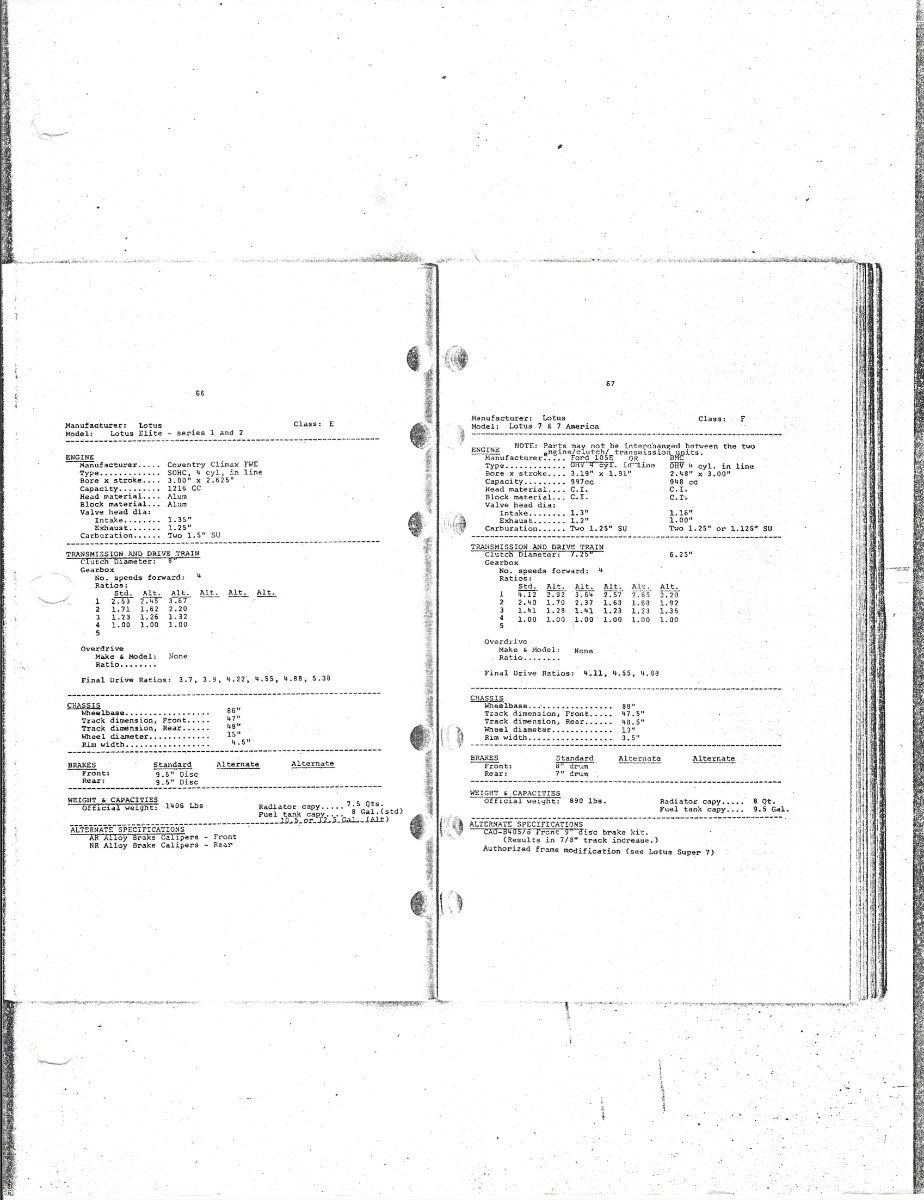
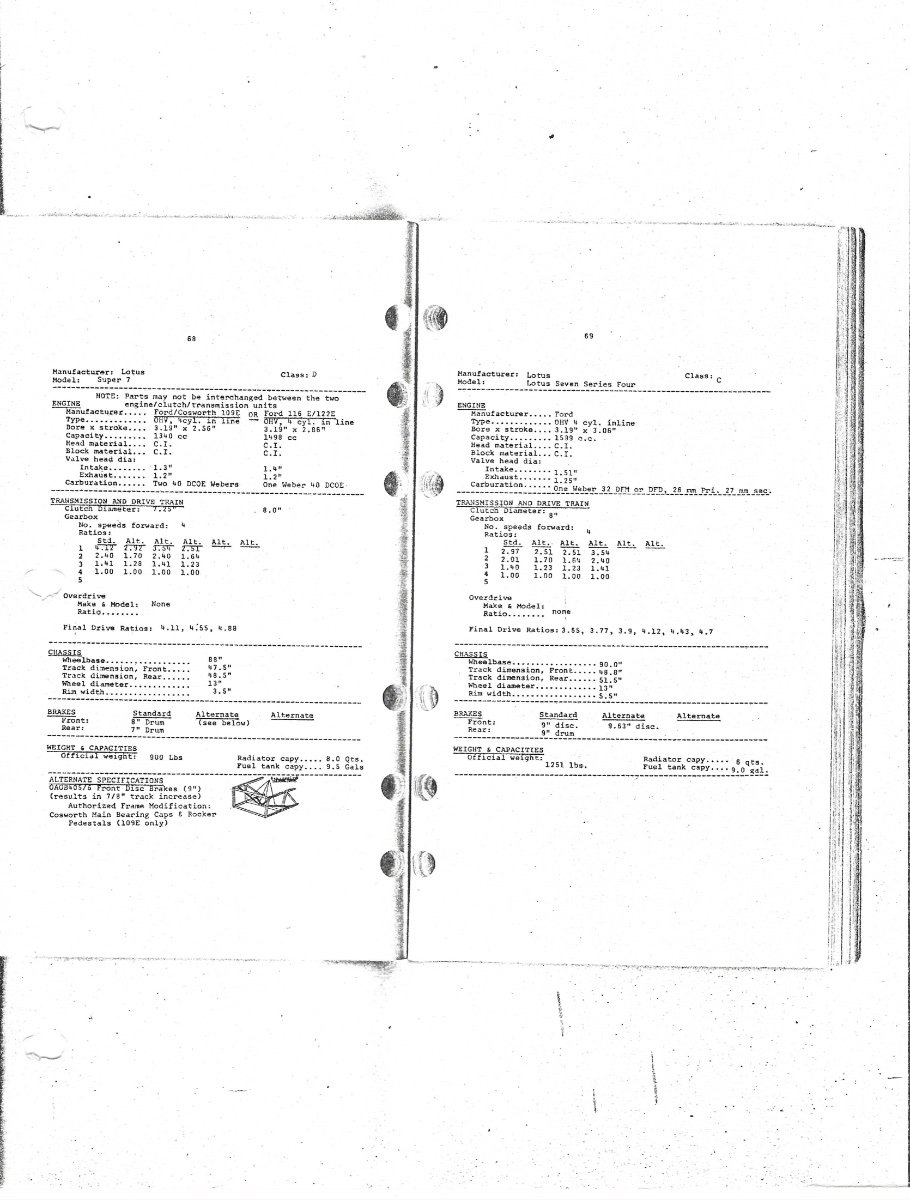
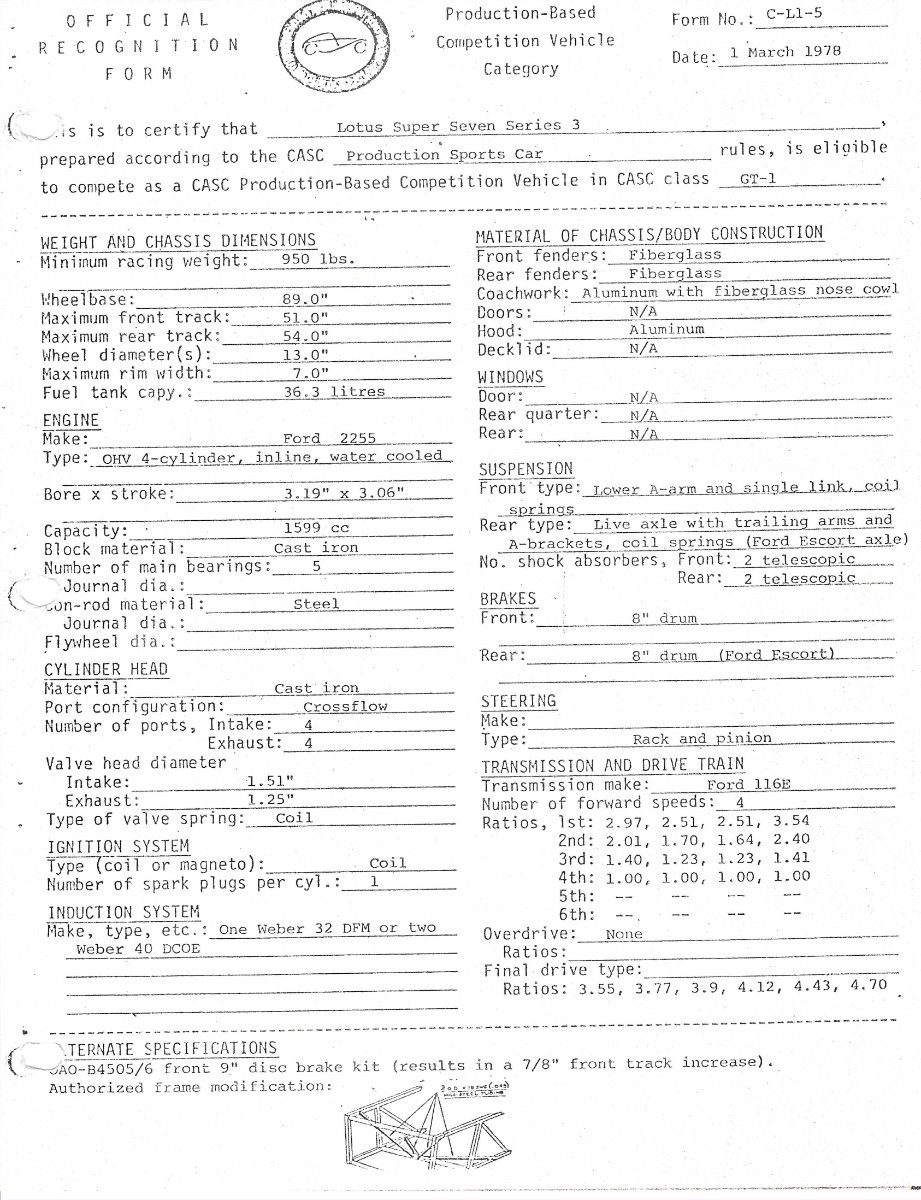
Hi Tim. I found these pages in my notes from when I purchased my car. The second owner had raced the car in Canada. The first 2 pages were from a 'black book' but not sure if it was SCCA or CASC (Canadian Automobile Sports Clubs 1958 - 1988). I have also included a page from the CASC dated 1978, which specifically details the Series 3, however you may note the error of the person/body/organizer who typed in the note that the front brakes specified for the 'Lotus Super Seven Series 3' were '8" drum' with a disc brake conversion as an option.. As front drums had not been used on a Lotus Seven for quite a number of years (and never were used on the Series 3), one can only conclude that they took the info from a very old spec. regarding the Series 1 or early Series 2 cars? Also, not sure if they 'borrowed' the specs from the SCCA? Forum members who race(d) in the older SCCA series may know if the smaller pages are in fact SCCA or possibly CASC specifications? Will. And a P.S. Tim. I hope you won't require a magnifying glass to read the specifications? They are from a very old photocopy from the early 1970s.

-
Looking for bellhousing for twincam/crossflow
EdWills replied to Healeyracer's topic in General Sevens Discussion
Hello Henry. Thank you for all the info. I noted that the same Elan forum also contained a comparison between the 105E and 113E bellhousing ('Difference between 105E and 113E bellhousing') which also shows the factory machined clearance in a 105E unit. As @MV8 advised, it would be a good idea to check the clearances just for peace of mind. On another note, I just received an ad from 'Absolute Lotus' magazine. Although I don't subscribe, I purchased some back editions and they placed me on their list. In the 2026 edition, there is a story of a 90 year old Lotus Elan driver who still competes in hillclimbs (but thinking of hanging up his overalls?). Oh to be young again! Also sad to hear about Chris Rea noted in another post on this forum. Merry Christmas to all, and a Safe and Prosperous New Year. Cheers. W. -
Looking for bellhousing for twincam/crossflow
EdWills replied to Healeyracer's topic in General Sevens Discussion
Hello Henry. I still can't find the article on the Twin Cam bellhousing, but I did find some interesting perspectives on which type is suggested for use on https://forums.lotuselan.net Two contributors, '2cams70' and 'promotor' (under the heading '4 speed bellhousing') provide details on the Ford bellhousing part numbers. '2cams70' advised that some 105E bellhousings he had seen were professionally machined internally (by Ford?) for clearance for the slightly larger twin cam flywheel and clutch. The bellhousing was apparently given a different part number by Ford (not necessarily a different casting number?) due to the machining process. W. -
Looking for bellhousing for twincam/crossflow
EdWills replied to Healeyracer's topic in General Sevens Discussion
Just to confirm what Henry @SENC has noted, the Twin Cam flywheel and clutch may fit in the 105E bell-housing, but an article that I am still searching for, advised that it may be a tight fit, and there may be clearance problems inside the bell-housing. The Twin Cam clutch was an 8 inch diameter unit, but Burton Power advise that the flywheels they sell for the Twin Cam and BDA are for an 8-1/2" diameter clutch? David Vizard in one of his books on the Escort advises that if you wish to upgrade to a Twin Cam in one of these cars, then the appropriate clutch, flywheel and bell-housing are required. He provides the original Ford part numbers for his suggestion, but I do not know if they are still current? As @7Westfield advised, Burton will sell you an alloy bell-housing that is noted to accept the clutch and flywheel for the Pinto, Twin Cam and Crossflow (7.5 inch diameter clutch.), but not cheap. W. -
Lotus Seven Frame and Chassis Numbers
EdWills replied to EdWills's topic in General Sevens Discussion
Hello Henry. I contacted my pal who updates the web site, and he will add a postscript to my article that provides information on J.W.s site in the U.K. Thanks for suggesting it. Cheers, W. -
Lotus Seven Frame and Chassis Numbers
EdWills replied to EdWills's topic in General Sevens Discussion
Hello Henry and forum members above. Many thanks for the compliment. John Watson provided a lot of information to me for the article, I didn't want to duplicate (copy) other information he has previously provided on his web site, so I noted his site in the reference section. On reflection, I should have mentioned where to find this info! John's 'Lotus Seven Register' has a couple of photos that show the possible location(s) where the frame identification is stamped by the frame contractor. They are shown by clicking the 'register page' and scrolling down. J.W. does advise that the frame identifier letter/number can be in various locations depending on when the frame was constructed, but there is no mention if Lotus (or the frame builder) ever recorded exactly where they would be located. Lotus fitters similarly seem to have riveted the Lotus plate in different orientations to fit around the heater for example, but in all of the photos I have seen, on the flat horizontal aluminium sheet in front of the scuttle. Which side of the flat panel would depend on whether it was a l.h.d. or r.h.d. car. It does appear that the 1" angled steel bracket - that holds the front of the brake and clutch master cylinders alloy bracket - was the location used by Universal Radiators, but J.W. also shows another location on older cars produced by Progress Chassis. I am guessing, and this is only my guess, that the angled bracket would be easier to stamp before being welded on to the frame. Similarly, the plate that John refers to as being welded on to the frames constructed by Progress, would be pre-stamped. It really wouldn't matter what order the frames came off the production line, as the mis-match in frame builder letter/number combinations to the Lotus chassis number combinations reveal. Some may be very close to each other, some hundreds of numbers apart. I have only found one Lotus Seven so far that had the exact same builders i.d. number to the number on the Lotus plate. And just to throw another bit of confusion into the mix, John advised me that the last Lotus Seven Series 3s to be produced were SB2649 a, b, and c. I queried this, but it seems that as Lotus was at the end of the Series 3 line, someone at Lotus involved with the Series 4, decided (insisted?) that the Series 4 (or IV) should start with the chassis number of '2650'. With three Series 3 chassis waiting for completion, they were given the numbers SB2649a, SB2649b, and SB2649c. Not sure how this was viewed by the U.K. vehicle licensing office, but it must have been accepted, as they are fully recorded as individual cars in the Lotus factory records that J.W. has, and were registered for the road. W. -
For Lotus Seven owners or prospective purchasers of a Lotus Seven, I have added a section "Lotus Seven Frame and Chassis Numbers" on https://anglocanadianlotus7.ca dealing with frame and chassis numbers, plus the estimated numbers of cars built. The article was written with the help of John Watson of the Lotus Seven Register, plus a few recommended books. John Watson has detailed on his Lotus Seven Registry the locations on the Lotus Seven frame where the frame constructor stamped their build number, before bodywork was added by another company, with Lotus then riveting their aluminium chassis plate with their serial number on to the flat scuttle area. Hope it is of assistance. W
-
Just rechecked the Burton Power web site, and the 2025/26 catalogue is free with free delivery world-wide (Just ordered one. I have no connection to this company, but have sourced many parts from them in the past). A download version of the catalogue is available at https://burtonpower.com and on pages 114 and 115 there are colour photos of each Ford transmission with parts list and details of each. W
-
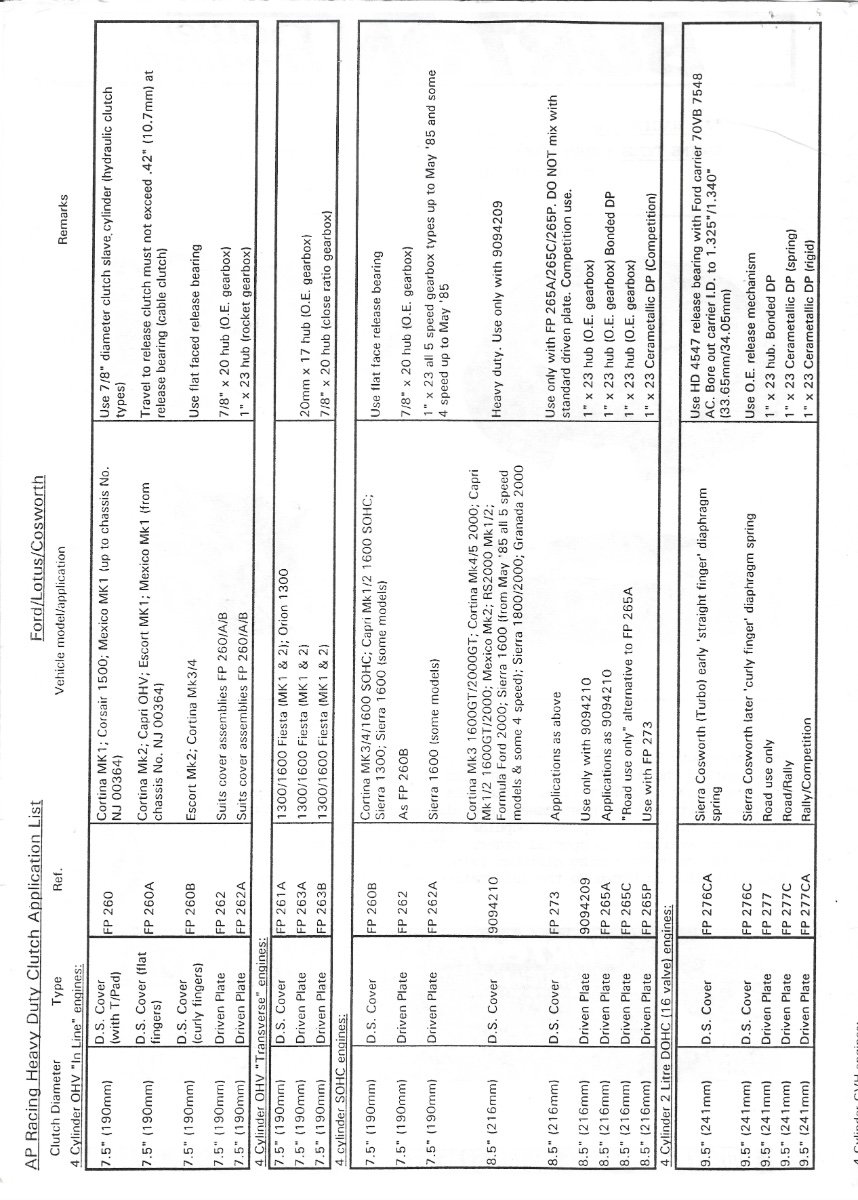
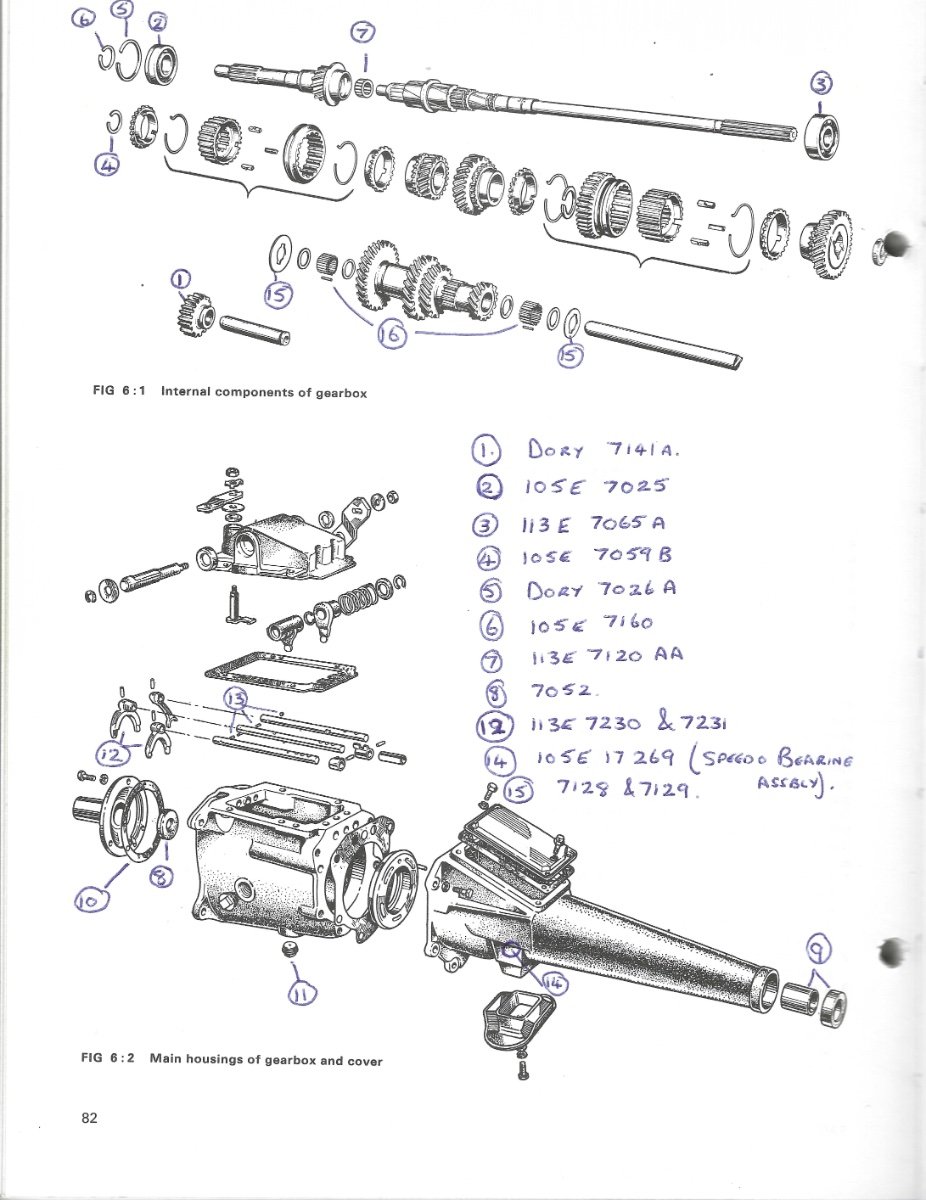
Hi CHristopher. According to author Paul Davies who wrote a book for Cars and Car Conversions titled "Tuning Four Cylinder Fords" (published 1971), quote: 'First all-syncro box was that fitted to the 1200cc Anglia Super and the 1200 Mk 1 Cortina. Apart from the advantage of having a syncro first, this unit should be regarded in the same light as the 105E/109E boxes (my note - no syncro on first on these earlier boxes) having ratios unsuitable for spirited motoring. In this same form this box was also used in the 1500 Cortina, Classic and Corsair models, and - initially - in the GT versions with the addition of a remote change" (remote change part 113E). He also notes: "Ford Performance Centre (as it was then) marketed a special kit which provided uprated 1st, 2nd and 3rd cogs for the 1500 GT casings." These were later incorporated into the 'new' (for 1967) box known 'incorrectly' (Mr. Davies' words) as the 2000E box (actual 2821E). The 2821E was later fitment into some 1969 manufactured Lotus Seven Series 3 models as supplies of the 116E dried up, plus the Seven Series 4 and Elan. The Lotus Cortina Mk 1 received an ultra close ratio box which Mr. Davies noted proved a little unsuitable for everyday use. In the Lotus Seven Owners Manual, Lotus refers to the 116E as an engine and gearbox combination. Christopher, I mentioned to you once before about Burton Performance in the U.K. I realize with the ongoing tariff situation that importing from the U.K. has become overly expensive, but Burton does have good reference material for clutch and gearbox combinations. The 1 inch 23 spline you note was used with the 'Type E' Rocket Box' (single rail operation - as used on the European Ford Taunus and others?). The original equipment gearboxes used the 7/8" x 20 hub according to Burton. I will attach a page from their old print-out regarding AP clutches (these original AP clutches may not be available now, but replacements are), which may help decipher the combinations. If you think it will be useful, a copy of the latest Burton catalogue may be very helpful to you, or just check on-line https://burtonpower.com Only cost for the catalogue will be postage (no tariff charge). It details the full range of gearboxes produced for the U.K. and European markets with all the necessary accessories noted. I have also added a page from the Autopress Ltd Ford Cortina 1967/68 manual where I noted the parts required for my 116E box rebuild as fitted to my 1969 reg. (built in 1968) Series 3. I am guessing that these parts have been unavailable for some time?. Cheers, W.
-
Maybe check with your health professional?
-
A GPS tracker is a great idea for expensive equipment such as a trailer. A neighbour of mine around the block, had his utility trailer stolen from his front driveway during the night. The thief had to drag it out onto the street backwards in order to attach it to the get-away vehicle. Unfortunately, no one heard the probable racket, even the owner. He was able to track the trailer to a trailer storage yard, and the yard owner found it hidden in the back of the lot. An employee of the yard was charged with the theft. Presumably the thief hoped to store it for a while, with no one at the yard noticing, and then sell it on. W