
EdWills
-
Posts
275 -
Joined
Content Type
Profiles
Forums
Store
Articles
Gallery
Events
Library
Everything posted by EdWills
-
Hi Scott. Most of the LHD and RHD Series 3 cars that I have seen were fitted by Lotus with the amber Lucas L691 signal lights mounted on a bracket fitted directly under the headlamps (as per mine and other Series 3 Sevens that were imported into the city where I live). Lotus attached the amber signal lamps to the side of the nose cone on the 13 or so Twin-Cam cars (all RHD except 1), and possibly some owners chose to do the same? Photos on https://simplesevens.org will show how Series 1, 2 and 3 cars are equipped. Also Tony Weale has a number of photos of how the lamps were mounted. (see page 111 for example of a Series 3 RHD). My scuttle came from Arch after the Caterham take-over (I have no photos of my original unit unfortunately), so possibly Arch may have followed suggested aircraft practice and placed the pop rivets at the recommended spacing (roughly 1 inch apart for a 5/32 inch rivet @MV8?). I don't think that Lotus were practising 'add lightness' by only providing 23,24, or 25 rivets on Timothy's or your scuttle Scott, but maybe cutting costs because, as noted, the scuttle is not structural? Also, if an owner wishes to keep the firewall and scuttle in one piece, it does make it stronger to handle to remove and replace and it keeps its shape better this way to avoid having it buckle. Only the hole above where the steering column slot is located needs to be modified to join the two up. (see: 'where can I get a Series 2 nose cone by @Bill. His scuttle appears to have the modification I am referring to). In any event, to remove the scuttle without a firewall attached, you still have to unbolt it from the frame, and remove the wiper mechanisms. With a scuttle that is kept intact, the choke cable also comes off with the scuttle, after unbolting the end from the carb(s). So naturally, whatever works best for you. Cheers, W. Just a P.S. Just read an article from the 1980s by a Lotus Seven racer in the U.S. He described the twisting that an original (unmodified) Lotus Seven Series 2 frame goes through in a race situation, and the stresses placed on the frame, ally body, and rivets. I would have to defer to @MV8 to advise if Arch - with my scuttle at least - were trying to make this body part more structural? With double the amount of rivets than required by Lotus, double bolt and nut fixing on each side of the chassis, and a strong channel piece to cover the area of the scuttle that bolts to the frame, possibly Arch have attempted to provide some structural support to the top of the chassis. I wonder though, how much extra it would provide? W.
-
Hi Timothy. I think I see what you have done. My scuttle has 47 Monel rivets (spaced at approximately 1 inch apart) that connect the vertical firewall panel to the 'U' shaped scuttle front. Each rivet has a steel washer fitted (on the opposite side of the sheets to the domed head) that the pulled stem of the rivet sits against. The scuttle is not a structural component, but where ally to ally is riveted together, a washer on the opposite side to the domed head of the rivet of the 2 pieces to be joined is good practice, and Lotus and Arch seem to have followed this method in most instances. This is the same practice used by Lotus for the structural floor under-tray and prop shaft tunnel riveting method. The vertical firewall also has the starter solenoid installed, and the choke cable pokes out of a hole beside the solenoid unit. The battery clamp shown in the pic. for the Exide battery was used on some Series 2 models and more so on the Series 3. The vertical firewall slots into a 'U' shape formed in the horizontal firewall panel that the battery sits on. My appreciation to John Watson for the photo of a LHD Series 3 Seven engine compartment. In this rather grainy photo reproduced from a Lotus ad, there are quite a lot of rivets on the scuttle firewall. W

-
Hi Timothy. Just my take on this, but if I understand it correctly, you are referring to the scuttle - which is the shaped aluminum section that holds the windscreen and the wiper mechanisms and wiper arms/blades? I see that your scuttle does not have a flat aluminum firewall sheet permanently riveted to the front of the scuttle as designed by Lotus. Lotus did not intend the scuttle to be riveted or held to the top of the dash tube by any means. On most? Unirad constructed Series 2 and Series 3 chassis frames, it was held on to the top of the chassis using 1 threaded bolt welded into the top of the frame. The scuttle was then held in place by a washer and captive nut either side. Later Arch frames incorporated 2 bolts either side, and Arch/Caterham specified a metal channel section to fit over the bottom section of the scuttle to snug it down over the studs and on to the frame using 4 washers and 4 captive nuts. Some owners discovered that the hole in the scuttle through which the oil pressure tube, water temperature mechanism, and speedometer cable (at least as applied to my l.h.d. 1969 Series 3 Unirad built Seven), just above where the steering column exits, caused problems when the scuttle had to be removed. The scuttle was modified by some owners to join the steering column slot to the hole therefore allowing the scuttle to be removed more easily without disturbing the 3 gauge connections. A rubber grommet would still be used on the 3 connections, but would easily slide out of the slot as necessary. The only other items to be unbolted from the scuttle for removal would be the wiper blade mechanisms with their tubes still attached. Many scuttles have press studs riveted or bolted into the scuttle to allow the tonneau cover to be attached, but - as relating to my frame - they were not attached to the dash tubes. I have found that my replacement scuttle does sit a tad too high when loosely placed on my frame, but when bolted tightly with the windshield unit in place, it should sit correctly on top of the curved dash tube. Best. W.
-
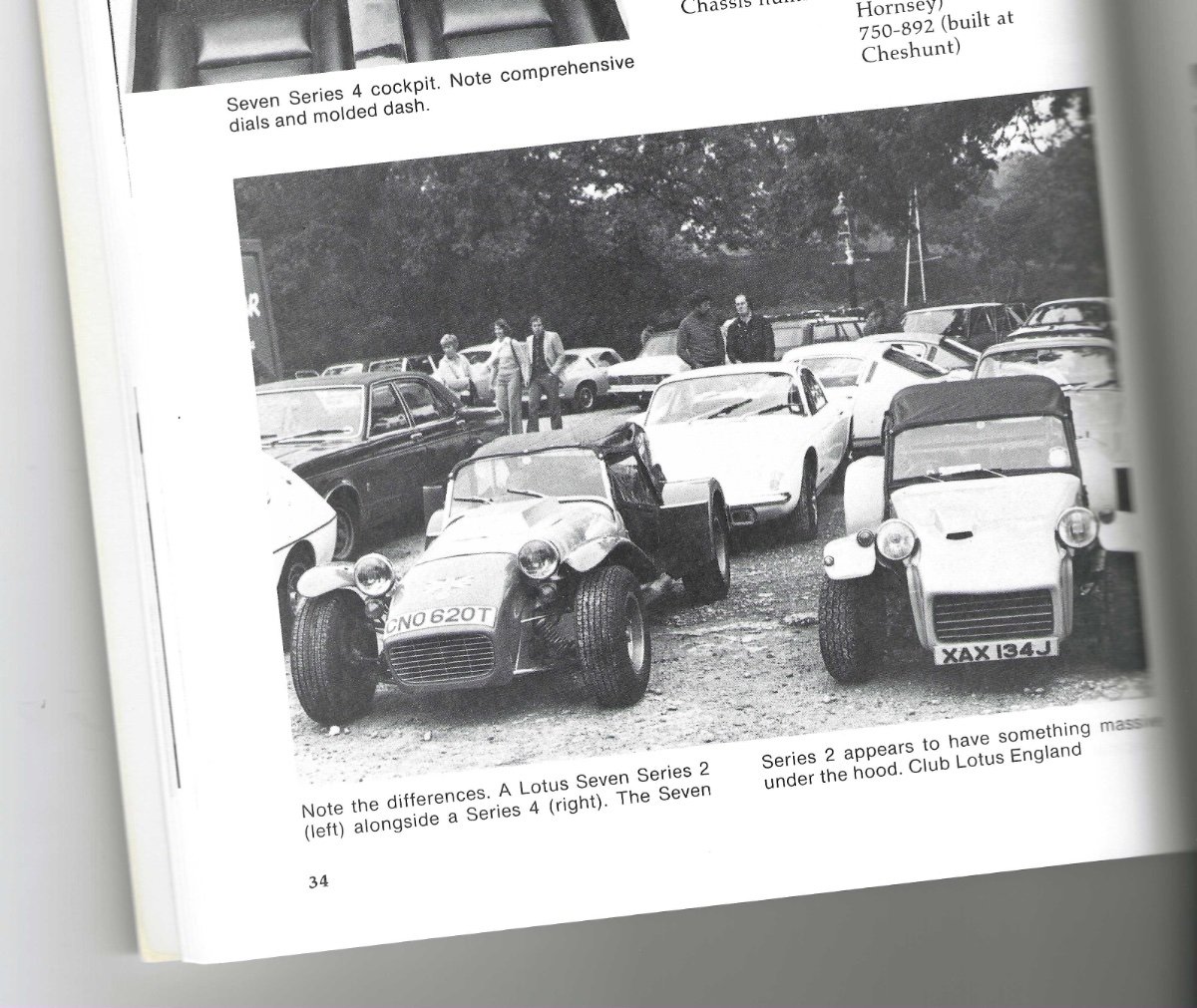
The attached photo (apologies for the lousy angle, the book kept sliding out of the printer!) shows a 1979 registered (U.K.) Caterham 7 (the nose cone looks Caterham not Lotus) fitted with a large square scoop, probably covering a V8? From the book 'Illustrated Lotus Buyer's Guide' by Graham Arnold (published 1986). He describes the car as a 'Lotus Seven Series 2', but it appears to be a modified Caterham.
-
Hello Christopher. Apologies, but perhaps this ties in with @pethier's unnatural act above?
-
Not sure if this will be helpful and save you a bit of cash, but many years ago a company in the U.K. - John Aley - used to manufacture custom roll bars for many British saloon and open cockpit racing cars. For taller drivers, he would add a curved bar on top of the 'standard'** shape type of roll bar, to cover the driver's head and helmet. I have searched the web, but cannot find any photos of this or any in my collection unfortunately (apparently Aley closed after the death of John Aley - although Rimmer U.K. carry a couple of his examples). The radius of the additional tubing was quite large and not a hoop as such more a 'bump' added on to the existing bar top. Not sure how the roll bar fitted to the Seven shown below passed scrutiny, but in the 60s and 70s from other photos available, roll (over) bars hardly ever protected the top of a driver's head and helmet, often ending below the top of the helmet (even F1, F2 and F3, etc.). W Apologies for the rather crude addition to the drawing, but this is how Aley modified some custom bars.
-
The spec. pages for both the Cosworth BDR engine, and the many parts that Holbay Engineering sold for their engines is now listed under 'Technical' on the website: https://anglocanadianlotus7.ca I am advised that it is in both jpeg and pdf format for free download if it is of interest. JohnCh has been advised, and it may end up in the library. The Cosworth sheets are spoken for and will be on their way to a BDR 7 owner. W.
-
Hi Scott. The son of a friend of ours here in Canada worked for Cosworth in California when the company had a facility there. His mother went through a lot of challenges to get him a green card (had to hire an immigration lawyer), as merely using 'auto mechanic' or 'auto technician' didn't separate him from all of the other men and women in the same occupation. He had originally been hired by Toyota to build racing engines, and finally moved to Indianapolis where he opened his own machine shop building engines for the truck racing category. He suffered a fatal heart attack and his business folded. He provided me with a lot of engine build tips, which I still have in my collection, although I would prefer to leave engine building to the professionals as twice is enough for me (Honda 250cc m/c engine, and Triumph Herald!). W
-
For Canadian 7 owners and just to confirm what many of you may already know, but Aircraft Spruce Canada (Brantford, Ontario) carries all of the same quality hardware that Pegasus in the U.S. carries, at the same or lower list price, but in Canadian Dollars. I like Pegasus, but with the exchange rate between us and the U.S. making it more expensive to purchase hardware for our cars from our neighbour, buying from Aircraft Spruce in Canada is a win-win. I had to wait a few days until some special lock nuts came in to Canada from the U.S. warehouse (so that my order would arrive in one package), but the price was lower than Pegasus, and the shipping by Loomis ground was cheaper than shipping from the U.S. and naturally in $CDN.W
-
- 2
-

-
Just an update. As the BDR is not applicable to a Lotus constructed car, I have finally been able to successfully scan all 18 pages and sent a note to @Croc and @JohnCh for their approval to add the pages to the forum library (the first attempt at scanning probably ended up in the ozone, as I still cannot find them on my computer.!). I will still add the Holbay parts list to my website as time allows. Chris Rees in 'Caterham Sevens' advised that "480 BDR engines have been built to date, and only two remained unfitted to cars at the time of writing (note: my copy published 1996); 331 were 1700s, the remaining 149 being 1600s. Some 400 Cosworths went to Japan" (page 77 in your hymn book). The 1987 Cosworth parts list that I have only mentions the 1600 cc version (1601 cc actual) but in 120, 150, 160 and 170 BHP tune. Rees mentioned weeping cylinder head gaskets, comparatively temperamental running, and carburettor flat-spots (plus being a very expensive engine). As far as effort goes, I've curtailed the riveting on my chassis, and packed up all the tools for the fall and winter. Snow expected this weekend (0 deg. C) + no heated garage! Oh well. W
-
If I'm going to scan 18 pages, I may as well have them added to my website along with the information from Holbay with all of the original parts they offered. I have found a way into my HP printer via a 'back door'. It's slow, but it seems to work so far. The pages are U.K. sized paper, which is longer than North American standard, but just fits on my printer platten. I didn't realize that there was interest in the BDR. According to a Caterham book, there were not that many produced, but some must have made it 'over the pond' to North America. I also do not know if any/many of the parts listed are available anymore? Same with Holbay.? Will advise, and you can then download whatever info. is of use to you. W
-
Hello @wdb. Unfortunately my HP printer/scanner has not kept up with my iMac updates - even with the assistance of HP technical help line, and so I am looking at purchasing a new one. I have received a request from a BDR owner, and the 18 pages of assembly data will be sent to him. If he wishes, perhaps he can add them to this site? Cheers. W.
-
Does anyone on this forum have a Caterham fitted with a Cosworth BDR engine? If so, I have a full set of spec. sheets from 1987 sent to me by Cosworth, that are available free - if you don't mind paying postage (at the lowest rate available from Canada)? Unfortunately, there is a postal strike going on here, but I just thought that I would put the offer out to see if there are any BDR engined cars in North America prior to the strike being settled. You can buzz me a message if you are interested. W.
-
Hi Scott. I was checking out the Holden Vintage (U.K.) web site, and they sell this type of mirror and also variations with curved stem etc. If you can get them to send as noted in another forum, you may not have to pay too much to import them? W.
-
Burton Power U.K. sells a brand new 701M 1500cc Lotus block with the same specs. as the 1600cc block as sold by Ivey, Pegasus, BAT etc. Part No. FL105. 7.8" deck height, bores semi finished to 3.228", 40,000 PSI grey iron, includes cam bearings, upper and lower thrust washer on centre main, etc. L3000.00 Pounds Sterling without tax for export (L3600.00 Sterling in the U.K.) Produced by Ford Racing. With tariffs added on, won't be cheap, but it is available brand new, and stronger than original. Perhaps Ivey or Pegasus can bring one in for you Craig? W
-
Are there many Lotus produced Seven owners on this forum?
EdWills replied to EdWills's topic in General Sevens Discussion
@craig chima. I like the way you have engineered the top suspension link. With your racing rules, are suspension, tires and engine modifications all free choice? W -
Are there many Lotus produced Seven owners on this forum?
EdWills replied to EdWills's topic in General Sevens Discussion
@MV8 I have the same page and totally agree with you. It shows 'Seven Ser. 1 as 93 F, 65 R'. 'Seven Ser. 2 as 95F 54 R.' I also have a 'blow-up' of the page, and the 'Rate 105 in' is actually "RATE lbs in.' The lbs has been lazily written and on my copy is a tad blurred and looks a lot like 105. However, a page from the Armstrong catalogue that was sent to me by one of the members of this forum notes: "Mark 7 Series 1 up to C/No. 1000 1959 - 60, spring rate lbs/inch is 93 front , 65 rear". "Mark 7 Series II and Super 7 1960 the spring rate lbs/inch is 95 front, 50 rear" Tony Weale advised in the appendix to his book that the Series 1 used the same Spax damper and spring combination as the Series 2 and 3 on the front of the car. In an article from a 'Motor Sport' magazine (U.K.), Caterham raced an early Seven built by them and the rate was 105F/75R, but the springs sagged due to manufacturing errors. They then tried 90F/70 R. These spring rates were controlled by rules in the British 1980 Prodsports Championship. The same article advised that for a road-going Caterham 7 (1980-81) fitted with an Ital axle, the rates were 100 F/ 55 R. Later in Series 2 production (and later copied for Series 3), Mick Lincoln, former co-director at Redline, advised me that Lotus changed their specifications to 105 front, 75 rear as standard. DSK (U.S.) used to offer street springs rated at 85F/60 R. Their auto cross springs were 125F/90R. Tom Robertson used 140F, 100R. on his Series 2 race car (1977). Dave Bean recommended 115F/75 rear for standard road use. Mick Beveridge, formerly of Xtra Special Sevens (U.K.), liked 125/11" free length F, with 80/14" free length R. on his road cars, but noted that most companies in the U.K. don't make the 80s, so he went to 100 lbs/inch with 14 inch free length. W. -
Are there many Lotus produced Seven owners on this forum?
EdWills replied to EdWills's topic in General Sevens Discussion
Hi Scott. I think the magazine writer also got the spring rate numbers for the basic Seven Series 2 and 3 wrong. They were originally 105lbs on the front and 75lbs on the rear (o.k. we'll give them 80!) @SENC very kindly sent me a list of Armstrong dampers and springs a while back from an old catalogue. Not sure if they are in the library though? W. My wife thinks that I am lotus intolerant. I think she meant to say lactose, but either way seems to fit! -
Are there many Lotus produced Seven owners on this forum?
EdWills replied to EdWills's topic in General Sevens Discussion
If you can purchase a copy of the late Dennis Ortenburger's book "Legend of the Lotus Seven" (or perhaps you have one already?) he has a chapter on some racing Sevens and their owners in the U.S., one of them being Tom Robertson who ran a Series 2. His Seven had fairly soft springing, beefed up chassis frame, spherical joints on suspension arms, Spitfire diff. nose piece and TR7 axles. The engine was the 116E over-bored with dry-sump. He also used adjustable anti-roll bars front and rear as @craig chima recommends. Robertson was able to make use of Goodyear Formula Ford tires, which heavier cars could not use. He beat the works Triumph TR7 team to take the Class 'D' Championship (1977) even after an appeal was launched by Triumph over the use of the nose piece. Ortenburger features other U.S. racing Sevens in his book, and I wonder where they are now? Reading stories out of the U.K. and the U.S., it reveals that the Lotus Seven has often (always?) been placed at a deliberate disadvantage by being classed in racing categories with cars that were way over the top in terms of power and engine capacity. Even so, the Lotus Seven gave them a run for their money. It probably gave Colin Chapman a good chuckle too, even though he had really lost interest in the car. Thank you Craig for all the information.. -
Are there many Lotus produced Seven owners on this forum?
EdWills replied to EdWills's topic in General Sevens Discussion
Thank you @panamericano for the attachment. That's a great looking Seven and Craig's hints at improving a race car are invaluable.. I enjoy reading Classic Motorsports magazine, and they have featured Lotus Sevens in the past. Craig Chima has built and raced some very successful Lotus Seven based cars in the past, and is selling or sold a couple of them on (see https://simplesevens.org) for details on these cars along with his racing successes). Thank you to those who submitted their Lotus Seven serial numbers. I will add them to my list. There is also a Lotus Seven owner in the U.K. who has purchased a few Lotus Sevens from the U.S., and shipped them back to the U.K. for refreshing or rebuilding. The Historic Lotus Register (U.K.) has featured some of this gent's cars. Cheers, W. -
Thanks all. It's not really a problem, but the Unirad built Lotus Seven chassis, and the Arch built Lotus Seven chassis have slightly different ways to mount the handbrake (along with a few other frame differences). I have a replacement Arch built Seven space-frame that replaced my original damaged Unirad frame. On the Arch frame, 2 bolts are required - 1 of 7/16" x 2-1/4" long, and 1 of 1/4" x 2-3/4" long (per Tony Weale). They go right through the flat panel that the scuttle slots into, and the heads sit just beside the battery mount. If memory serves, the Unirad chassis had a solid boss with a groove machined in the end, which was welded into the square tube, the handbrake fit over it, and was then secured by a circlip. The 1/4" bolt for the ratchet plate also did not go all the way through, but threaded into a blind tapped bush welded into the frame tube. No big deal, but the Unirad method was possibly a cleaner way to mount the handbrake? W
-
Are there many Lotus produced Seven owners on this forum?
EdWills replied to EdWills's topic in General Sevens Discussion
I think that @slngsht did a great job of creating this site, and I realize of course that it's specifically called 'USA7s' to cover all of the models that have copied the Lotus Seven in appearance, and not just the marque produced by Lotus. Even the Lotus and Caterham 7 Club U.K. have moved on from when I joined. At that time the editor and some of his staff owned and raced their Lotus Sevens. For unknown reasons, they were ousted from their positions on the magazine, and then the club evolved more and more to predominantly cover Caterham produced cars. As I believe you may be aware John, I started contributing to John Donohoe's web site and then with more information piling in, I started my own web site to give J.D. a break, dedicating the site to just the Lotus Seven, which is still accessible on Simple Sevens. I have "spread the word" as much as I can with my limited resources and minimal knowledge of computers. I still keep in touch with JD, John Watson, and other Lotus Seven owners, technicians and designers as time allows. I have received requests for information on USA7s by private message regarding parts and fixes specifically for the Lotus Seven, and I have also used this method to gain information from other Lotus owners. I like this site as there are professional engineers, technicians - some still working and some retired, who provide excellent advice and feed back on many automotive topics that cover many of the various cars that look like a Lotus Seven. Also, the pictures and drawings are really valuable as sometimes just a written description of a process doesn't always become clear. My comment was merely that the number of owners of Lotus Sevens that were on this forum years ago (2014 for example), have possibly (question mark) not continued with their posts, have perhaps sold their cars, or have no need to post. You may note that one poster above has been wondering the same thing as I have. No biggy, and I'm not trying to make any waves, bellyache about it, or change the format. I think we can agree that Caterham built cars do appear to be the most popular for questions and answers on this forum, and it's how it should be as they are in the majority. If I have missed your point John, my apologies. Cheers, W. -
Are there many Lotus produced Seven owners on this forum?
EdWills replied to EdWills's topic in General Sevens Discussion
Very good to hear, thank you. I am not sure how your and my information can be tabulated, and how it can be used to perhaps give a heads up to prospective purchasers of any type of Lotus Seven considering privacy concerns? I feel that I need to contact John Watson in the U.K., to see how he disseminates the information he obtained from the Lotus factory regarding Seven production, which he uses to provide confirmation of a genuine Seven to interested buyers. For some reason, he didn't have the information on my car until I forwarded it to him. I had received the history of my car direct from Lotus. W -
Are there many Lotus produced Seven owners on this forum?
EdWills replied to EdWills's topic in General Sevens Discussion
In 1992, a very considerate Lotus Seven owner in New York - who had started a Lotus Seven Registry detailing North American Sevens only, decided to relinquish his entire collection, including a couple of magazines that he had produced, and sent them to me free of charge. Along with his list, my list of Canadian Series 2 and 3 Lotus Sevens (collected in the early 1980s), listings from 'Bring a Trailer', plus magazines, as well as six Lotus Sevens with serial numbers provided on this forum from 2014, I have a total of 155 Lotus Seven Series 1,2,3, and 4 Cars recorded in the U.S. and Canada to date. Some have full specifications and some just partial information (name and Lotus build number only) provided by the owner. Some may now have been exported back to the U.K., and some to Europe from N. America. The list also includes 16 early Caterham 7 cars in N. America, with Caterham and Arch numbers provided. Note: I do not make the list public, it is just for my interest in order to see how many Lotus Sevens may have survived. John Donohoe on his Simple Sevens site, currently lists Lotus Sevens where owners have provided the Lotus serial number along with their name - some with just a photo of their Seven, or full details of their cars in others. J.D. also provided further details on other Lotus Sevens in a C.D. that he made available for sale, and it contains even more Seven information along with owners' details and car serial numbers. There is a lotus@se7ens forum in the U.K., but there have been minimal postings since Covid struck, and there is no function to post photos or drawings unfortunately. The library on this U.K. forum - dedicated to Lotus Sevens only - is extensive, with information provided by Seven racers, technicians or just owners like myself. It is still available to join, and it worked very nicely side-by-side with USA7s, until posters unfortunately lost interest. There is also a forum that can be accessed from this same U.K. site for Caterham 7, Caterham 21, and other 7 lookalike owners. W -
I've been re-reading a book by Graham Arnold a former Director at Lotus in the 60s, 70s, and early 80s. Chapman fired him in 1971, and then Mr. Arnold was hired back from 1977 to 1981. Arnold notes: "Lotus cars were designed to make the biggest profit possible. The formula was quite simple. He (Chapman) took the materials and labor and multiplied them by a factor of 2.8 (which eventually increased to 3) to get the U.K. retail price. Cutting the material or component costs without reducing the retail price gave good extra profits. For example, I (Arnold) discovered that Ford had produced a semi-close-ratio gearbox for the Corsair 2000 in 1964. This, with the 3.7:1 differential could be bought to save $75 per car or return us an extra profit. Similar savings were used to stave off price increases. We acquired as many parts as possible from other manufacturers' parts bins, and frequently found their van parts costing less than car parts." Note: Regarding the cost of parts mentioned by Graham Arnold, it seems possible that van parts may have been cheaper for Lotus to purchase due to U.K. Govt. tax breaks on commercial vehicles as opposed to regular road passenger vehicles (example: the Seven and 11 handbrake?). Arnold: "Almost every year the company organized a campaign to "take pounds out of cars". Of course, we were talking about both pounds in weight and pounds sterling!" Mr. Arnold goes on to describe testing cars to their limit (on U.K. roads) until they almost - or did - fall apart. "One of our favourite money-saving ideas was to push the frontiers of other manufacturers' "overengineering," which meant a part built for a smaller car would be tested in a Lotus to see if it was sufficiently overengineered and understressed to give adequate life." W.