

SENC
-
Posts
749 -
Joined
Content Type
Profiles
Forums
Store
Articles
Gallery
Events
Library
Everything posted by SENC
-
@barbox - I appreciate your post and respect your comments, and though we'd likely continue to disagree on and debate specifics, I suspect we'd get along just fine having the same conversation over a beer (or 10). I suspect we're approaching the point of getting into circular discussions repeating covered ground, so will leave some final thoughts (from my perspective). That isn't to meant to shut down any further response you may have to them - just to say I'm not sure I'll have much more of value to add. Though I agree in general, I think this adds a lot of unnecessary work when there are (or should be) fairly universal definitions. The purpose of language is just that, for words to have common meaning so that communication occurs. When we accept/allow significantly varying definitions based on unique experiences or circumstances, we undermine the very purpose of language and words. I still shake my head at the Clinton response "It depends on what your definition of is is." Here we are in pretty solid alignment, with the caveat that (again) intent is critical. There are people with bad intentions - and we should have no qualms about calling that out. But we can only go there when we have clarity of intent (and not based on assumptions or poorly aligned definitions of words). I can't go here with you, there is too much room for interpretation and opinion. I mentioned desegregation earlier - specific to schools I don't think many would argue our schools are in bad shape and some would say the outcome has been predictable. Was desegregation wrong? I certainly don't think so, there are too many variables that have driven the outcomes - but forced bussing and resulting degradation of neighborhood schools are thought to have contributed to deteriotion of our education system (and, thus, have been reversed in many communities). I'd say we mis-diagnosed the problem (or part of it) and implemented a faulty (or just partial) solution before I'd define the action based on the outcome even though it may have been predictable to some. We may be missing each other entirely, as this is exactly what "-ist" words do... they are adjectives, adverbs, or even nouns. "-ist" words, by definition, define/describe people, things or actions. Here is the Oxford definition, for example, of racist: I should note that defining or describing is (or should be) quite different from judging (ascribing value), though the common definition of racist itself (whether adjective, adverb, or noun) does include an assumption/judgement call: "on the basis of..." I think this is exactly where overextending terms like racist, misogynist, homophobe, and genocide is problematic - their generally accepted definitions include judgements on intent (can't escape that word!). Using terms like bias and even prejudice largely (or at least somewhat) avoid this contamination and acknowledge underlying differences/intentions without connotation of intent. We'll both agree and disagree here. I'll agree fully that intent is irrelevant in terms of harm incurred. Officials should be held accountable for their actions regardless of intent. BUT, without understanding the root cause "why" there is no way to craft a solution that will prevent recurrence. Intent is a definitely potential root cause and shouldn't be either assumed or eliminated if we really want an effective solution. I won't go anywhere near applying a term such as racist to the Flint MI situation (nor did you, though I've heard it said) even though the outcome disproportionately impacted minorities as I have no reason to believe the actions taken were "on the basis of" race. Nor would I discount the possibility of racial motivation as a root cause without further investigation. My point is, we'd find a different way to prevent recurrence if the root cause was intent than we would if the root cause was negligence or ignorance or greed or just bad workmanship. So, we're back to the criticality of definition being commonly understood and accepted rather than specific to individuals. You may define racist or racism based on an outcome with no/zero intent implied ("on the basis of" eliminated). You are welcome to that personal definition, and if you tell me that is what you mean and then tell me in a personal conversation a behavior or action of mine is racist I'll be less offended (I can't say I won't be offended at all as the word carries too much historical baggage for me). But tell me that without clarifying your definition, or in a public space where I'm going to assume the generally accepted definition applies and I'll be highly offended and go on defensive or shut down entirely. I also think there is harm in diluting a term like racist by eliminating the intent component. There are absolutely racists (in the common definition of the term), and we shouldn't be ashamed of having or using the word as defined. David Duke comes immediately to mind as a person who has clearly admitted intent. Slavery in the US was clearly a racist action/state. Elimination of the Jewish race has been the clearly stated objective of multiple racist, genocidal leaders. The terms are applicable and valuable in those contexts, but when watered down to include people or actions that have similar but unintended impacts the words lose value. That isn't to say the impacts are better or worse or more/less important to be resolved, only that we've lost clarity and thus the ability to resolve them. Resolving a "racist" (traditionally defined) caused impact or outcome clarifies that the central cause of the outcome to be addressed is the racial motivation. On the other hand, resolving an impact or outcome that disproportionately affects a race MIGHT require addressing racial motivation, or it MIGHT require addressing something altogether different. Correlation is different than cause-effect. When we know intent is the cause we should attack it head-on and clearly defined words like "racist" assist in doing so - but when we don't know intent or use more ambigous or personally defined words that can be misinterpeted we risk causing new harm and we miss an opportunity to search for root cause and identify solutions that might actually work.

-
This one is a VERY interesting one, to me - and one which has definitely shifted over time and in a way I think is counterproductive. In my opinion and observation, we have trended towards using more "extreme" words for all things and lost more descriptive words that better capture nuance and "shades of gray". I recently read a pretty good article that captured many of my thoughts on this that I'll try to find and share, but I'll do my best on my own... I grew up in the midst of desegregation, just after the major Civil Rights movements and during the period where change was finally being implemented and catching hold at a mainstream level and not just talked about. To be sure, there was a lot of racism still in existence - I would posit significantly more than remains today (though I could only make that argument using generally accepted definitions of racism at that time). We would have defined racism along the intentional lines, where folks specifically and willfully treated folks differently based on skin color - and, frankly that was "racism light" (made up term) whereas "real" racists weren't just treating people differently but intentionally doing harm. I was fortunate to grow up in a family that was VERY anti-racist (by that definition), and the societal and educational models at the time focused on teaching that we should be blind to skin color differences. Of course, this was the lofty and worthy goal we were working towards, and I think most accepted it as a journey and not likely something ever to be fully achieved in our broken world. As such, with racism on one end of the spectrum and race blindness on the other end of the spectrum, there was a full continuum in between - and my generation was often challenged to look at and accept where we were on that continuum. Words like "prejudiced" described those who struggled with the idea that skin color was irrelevant but who didn't think negatively about those with other skin colors - and words like "biased" described those who had accepted the conceptual goal of skin-color blindness but also recognized biases they had (real or perceived) that sometimes resulted in actions with unintended consequences. In my opinion, this "individualistic" approach allowed for one-by-one self-definition and opened the door for dialogue between individuals and groups that promoted growth and development (generally, but not always, in the right direction). Today (again, my perception and opinion, so not infallible), we seem more focused on putting groups into either/or boxes with labels (racist, sexist, phobic, etc.) and no room for shades or individuals. Where I would say that I have shifted (consciously and intentionally) rather radically over the years from somewhat prejudiced to still-have-some-unconscious-biases and continuously shifting in the right direction (and, in my opinion, much more importantly having raised the next next generation to be much less skin color conscious), using the trending definitions of the moment (similar to the definition you proposed) I'd be called, simply, racist. I think this is highly damaging in a couple ways: first, without an anchored definition of racism, positive change/improvement in behaviors over time are lost due to the shifting definition (societal level damage as it gives the appearance nothing has changed, or even that things have worsened); and, second, individuals react negatively to being labeled and put in group boxes and tend to get defensive and shut down conversation, inhibiting growth and change. In my opinion, this is exactly what is causing the polarization of our society - sorting people as racist/non-racist, sexist/non-sexist, phobic/non-phobic, pro-life/pro-choice, etc., etc. Doing so eliminates any middle or common ground between the groups that once existed even between individuals with quite different viewpoints. I'll clarify here that I don't think this grouping/boxing/polarization is the sole domain of any one political party or group, but rather that plenty on both sides are guilty (Trump and Biden equally and similarly, to use our 2 most recent presidents as examples, are all too happy to label those who disagree with them on anything as kooks and crazies). So, to get back to your specific comments - I disagree wholeheartedly with a generic statement that outcomes matter more than intent when it comes to defining people or even actions. Changing outcomes is what we all hope to achieve - they are results of actions - and they are ultimately the measurement of change (positive or negative) - but they should not be used to define us. Actions (process) have limited value in defining us as people, as many of us have quite similar intent but have different opinions on how to achieve intended outcomes - nor should actions be defined by outcomes as not every outcome will be successful in a complex and multi-variate world. Maybe more obvious, outcomes are only known "after the fact" so using them for defining actions or people retrospectively adds zero value or opportunity for change, and carries the severe downside of castigating and demeaning the well-intentioned person or behavior. Rather, intent is THE critical piece, and the only one (IMO) that allows for civil dialogue and for positive change. Without it, I can't see how someone determines/evaluates actions/behaviors nor how they determine/evaluate change/progress. Sorry for the long note, but as you can see this idea of subjugating intent confounds me and gets me worked up.
-
@Bruce K I generally agree with the first 3/4 of your post (before you turn to Vlad), but I suspect you and I are from similar backgrounds and beliefs and/or had similar raising. I, too, think words have universal meanings (or at least should, if we are to use them for purposes of communication) - but as I've found with my kids (and bet my parents found with me, too, at least some extent), they shift more than I'd like. I suspect you'd join me in my complete frustration that words and sayings I've used with no (zero) ill intent have become taboo in today's world. I'd give some examples but suspect we'd all go off on tangents that wouldn't add to the conversation at hand. I also think your pet/dog comment is quite useful, in that it goes to another lesson I've learned over the years... that while words may be universal, tone of voice trumps definition. Who can argue that "good dog" is anything but positive? As you observe, the dog that hears it in an angry voice! As I've learned, this is a major issue with texts, emails, and forums - where tone is completely absent. Are someone's comments serious, joking, sarcastic, righteous, smart-ass? I have no real idea without tone unless they say so explicitly (or display in some other way, as with emojis). To the quarter of your post with which I struggle... I don't disagree with your truths about Saddam nor the child molester, and if I had to bet I'd guess Vlad would agree with them as well. As your Trump compliment is based on the fact that you find him (or find at least some things about him) praiseworthy, Vlad's suggest that either Vlad or someone somewhere thought highly of them, too. I think those are so far afield as to be absurd and incomprehensible. I, too, would have found Vlad's comments out of place and insulting if I thought for a second he was actually comparing you to either - but because both are so far out of the realm of any comparison to Trump, Biden, Obama, Bush, McConnell, Pelosi, insert your least favorite US politician here, I think I would find it hard to be seriously offended. I can't put myself fully in your shoes, but as I noted had a similar barb been targeted at me I'd have laughed and ignored it due to its absurdity. I'd put $100 on the table right now that Vlad's intent was not to insult you by actually comparing you to either... rather that it was a totally sarcastic (and hyperbolic) comment based solely on mimicking your defense of Trump as a compliment. I'm speculating that his tone changes the meaning of his words, just as and angrily voiced "good dog" means anything but good dog - and my indication of tone comes from the absurdity of the comparisons he used. He can certainly correct me if he meant ill.
-
Thanks for the response, Vlad. I'll take the time to go back and read initial comments and early responses again (I probably should have before commenting). More generally, your response reminded me of the freedom of speech components. If I'm remembering correctly, I think it was you who said, and I totally agree, that there is no guarantee of such freedom on a forum or other private place. The only "right" we have is that the government won't infringe upon freedom of speech - individuals and private groups can set whatever rules they like and we can choose to associate or not with those individuals and groups. That said, I appreciate that this forum seems to allow such freedom rather than shutting it down. Though I'll rarely jump into such conversations, I enjoy periodically reading then to get perspectives other than my own. One correction - that is all 1st amendment. Start messing with the 2nd amendment and I might get defensive!
-
I suspect this is the crux of many disagreements these days - the growing chasm between those who focus on intent and those who focus on perception. It's a conversation I have frequently with my (now adult) kids, as the "sticks and stones may break my bones but words will never hurt me" mentality I grew up with is definitely dinosaur material to the younger set who discount intent altogether. I'm trying to understand it but admittedly struggle. The discussions that prompted this breakout, I think, are at least somewhat reflective of this chasm (and I do see value in this discussion in improving understanding of the various perspectives). I, personally, find Trump repugnant - and have since I started following him in the mid/late 80s (when, parenthetically, he was considered a bit of a liberal favorite). Given my opinion of Trump, had Bruce directed his comment toward me I might have initially wondered whether he insulted me. Having said that, and notwithstanding my opinion of the man, I recognize that there are many people in this country who think extremely highly of him. And because my tendency is to look for intent when something strikes me funny, my considered response to Bruce would probably be along the lines of - "Bruce, your Trump reference doesn't hit me as the compliment you may have intended, but assuming you intended a compliment, thanks for the thought." It seems Croc got to a similar place. Had I been the target of Vlad's Hussein reference, given my focus on intent, I would have been left with a making a conclusion between 2 alternatives: 1 - he truly admires Hussein or 2 - he is making an absurd comparison. Because (unlike Trump) I know of absolutely no-one who actually admires Hussein, I'd have concluded the second intent - and, as a result, ignored the comment entirely as trolling and not worthy of a response. Perhaps, given Vlad's continued insistence he intended it as a compliment I might start leaning more towards believing he does actually admire Hussein (or some of his characteristics) as he claims - but that still seems so preposterous to me. Assuming Bruce has a similar tendency to prioritize intent as I do, it seems quite easy to understand how differently he sees his comments from Vlad's comments. I don't think I'd take offense though, because of the absurdity of them. Alternatively, as I consider how someone who focuses on how comments are perceived upon receipt (rather than intent), I can see how Vlad (and others) see no difference between the "compliments" and find Bruce's reactions to them inconsistent. Of course, by reaching my own conclusions about Bruce's and Vlad's comments based on my own knowledge and experience, I'm doing at least a little of the same. I guess the best response to each would simply be "What did you mean by that comment - compliment or insult?" And then to accept the response at face value. What I personally find even more interesting and confounding than any of the above (and so genuinely would love some insight), is that several to whom Bruce's initial comment were not directed felt called to respond. What drove that? Defense of Croc? Why? Did you know/think he would be offended and think him incapable of defending himself? Or did a comment towards someone else somehow strike you as offensive towards you or your sensibilities? Something else? I'm truly interested in gaining some understanding here, as I can't fathom injecting my thoughts/biases/reactions into a comment Bruce directed towards Croc, at least not before Croc responded. Maybe I need to go back and reread the initial comments again to see if they were more broadly targeted. While I may disagree with or take a different tack than Bruce about many things, I do agree there is value in sussing out different reactions to gain understanding. I very much appreciate that this forum and several others I enjoy, leave the door open for such discussion in a way that folks can choose to participate or not. I think the "zero tolerance" rules that have been enacted in so many places (online and in person) have had the opposite of their intended purpose and have created more triggers and polarization than they have eliminated. I appreciate diversity of opinion and civil debate, and think they add much greater potential for value than shutting down discussion.
-
To my knowledge, the heater was an option to be added. My 65 did not (and does not) have one.
-
And perhaps this is the reason for the swirlpot.
-
I think issue is that the swirlpot isn't designed for it. Found a picture that may help. To overcome this design, the PO had bored out the base plate of the swirlpot to allow for a t-stat, which I suspect caused the sealing problems.
-
Not disagreeing, Joe, but wouldn't the pump determine the speed? I know there is a problem that it doesn't pump much at all when the engine is idling, thus the need to put a few revs in it from time to time to keep water flowing and the engine cooling. I guess what you're describing could happen with continued high rpms where the pump is pushing water at maximum rate. Putting a t-stat or blanking plate of some sort above the between the pump and the swirl pot would, I guess, put some back pressure on the pump and effectively slow it? I don't race mine so not running long periods at 5k+ RPMs, but will say my Seven runs a much more consistent temp when on the highway at a consistent 4k+ rpm and I only approach issues when idling lengthy periods. Turning on the fan and blipping the throttle periodically to get flow resolves on all but the hottest days.
-
I don't believe Lotus used a thermostat under the swirlpot on our Cosworth pre-crossflow engines. A prior owner had one installed there, but it didn't seal right and leaked. No problems since removing it.
-
The same gearbox was used in the Elans, so check the usual Elan vendors (Bean and RD Enterprises in the US; Kelvedon, Tony Thomson Racing, SJSportscars, Mick Miller in the UK; also, Lotus Classic division bought out Matty). The key is to get the right color gear for your combination of differential gear ratio and gearbox ratios. I think there is a file in the documents section, but if not I can dig it up in my files.
-
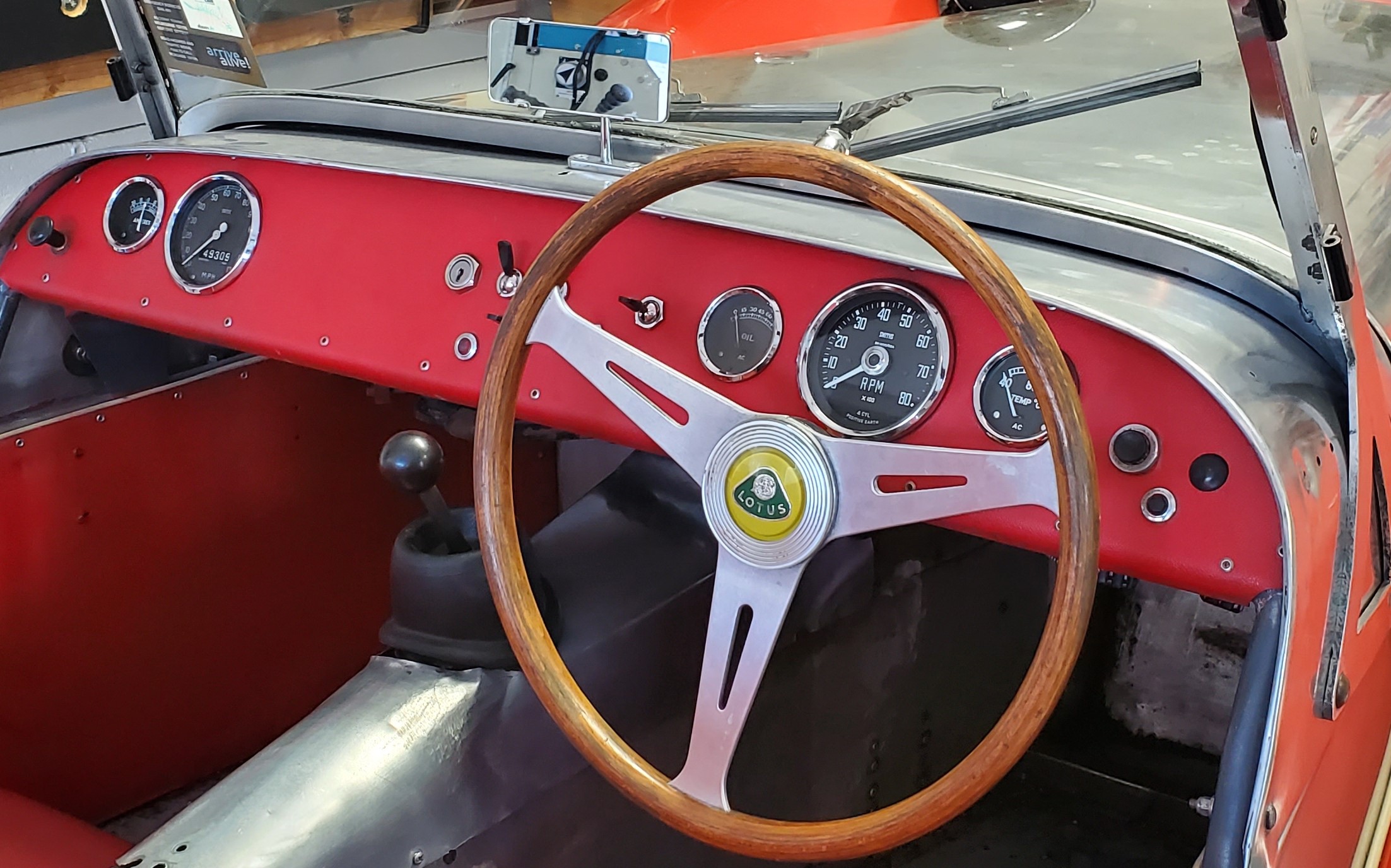
Here is a scan of a photo the original owner of my car, a 65 S2, sent me. This was taken in the UK in 66/67. The car was purchased from Lotus in Jun 65 and built by a nearby mechanic for the owner. As a scan of an old photo it is certainly not definitive, but to my eye looks to have the same lights as it does currently (photo above) and definitely has no separate flasher. Maybe you'll look at it and see something different.
-
Bill, as I understand it (and as reported on John Watson's lotus 7 registry site), the L516s were used in conjunction with separate flashers and the L1130s were used otherwise. Happy to be corrected.
-
And no flow the other way, too?
-
@TEM - you may be already aware, but borescope cameras have become quite good and quite cheap. I bought one that connects to my phone a year or so ago for around $40 as I recall, and have used it numerous times since on car and home (in-wall) projects.
-
 Vacuum advance is only going to benefit mpg and emissions, at some cost to performance. I'm a fan of points on these cars, generally easier to dx and cheap/easy to keep a back-up to critical consumable parts in the car. If you go this route, be sure to buy quality condensers and rotors as there is some really cheap sh!t out there. Distributor Doctor in the UK is a reputable supplier if quality parts
-
@TEM looking at your pictures again, I see someone added side view mirrors to the wings. I can't see exactly where those are mounted, but look to be pretty close to in line with the lights. Is it possible that whomever installed the mirrors used one or more of the original holes for the lights and just moved the lights? Either to minimize drilling or to effect the location of the mirrors to their liking? Then never got around to rewiring, or decided the functionality wasn't worth another hole?
-
Now that you say that, I think that is my recollection - I'd forgotten. My wings have been repainted, but to my knowledge they are also the originals.
-
Here is a picture I took when disassembling my wings to polish the alu. Securing the light to the wing required 1 hole/bolt, electricity through the other hole. I know some cars had separate indicators mounted below the headlights, but not sure when that started.
-
Not sure what parts would be useful given the limited pictures. I only took a quick look at a dash photo but it didn't appear much on it would be original, so if that is any indicator I'd question whether there are many original parts left on the car. It could also be a built up group of parts on a 61 plate.
-
Count yourself lucky! Mine didn't have the special ones (likely someone's previous work) so it was extra fiddly. A long round head hex key with a 45° bend saved my sanity, but is still tough sledding. The sequence is important.
-
Indeed, they are a real bugger!
-
Interesting, I have not seen one with the markings on top (not that I've seen a lot, so could be common). Attaching a picture of mine on rebuild, which also shows the intake manifolds - which I believe to be original/Cosworth manifolds. Yours look quite similar. On this one, like the diagram above, the 116e casting is on the bottom of the water inlet.
-
This from the Seven manual suggests that the gap between the 2 ridges is 10 degrees btdc. I also found the following in my files. Assuming this marking us how you identified your head, it may explain things as it appears the same 116e casting for the head was used on 1300cc blocks. I think this was related to Cortinas, but would support such a head on a 1300 lotus engine.
-
I'll have tonight back through my notes and files, but my memory is that the two "pointers" on the cover are 8 and 10 degrees. In the downloads "Lotus 7" section are copies of the Lotus 7 manual, a Ford 105E manual, and an article on the Cosworth evolutions. The Ford manual shows the markings, but it may have been somewhere else I saw the description. The Lotus manual and article describes various initial intended timings. It looks like you have a Cosworth cover, so perhaps you also have a Cosworth head. They did make them for both 105E and 116E engines. How are you identifying this as a 116E head? 116E blocks, in my experience with Lotus, are most frequently marked 120E. Think of 105E and 116E as "classes" that can include several subgroups. It could be that yours was a Cosworth 116E engine where the block was replaced - or a 105E where the head was replaced - or maybe someone just added the Cosworth cover and new manifolds to allow the dual Webers. I can't see the manifolds well enough to tell if they look like the Cosworth manifolds. The unique engine number should be engraved on the top of the motor mount on the distributor side. With that and your vehicle ID number (SBxxxx or LSBxxxx) John Watson (Lotus Seven Registry) could tell you if the block is original and maybe more about original configuration.


