
EdWills
-
Posts
282 -
Joined
Content Type
Profiles
Forums
Store
Articles
Gallery
Events
Library
Everything posted by EdWills
-
Where can I get these, and what are they called?
EdWills replied to hahuang65's topic in General Tech
The bushings I have are mild steel. I will check to see if I have anything close. W. -
Hi. I agree with your findings regarding the pin.. Sometimes the mandrel stays in the nose and the next rivet is required to push it through to be ejected either into the mandrel receptacle or on the ground. I also have a brand new/unused U.S.M./Stanley PRG540 air hydraulic (now out of production, manufactured in the U.S. and the last one in stock at my local compressor spares company). A fantastic piece of machinery, but an aging compressor bit the dust, so I deferred to the Milwaukee. The PRG540 will handle stainless rivets up to 1/4" with a hefty pull as demonstrated by the shop manager where I purchased it from. W.
-
Where can I get these, and what are they called?
EdWills replied to hahuang65's topic in General Tech
I have a number of bushes originally from Arch and also Xtra Special Sevens that are spare. Mine are in Imperial measurement, but if you can send me the o.d. and i.d plus length , I can determine if 3 of these will do for you. W -
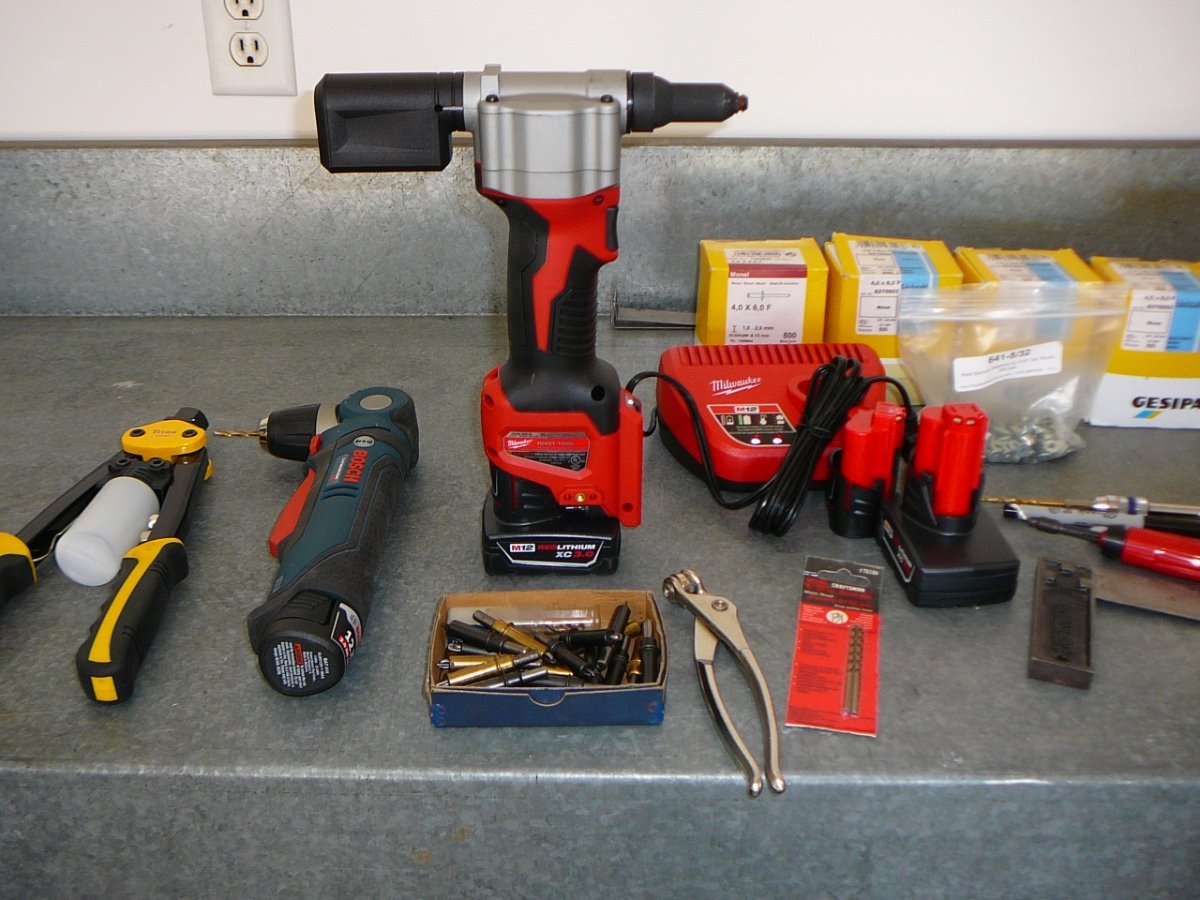
Needing to reattach some aluminium panels to my chassis, I checked some on-line videos and a popular alternative for riveting (than air/hydraulic) was the Milwaukee M12 electric riveter, which is designed to pull up to 3/16" stainless steel rivets. My local Home Depot showed that the riveter tool was on sale (no battery or charger), plus a reduced price pair of 3 amp/h batteries, and a reduced price 2 amp/h battery with charger. The entire package was sold as separate items that you could add or delete, and was very reasonable. The M12 will easily pull 5/32" Monel rivets, and also the quoted stainless steel. I had obtained my Gesipa rivets from a U.K. rivet company 2 years ago,, but Gesipa does not show Monel in their latest catalogue. The rivets I have use stainless steel 'nails' and make a good job, as the nail pulls almost flush with the head of the rivet making them more or less structural depending on the material thicknesses being joined.. Three different lengths covers all the thicknesses of ally that Lotus/Caterham/Arch use along with the 18 gauge mild steel chassis frame. Caterham/Arch used aluminium rivets on some of their frames and body parts almost entirely, but Tony Weale in his book only mentions Monel for the rivets on both Lotus and Caterham frames. Gesipa (of Germany) does manufacture an electric riveter, but it is quite expensive. Gesipa does have a U.S. distribution centre and they offer good advice. Home Depot offer a 90 day full refund/replacement if the tool or accessories fail within this time period. The batteries are also compatible with the Milwaukee extensive line of electric hand tools. Removing the 'nail catcher' allows the riveter to get into most small spaces on a Seven chassis. If using this tool in the garage where vehicles are parked or are planned to be parked, make sure that you recover all of the nails before parking - if the 'catcher' is not used, as the riveting action does tend to gently fire them out of the back of the tool. Safety glasses are also essential if you don't want one in the eye! The tool is about the same weight as an air/hydraulic riveter. It is working great so far.

-
Well, there is a proper way to do it, and then there is your method I guess. What would be wrong in slightly undoing all of the bolts that hold the diff, and then perhaps using a dowel pin or a bolt with no thread and rounded off at the end, or possibly the non pointed end of a correct size drill bit, using them to align all of the holes. Then with the correct sized bolt, slide the bolt in displacing the dowel pin(s)? When the chassis frame is built, there is no guarantee that the welder snugs up the jig tight enough, or perhaps moves the frame pieces slightly? Presumably the bolts were correctly installed in the first place, so why use brute force to replace them? W. 'Before you criticize someone, you should walk a mile in their shoes. That way, when you do criticize them, you're a mile away and you have their shoes'.
-
John, Not the greatest photos, but if you need anymore info, just drop a line. The strip is probably 28+ inches long. Not sure if Fanny's Fabrics sells it though!! I am curious about what other application it would be originally used for? W.
-
Hi John. Pics from my top
-
I was at a small racing car shop in my city a number of years ago, and I watched in horror as a so called mechanic attempted to install the Hewland gearbox and bellhousing assembly into the Lotus twin-cam engine of an immaculate Lotus 23C. He was using what we used to call a Birmingham screwdriver (a large mallet with steel head) to attempt to drive the input shaft into the end of the crankshaft by hammering on the rear of the gearbox. He had not properly aligned the clutch plate with the flywheel, and the install was not going well. The car owner was trying to help, but seemed oblivious to the damage that could be caused to his car, trusting that the mechanic knew what he was doing. I got both their attention with a few choice words, and inquired if the clutch plate had been aligned correctly. A check proved that it hadn't, but the mechanic insisted that he could have jogged it into place. The mechanic did finally adjust the clutch plate. I'm hoping that the above quoted response is meant to be humorous, but please don't try and force any bolts with a steel headed hammer. A rubber mallet can be used to budge some components into place, but if something doesn't line up, please find out why before resorting to brute force and ignorance. Cheers W.
-
Hi John. Just dug out the original soft top as fitted to my 1969 Series 3. It is exactly the same material as you describe, with the thick-wall hollow rubber hose inside (3/8 inch diameter possibly?). Mine is a claret colour, but probably whatever the Lotus supplier could get their hands on. It is stitched in place on the front of the soft top, but 5 snaps that clip the soft top to the upper edge of the windscreen are also fitted into the material further securing it. Will send a photo with measurements as soon as my battery charges up. W.
-
Wanted: replacement windshield glass for S3
EdWills replied to greasymonkey's topic in Parts For Sale / Wanted
My Seven windscreen was fitted with a gasket by the previous owner. It consists of a bicycle inner tube cut to fit! It works very well, and makes a nice fit for the new glass to prevent unnecessary movement due to vibration. Make sure you use the original screws (or same screw lengths if replacing the old ones) to put the frame back together, as they shouldn't be too long to prevent them digging into the new glass and causing a new crack. W -
If anyone missed this edition of C&SC which contained an article regarding 2 Lotus 6 cars, plus an 8 page spread on 5 decades of Caterham cars covering test drives of 7 vehicles from a 1977 Lotus Twin-Cam sprint car to the R500, I have one in good condition to give away just for the cost of postage to your location. W
-
Hi WB. I checked the part number of your caliper with my Girling reference, and your caliper is exactly the same part number as the caliper fitted to my 1968 built, 1969 registered Lotus factory constructed Seven Series 3. There must have been a very adequate supply of these items coming out of Girling/Lucas for Standard Triumph, Lotus, Caterham, Marcos, Formula Ford constructors, plus various kit-car producers of the time. You have the 14LF 111B type calipers. Pegasus of New Berlin, Wisconsin carry the 14LF repair kits, and the seal that fits between the halves if necessary, plus pistons and various pad compounds for the 14LF. I have no connection to Pegasus (I wish I did!), but I have always found this company to be very helpful, and they carry a lot of parts that are suitable for a 7. They also have a kit for the Girling 12P caliper and pistons etc. Good luck with your rebuild. W.
-
The shape of the diff nose piece gives it away as a Ford Escort axle, (Cortina nose piece may not have the 'lip' on the very front). Also the 9 inch rear brakes (and of course the 'Ford' logo - well spotted MV8!). The diff for the RS2000 was 3.54:1 ratio. There was an alternative at approx. 3.9:1 but this was special order from Caterham, as they predominantly used the 3.54 unit. The ratio you have should be on the tag bolted to the casing. The Girling (later taken over by Lucas U.K.) front callipers should be the 14LF caliper assembly rather than the 12P model. Confusing? I should say so. Ages ago I wrote to Girling - as like you - I wanted to rebuild the calipers (English spelling?) on my Lotus Seven. From the caliper i.d. numbers, Lucas/Girling identified my 1969 Series 3 Seven as fitted with Mk 14LF 111B calipers used on the Triumph Spitfire Mk3 and Mk4 cars and the Herald 1200 and 13/60 models from around 1968 -1972. Apparently the 14LF came in 2 options, brake hose in from the top of the caliper, or from the side. The internal parts should all be the same. Girling did not recommend splitting the caliper bodies (after I had done it!), but as another forum member has noted, you should replace the small 'O' ring between the halves if you do decide to split them. I do not know the correct torque setting for the bolts to tighten them up unfortunately, but there are recommendations from a number of sources on-line for the correct setting for the size of bolt. The 12P caliper had a slightly smaller swept area than the 14LF. If Bean cannot help, any motor parts dealer that sells replacement parts for the Triumph Herald or Spitfire should be able to supply a rebuild kit for the front brakes. I am not selling for Burton Performance U.K., but they carry all of the parts for the Ford axles (even though most axles have been out of production for ages). They drop the pricey U.K. sales tax, and only charge for the part(s) and postage. If not in a hurry, get them to send by Royal Mail, tracked and insured. If in a hurry, I believe they prefer DHL. The front calipers should have designation numbers on the 2 halves. Girling sent me a list of all the parts for their calipers, and if you want to, you can send me the numbers and I can try to advise what kit is required. N.B. Tony Weale's book is commanding ridiculous prices on 'the bay', but if you need one, I know of a source that has one for sale at a reasonable price (not me!). Cheers.W.
-
Thanks John. White 'reply' box did not appear when I clicked on 'quote'. It allowed me to edit the quote and keep the photo, but I could only write my reply below the photo and edited script in the 'quote' box. Apologies if anyone thought that wbMoore had added the information that I had written. W.
-
Hey WM. Forgot to note that you could try Dave Bean for information (and maybe the parts?) for the front and rear brake kits and M/C. If that company doesn't carry the parts anymore, they should be able to advise how best to service the set-up you have. As it's still an unknown what axle your car is fitted with, further advice may be unhelpful? Ford, U.K., normally included a metal tag bolted to the diff case identifying the type and ratio of the axle, and Caterham or Burton would leave this on, (but it may have been removed by a previous owner). If there is a tag, it will help with positive identification. The long cockpit chassis wasn't introduced until 1981, and the De-Dion set-up around 1983 to 1984. According to Caterham, converting a live axle car to De-Dion is very complicated and very expensive (and would require a jig for correct set-up). A chat with Jez Coates at Caterham advised that it is not worth it. They felt at the time that the live axle was more than sufficient for the average 7 owner. The reason they went to De-Dion was due to the supply of the Ford axles becoming unavailable, and then the Marina/Ital axles following suit with no other U.K. manufactured live axle available (or suitable?) for their use. W
-
Hi WB. According to Tony Weale in his book 'Lotus Seven, Restoration, Preparation, Maintenance, the Ital axle was not used in a Caterham 7 until 1980 (81 Spec.) with chassis number 4002 TC R M. Moss Motors should have a rebuild kit for the calipers and you could also try Rimmer Bros. in the U.K. and compare prices from them. For the rear brakes, Burton Power in the U.K. lists rebuild kits for the Escort axle. The original Ford Escort Mk1 had 8 inch rear drum brakes, but the later RS2000 axle sourced by Caterham from Ford had 9 inch rear drums. Check the type number of caliper on your front disc brakes to ensure you are ordering the correct kit. On my Lotus Seven the caliper is the 14 LF model, but there is a slightly different Girling caliper that may have been used on later Caterham models (from the Triumph Spitfire range). Brake fluid according to Weale is Dot 4 for road use, or for racing Dot 5 can be used. W
-
1979 Lotus Super Seven Mk4 - twincam / Steelbro NZ - $25,000
EdWills replied to achova's topic in Cars For Sale
Hi @JohnCh. Thank you. Much better idea than adding information on to the car in the 'for sale' section. Cheers W. -
I found a reference by the author of a Lotus Seven book that Lotus also authorized construction of the Series 3 in Spain.
-
That is a real shame. Pegasus are selling a line of tools specifically for automotive use (road and race) and manufactured in Italy. I realize that Craftsman originally had tools manufactured by various companies in the U.S., but now source them from Asia. I did find a company in the U.K. (Sheffield ) that is still manufacturing tools there (Eclipse), but expensive to import, and limited tools in their inventory. They only seem to manufacture certain tools on a demand basis with minimum quantities required, which is understandable I guess. Apparently they sell some of their specialized tools to Japan, Malaya, and other Asian locations. W
-
Hi MV8. I have only once had my James Neill (Sheffield U.K.) 40 - 160 ft/lbs wrench verified for accuracy at a local aero instrument testing centre more for insurance against breaking studs on my family vehicle. It came out as almost 100% accurate on all of the readings that they tested. I realize that for speed, most technicians at auto businesses use the air wrench for doing up wheel nuts, but an experience a few years ago - where my front wheel nearly came off - led me to check the wheel nuts with my torque wrench. The auto business tried to claim that the technician's torque wrench was badly out of adjustment, but I have worked at a couple of auto dealerships, and never seen a torque wrench taken out of its protective case to this date for wheel nut tightness checks. What do aircraft technicians do to ensure that a torque wrench is accurate each time they use one? Do they have a test rig at every repair location to verify the readings before using one, or do they assume the tool is accurate? Scott, does Craftsman still obtain tools under their brand name and manufactured in the U.S., or are they now produced offshore like so many others? I noticed in Kauai a few years ago, that 'K' Mart sold them. There was a company in the U.S. that produced specialized tools for rebuilding many of the North American engines including the Pinto and 1600 Crossflow, but they closed down years ago. A gent in the U.S. was selling off a huge supply of these secondhand special tools that he had bulk purchased. He sold them on the well known web site at a very good price, and I managed to obtain a few tools for the 1600 engine (seal replacement tools mostly). They are excellent quality. I have a Craftsman U.S. manufactured beam type torque wrench, but it is for very low poundage, and hard to read in certain locations on the car. Beam type are not known for their accuracy as much as the other 'click' or digital types apparently. Cheers. W.
-
Is anyone familiar with CDI torque wrenches? I googled all of the options for torque wrenches, and prices and styles are so numerous with various sites recommending one over another. I understand that CDI is a division of Snap-On, so should be good quality I am hoping? I need a wrench for 5 to 70 ish foot pounds, and CDI manufactures one suitable for this range. I also have a U.K. produced wrench for higher torque values that I get checked at a local aero tech centre. Although it has been covered previously (some time ago) about which tools members should consider using for repairing or carrying in their Seven, are there any tools that are still manufactured in the U.S. other than Snap-On? I often see the Mac truck at the various car dealerships in my area, but I really miss the Sears Craftsmen tools that were manufactured in the U.S. and sold in Canada, which were the go-to tools for me at least. I never had one break, and the guarantee was very impressive if you ever did happen to break one. The original tools for my motorcycle in the U.K. came from Europe (Elora, Germany) or France, with a number of Sheffield U.K. manufactured tools to compliment them. The late, great, Carroll Smith was fond of Craftsmen tools although he naturally went more for the professional range for his racing car production. Thanks for any input. W.
-
Hi again Christopher. I have been looking at an older (2020) Burton Power catalogue, and on page 109 it lists some clutches and covers manufactured by a company in the U.K. called Helix. Part number 70-1605 for road or rally is an alternative cover for a SOHC Pinto with 1" x 23 hub (5 speed box types). The 70 Series is described as sprung centre organic drive plate type. Not sure if this is what you are looking for, but the size fits the description and the plate is for a 190 mm clutch cover (which they also sell under the Helix brand). Price for the plate (on the current Burton site) is L163.75 Pounds sterling with the U.K. tax removed (L196.50 U.K. Pounds with tax). I know that U.S. sourced would be best, but perhaps supplies of these items are now much rarer in the U.S. than when the engines, gearboxes etc., were still used in production vehicles? As many owners in the U.K.and Europe are still running cars fitted with all of the smaller Ford engine and gearbox options (including Imperial measurement parts), companies are willing to manufacture new parts for these cars. AP Racing also produces a 1" - 23 spline plate, but it shows that it is for a 216 mm cover (part no. CP5354-38). AP have always been very helpful with any questions I have had, and they don't mind individual inquiries direct to them. (Note: 190 mm = 7.48 inches or 7-31/64", and 216 mm = 8.504 inches in old money). W.
-
Lotus fitted a radio to the one-off 'luxury' Lotus Seven Series 3 'S' model in 1969, and the petrol/fuel gauge and tank sender came with the Series 3 in 1968 (and possibly a bit earlier with the Seven 2-1/2?). Lotus used a mixture of AC (Delco) for gauges and petrol senders, along with Smiths Instruments for other gauges. Rear lights for the Series 2 and 3 were from trailer accessory manufacturers. The one common original accessory to span the production of many Lotus and Caterham Sevens is the handbrake - which, according to published accounts - no one seems to know what original vehicle this came from. Lotus used Lucas electrics (remakes still available), and the Wipac washer system. W
-
Aha. The good old-fashioned Lotus factory method of securing the spare. My Lotus uses a brown leather strap. The hood also has a slot to take the strap. Easy to remove (or steal) the spare! Caterham were still following the Lotus methods up to the early 80s. What brand are those tires please? I see they are 175-70 R13s and maybe Dunlop SP60? W