copy.jpg.dd4bdbb41ccb3ea8a585d1ad217ef61b.jpg)
.jpg.da03509438cc84820b8cf5d64db570ab.jpg)
Austin David
-
Posts
422 -
Joined
-
Last visited
Content Type
Profiles
Forums
Store
Articles
Gallery
Events
Library
Everything posted by Austin David
-
@UglyFastand I were chatting offline about maybe converging on Greenville C&C one morning with @mrmustang... Looking at a map and squinting it sort of looks on the way to fun roads...
-
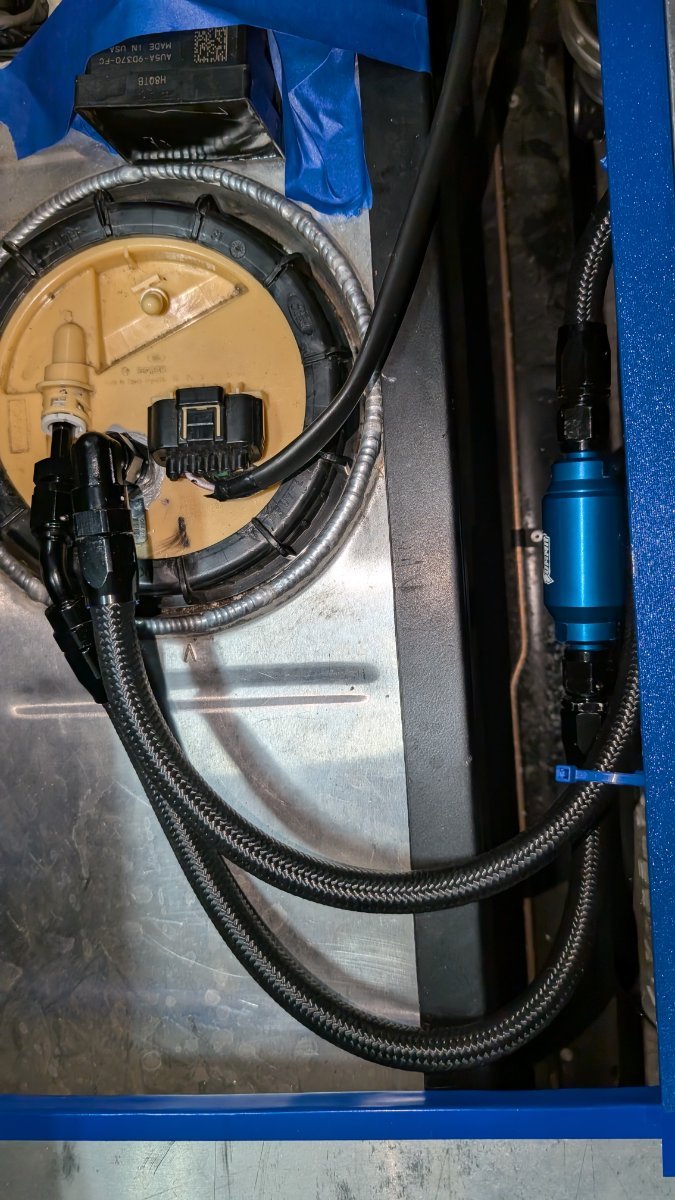
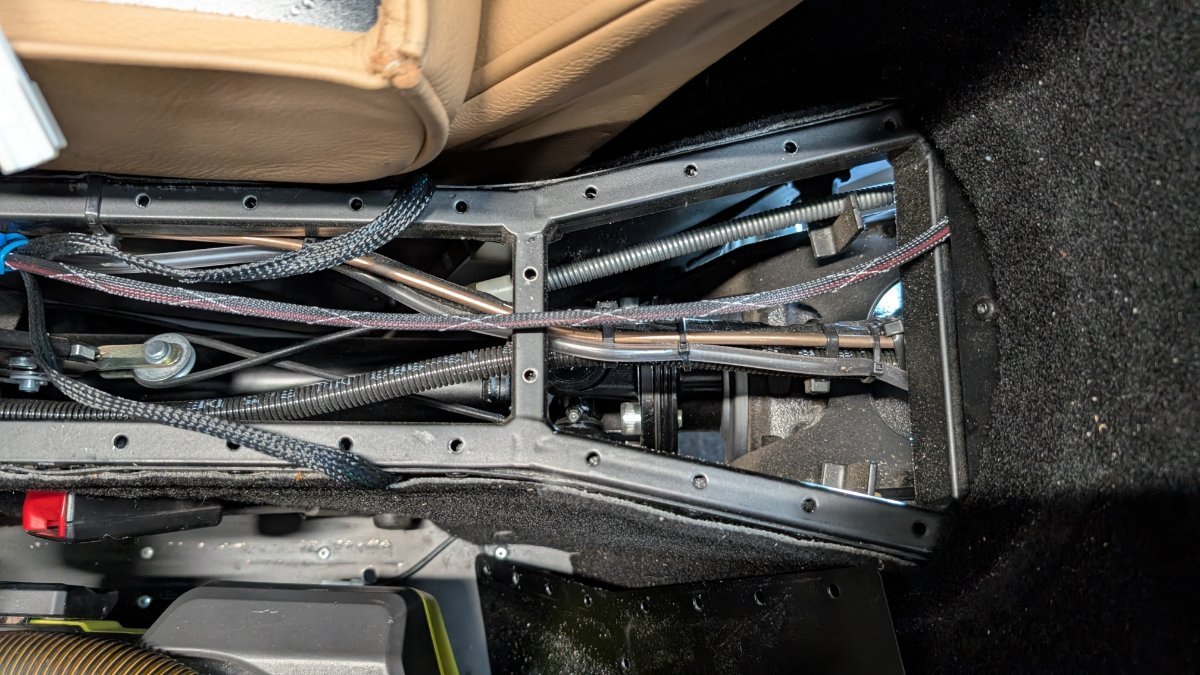
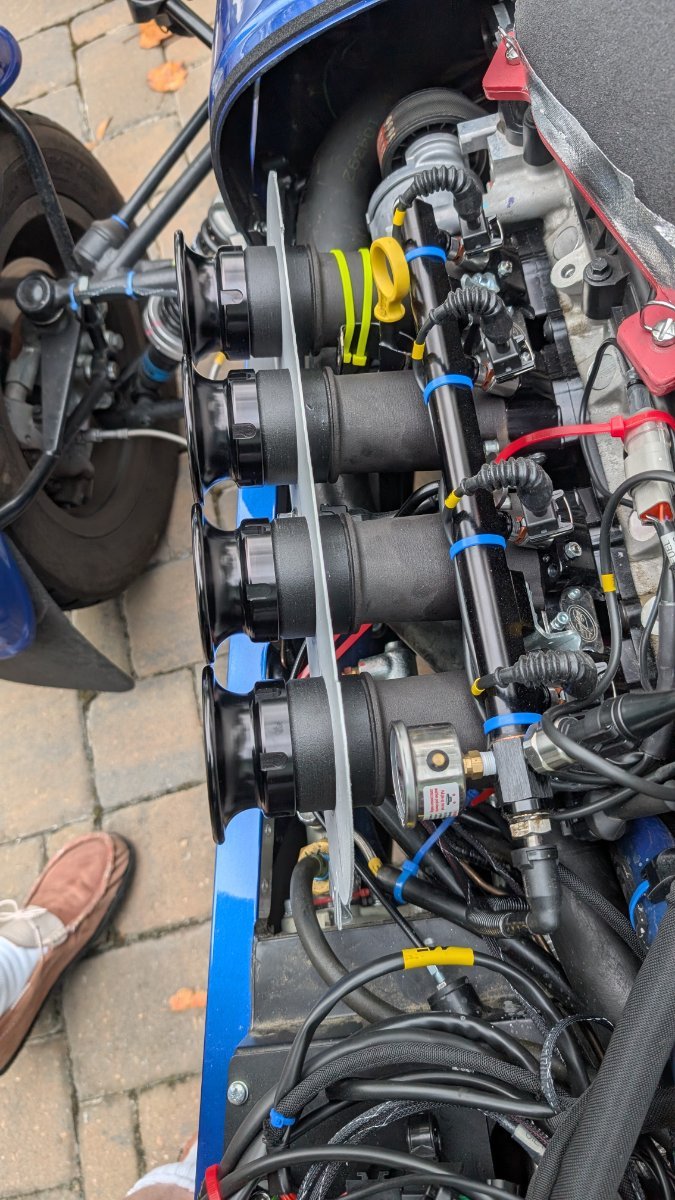
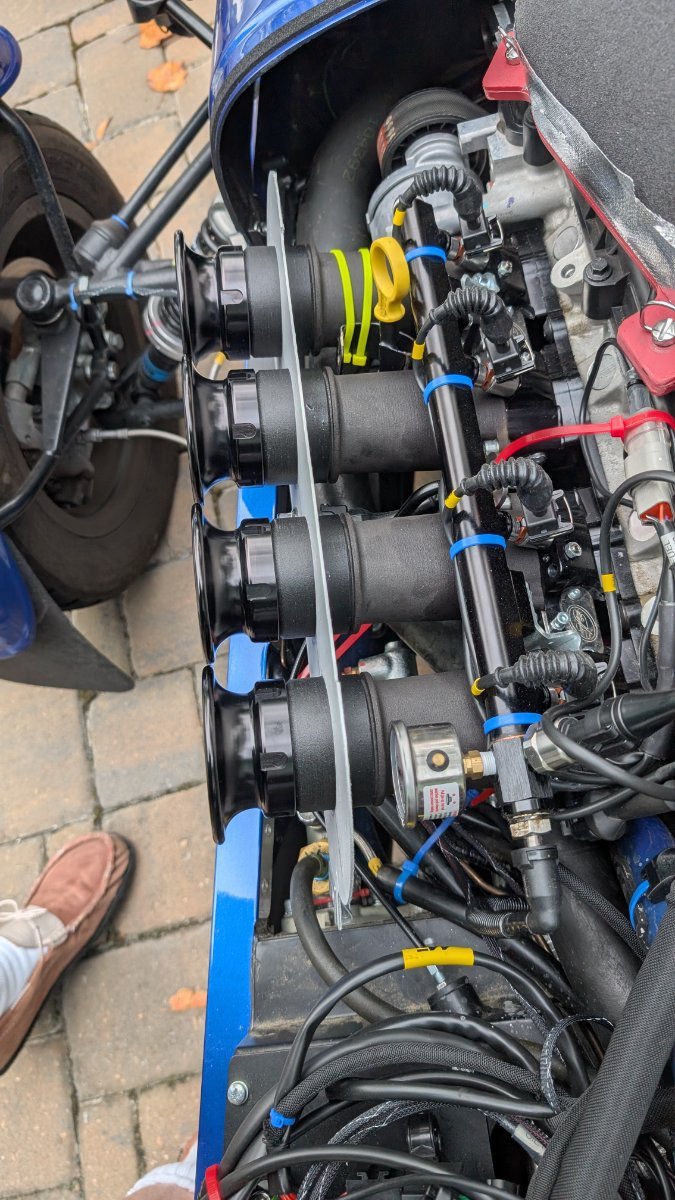
One last shot about fuel lines, showing the return placement and my lines. The blue fuel filter is maybe obvious; I hung a few more nylon brackets under that crossbar to hold the two lines and float that fuel filter. The lines are run well away from the pointy ends of the screws for the wood panel, and the metal deck screws are now embedded in the plastic risers, and the risers are held down with machine screws up from the bottom. They have a good foot of slack before going unto the tunnel, grommeted to pass through the frame over the diff. The two lines are tied together (plastic fittings I made -- @JohnCh are we competing on how much of the car is 3d printed) and zip-tied along the driver side of the tunnel. THe only "gotcha" here is the full width of the tunnel is required around the handbrake, between fingers and a few layers of leather. I have juuuust enough room for the AN6 lines to tuck together up against the tunnel, and under the top of the frame member. No real problems getting around the shifter turret or past the wiring harness and into the engine bay. NB: this is MOSTLY the final layout. The blue tape was to hold the FPDM still while I did some test runs to be sure everything was snugged up. As of now the module is back up under the deck in the original mounts, carpet and everything is right back as before, with a little less clearance on the left side with the deck raised up 2-3cm to clear the return elbow. I'll post some "final" shots of the fuel rail eventually, but for now: feed line runs along the rail and up front, away from the coolant hose and along the tops of the 4 intake trumpets. There's a swivel apter at the back #4 side of the rail with my regulator and gauge, which barely clears the valve cover. The return hose comes out the bottom of the regulator, then back down into the tunnel.

-
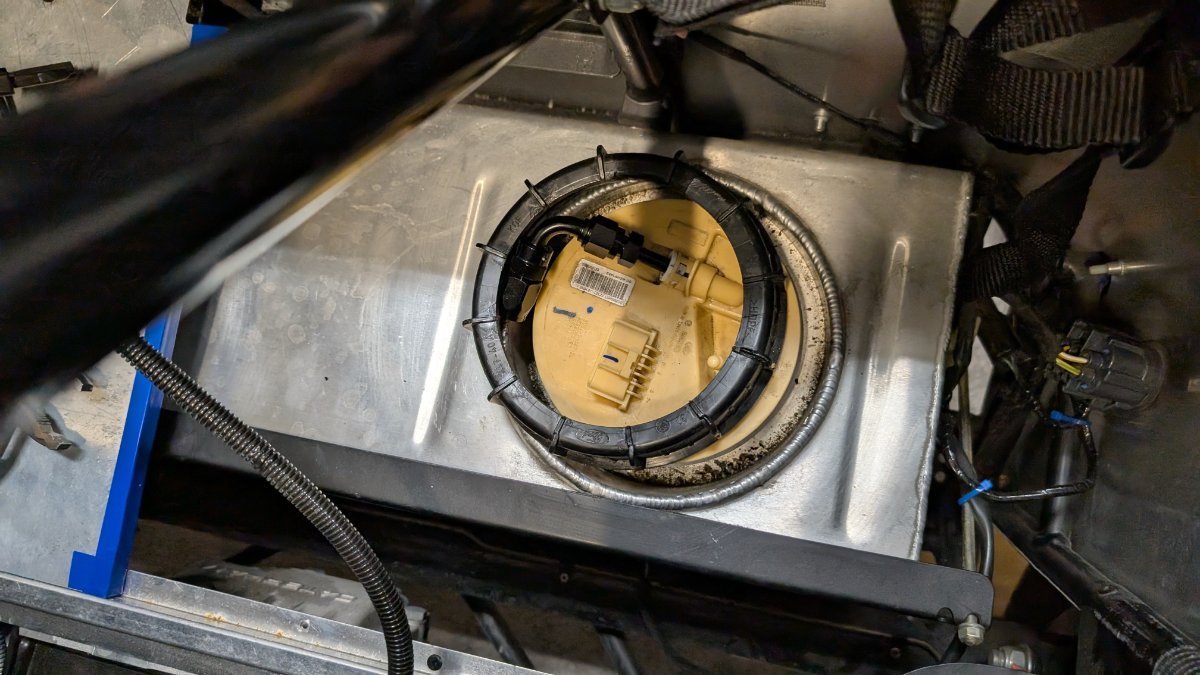
light update, I've got pressure and will be buttoning it all back up slowly. no surprises, but I'll leave some notes about what I ended up with: - AN6 hose in both directions. 16' wasn't enough for me to feel comfortable, maybe a single 20' would do it. - The plastic Ford hanger does have a sealed port for the return, but on the underside it appears to just dump mostly down. I opted NOT to use this, for some concerns about aeration. I have no idea if those concerns are valid. - the Ford assembly is "interesting". It's angled, but I'm not sure if it sits directly on the bottom of the tank. The very bottom of the tank feels more angled than the hanger, which means it probably strands a lot of fuel at level (like ~ 1 gal). No attempt to measure. @JohnCh has a much better diagram showing the problem. The fuel pump and what I assume is a sort of in-place filter are inside a significant plastic housing. That housing is actually a sort of swirl container, and I don't think there are any baffles in the rest of the tank (maybe 1, I didn't look very far). That housing has a small one-way valve at bottom, and it holds a fair amount of fuel. So when you're repeatedly taking it out and putting it back, you'll develop a sort of motion to tip it sideways enough to get the float out, then pour the contents back into the tank without sloshing too much on the garage floor. - there are a few bad choices for mounting the return line. I elected to plumb an an6 bulkhead near the outlet, with the logic that if I wreck it I'm getting a new hanger anyway. I did not drill a hole in the tank itself, but in some ways that would have been easier. - Even with a low-profile 90* to the bulkhead, I'll probably lose about 1cm of floor clearance in my boot. I do not consider this a significant problem, but it's something to sort out. - running the two fat AN6 lines through the tunnel was about the easiest part of the job; I assumed it would be harder. - under the hood my setup was approximately what I expected. In the boot / at the tank took some fiddling, and I ended up trying I think 4 different arrangements for the final return hookup. Each of those comes with several days of waiting on delivery, hence all the delay. The final insult was submersible return line, which is absurdly costly to source locally. So far it seems fine, I was able to pressurize the system on the first try. I'll post some pics of the fuel pump housing, it's interesting.
-
.thumb.jpg.885191d302e6c3704c848a8f5ac3a612.jpg)
The Regular Summary of Classified Ads of Se7ens Found For Sale
Austin David replied to Croc's topic in Cars For Sale
Kinda nailed it tho -
some catching up: the ITBs work really well with the stock deadhead fueling, using a 3D table to manage pressure feedback, and another 2D table to trim out injector timing. BUT at certain high-consumption periods I can see what looks like pulsing indicated from the pressure sensor. Between this and the heat soak, I've decided to re-plumb the fuel lines and install a proper regulator and return system. This is still work-in-progress, but I'm recording what works well and what I had to figure out the hard way. The stock fuel line is terminated with 5/16 ford quick connects; the fuel tank side is a male fitting. To remove it you press in on the tank side to release the clips, and just pull the line straight out. I had to 3D print a tool to help facilitate this, think of a 5/16 washer with a section removed. Pliers would probably also work. The fuel tank is sealed with a sort-of standard ford part; the magic search seems to be "fuel pump seal". The black ring is screwed on; I wasn't able to loosen it by hand, and hammer + screwdriver (or hammer + several gentler implements) didn't shake it loose either. In retrospect I bet penetrating oil would help. Fortunately the part seems to run about $10 online and $20 locally. The hanger itself (the plastic housing) is standard Ford, there's a seal under it. I'll update when I figure out a car that used this same part. Note that the pump-hanger is clocked, mine was also marked with sharpie on the hanger and an etched arrow > on the tank. The hanger module is not vertical, and I assume rotating it would change where the fuel level reader rests. Note to future self: tinker with that arrangement. Accessing the tank is unsurprising, but removing the big honeycomb panel is annoying. I elected to cut mine in half, and I'm glad I did. While I had it out I removed the washer line, I never installed my washer bottle/pump. About 60 zip ties held it in. The electrical for that was run separately and seems bundled with other wiring, it might have to stay or get hidden somewhere else. I will be using AN6 hose and fittings all around. The new pressurized line from the pump uses an AN6 to 5/16 (male) fitting, which I've test-fit. A 45* or 90* bend will get it aimed about the right way, TBD. For the return I've elected to mount a bulkhead fitting through the top of the tank, near the back of the car where it has a lot of clearance. The top of the new pressurized size looks like it will ride a little higher than the "factory" fuel line, so I assume I'll have to shim and lift the driver-side panel a little to make room. The bulkhead fitting is a little more shallow than my hanger so it will definitely clear. Plenty of room for a small inline fuel filter, near the tank, and probably just under the wooden panel for easy access. On the engine side: my chosen fuel pressure regulator is a tiny Radium model, with a 3-bar Bosch preset regulator. ITB = no vaccum, I've sealed the vac port. My ECU doesn't want pressure changing anyway. The regulator will also house a pressure gauge, which means I'll need to "clock" the regulator to the right angle. A 6AN ORB / 6AN female swivel fitting on the regulator side, then an M12 / 6AN (male, provided with ITBs) on the fuel rail. This will LIKELY go on the aft / #4 end, and I'll run pressure up to the front / #1 cylinder. The second regulated port gets plugged, the return is on the bottom. Plumbing will be: pump ->line -> filter -> line -> fuel rail, then rail -> regulator -> return line -> tank. The two lines will follow the same path through the tunnel. The old line was zip-tied in about a dozen places along the way, including 3-4 that aren't accessible unless you drill out the riveted panel at back of the tunnel near the diff. Electrical and brake runs along the right side, fuel seems solo on left. There are a few more zip ties up front under the battery, hopefully I can reach them from the cabin and won't have to remove the battery, heater, and that riveted panel. I'll post final pics and any other gems if I figure them out along the way.
-
The Regular Summary of Classified Ads of Se7ens Found For Sale
Austin David replied to Croc's topic in Cars For Sale
Don't knock heated seats! Three months a yeah are pretty rough around here. I also have a cupholder for my latte. Most types of cups do not handle the turbulence -
Based on the BaT info I'm guessing the extra lever is your reverse selector, and the knob is linked to the 1-6 CBR sequential? Is N just half up from 1, like a bike? And I assume the turbo + an engine designed to rev high just makes it BANANAS over 8k RPM... Looks like you cleaned it up a lot since the auction. It's fantastic!
-
420S Rainy Season Build in Western Washington
Austin David replied to Timberline's topic in Build Threads
OK but please do post a summary when you sort out the wiring and your troubleshooting. It does serve as a valuable future reference -- I haven't broken my sender YET, but "replacing the whole assembly" is on my to-do list ... -
420S Rainy Season Build in Western Washington
Austin David replied to Timberline's topic in Build Threads
I've seen the fuel pump / sender pinout but I can't find it with some searching. @JohnCh left some photos of the underside of that assembly here re: idle and the throttle cable... you want the cable to be a little tiny bit slack. The only pressure on the throttle plate at idle is the throttle screw. You can adjust the throttle cable at the TB bracket with the barrel and two nuts. Slack it up a bit, set your idle with the screw, then start snugging up the cable until it's almost putting down pressure. My stock setup (360) liked a relatively high idle, 1200 RPM. What is "too high" for you? -
Beautiful car. I took some measurements, wired up four probes inside the air filter right at the trumpets. The gap up front probably helps you... Trumpet #1 is warmest, then #4 (under bonnet). 3 is cooler. The range is about +15-20C for 1 and 4, and +5-10C for #2. It's most pronounced when running, with more airflow under the hood. After I got my data, I saw photos of ITBs & filters entirely under hoods and decided I'm probably "good enough". I also started mining my data for any signal that the ECU is compensating for (slightly) elevated IAT, and I really can't find it. My current thinking (and priority) is that the cold air intake is good enough, and maybe I'll revisit it after I fix problems I can demonstrate... Like my hot injectors.
-
420S Rainy Season Build in Western Washington
Austin David replied to Timberline's topic in Build Threads
the magnets are a genius idea. You may never get away from the rocks in your seat. I have mudflaps and I believe they help, but I still get a lot of rocks and debris. -
420S Rainy Season Build in Western Washington
Austin David replied to Timberline's topic in Build Threads
there's story about ducati not providing torque specs, and when asked they finally said "the spec is in the hand of the mechanic" (with appropriate translation from italian). I assume same/same. it's literally a hand-crafted car. part of the adventure is figuring it out. I went back and compared my instructions and my build with some of the much cleaner build photos in other blogs, and I'm pretty sure the instructions (which I followed diligently) are incorrect. -
420S Rainy Season Build in Western Washington
Austin David replied to Timberline's topic in Build Threads
3M 5200. Comes in white or black, I used white + sprayed black undercoat over top. 2 years and counting, but no track time. West Marine carries this, also carries the other stuff (I cannot recall the name). Home Depot or other big-box store may also carry one or both. For 5200 you'll need a tube for each day you want to work... once you break it open, it'll cure in place in about a day. -
420S Rainy Season Build in Western Washington
Austin David replied to Timberline's topic in Build Threads
cooling hoses get 100c, wires can get hotter than that. the electrical tops out around 16v, which will not penetrate the insulation. You mostly want to be sure things look good, are not rubbing in a way that would wear open the insulation or cut into a hose, and looks good. There are a few moving parts under there, like belts and the steering column, and you may not want to put weight on the hard brake line. I got a tip to drill out a rivet under the exhaust stack to mount a zip tie, to neaten up the O2 sensor line. I added zip ties in a few strategic places in the existing riveted-in mounts, including right over the bell housing for that fat loom connector. I've seen pics of a few pretty amazing tuck jobs, but mine is a lot more practical -
ITB update: heat soak in the injectors. Symptom is a rising AFR (lean) at idle or after resting when hot. Does not correspond to IAT, and drops with a few minutes running. These are different injectors + fuel rail, positioned in the TBs, further out from the stock locations. Heat is most likely conducting through the ITBs and into the injectors, and they're warming enough that they open slower than expected... less fuel -> higher AFR, enough that the ECU cannot compensate (it's limited to 20% correction). When the throttle picks up and more fuel flows, the injectors cool off and the effect goes away (but returns with a few minutes idling at temp). This appears to be due to the "dead head" fuel rail, which doesn't move any fuel (or soaked heat) at low duty. I assume the stock rail also has this problem, and is somehow managed by the stock ECU. The simplest solution is to bump VE around idle, which gives the ECU a little more room to compensate for the changing flow rate when hot or cold. +20% VE and -20% startup tuning leaves the cold starts still correct, and the ECU then has plenty of room to trim out any changes with injector behavior. A conventional return-style fuel rail would mostly hide this problem, as the fuel gets a chance to cool off on the way to/from the tank. I'll put this near the bottom of my list for next time I get bored, below "rewire the whole engine".
-
Great writeup, thanks! There's definitely a lot more auditory feedback with so little between the intake valves.
-
420S Rainy Season Build in Western Washington
Austin David replied to Timberline's topic in Build Threads
The older of my 2 actually helped mount the engine, which was nerve-wracking and weird. The younger definitely held some flashlights and fetched sockets, but not as much heavy lifting. Both will say they helped, tho, which is good enough for me. -
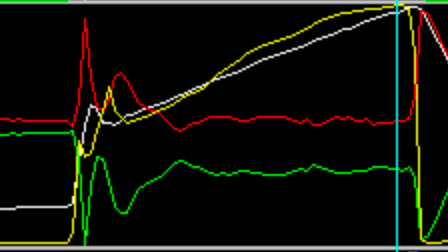
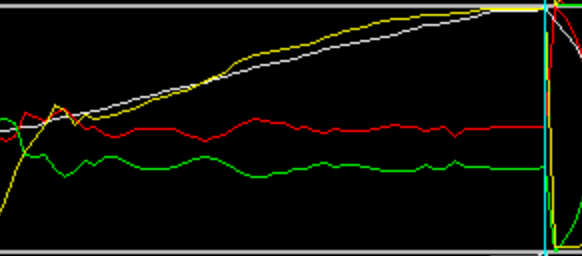
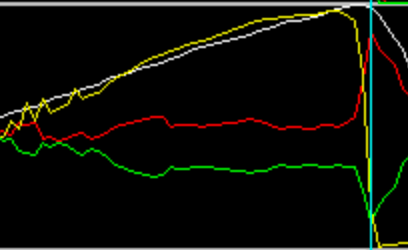
Analyzing some data, the trumpet lengths appear to make a difference but it's subtle, and really only relevant at WOT. I assume this would be a lot more effective when paired with cam changes, which I'm avoiding. White = RPM Yellow = "airflow est" from the ECU Red, Green are AFR & AFR err. Hypothesis is that length changes would shift the shape of the airflow graph. I've reviewed about a half-dozen pulls from each and these are representative. normal 100mm extension: +20mm inside the filter: +35mm total, with 15mm outside + 20mm inside the air filter: note that the extensions are cylinders so I expect they would have a small net dampening of total airflow at WOT, so the before/after aren't perfect comparisons, but I do expect the 20 vs 35mm measures to be really good internal comparisons. net/net: I think the graphs DO show a subtle lowering of the airflow / torque curve. Butt dyno confirms, but the effect is SUBTLE. Mostly at WOT I can feel it tapering off around 7k RPM, where the standard pulls smooth to the soft cut. In midrange it still feels great both ways. The airflow is also 35mm further out from the bonnet and the bonnet-hole would need to get a lot bigger.
-
Some investigation about the size of the bonnet cut, which led to some investigation about heat and airflow tl;dr: the intake hole may let hot air out of the engine bay, which will increase IAT 15-25C above ambient. the air filter is sized for 300+ HP, and can be blocked off to prevent heat intrusion, without significant impact to intake performance. the actual bonnet penetration can be fairly small, provided excess heat from the cooling system has somewhere to go Some offline investigation into runner length. This ITB kit offers 70mm, 100mm, and 130mm intake runners, I currently have 100mm. The manufacturer (or their associated engineering company) won't offer CAD, but do offer 30mm machined extension "tuning rings", with 50mm ID and M59 x 1.5 threads. The process appears to be something like "add 30mm, see if that's what you want, repeat as necessary", then get custom runners and/or screw-on trumpets to match the required length. Literature is thin; I THINK the math is linear with distance to the valve top, but the path is not straight and the tube is not a cylinder so changes may not be PERFECTLY linear, but I expect it to be close. Experimentation underway with printed rings. Peak VE is about 120% at 6500 RPM, with soft cut around 7400. Shorter = peak at higher RPM, longer = peak at lower RPM. The literal "tuning" here is setting the length from valve -> trumpet such that a standing wave bounces closed valve -> trumpet -> open valve, and forces its way in... hence the > 100% efficiency in a specific range. Butt Dyno indicates very linear performance to soft cut, but I'd like to see if I can shift the curve down a little. The attached model fits snug without trashing threads on my intake runner, and 20mm fits inside the air filter so I can run with the bonnet in place. I also added +15mm outside the filter, which is about the minimum extension because of the thread pattern, and happens to just barely fit under my bonnet. tuning ring 15mm.stl
-
420S Rainy Season Build in Western Washington
Austin David replied to Timberline's topic in Build Threads
I had to go back and read my post to remember... -
420S Rainy Season Build in Western Washington
Austin David replied to Timberline's topic in Build Threads
Also this is your best chance to undercoat that wood panel, it is exposed underneath. May also want to varnish the top and ends... -
420S Rainy Season Build in Western Washington
Austin David replied to Timberline's topic in Build Threads
I just let mine lay over into the boot. Once the cover is back in place you can't see it -
420S Rainy Season Build in Western Washington
Austin David replied to Timberline's topic in Build Threads
If you're going to turn the key without fuel, you'll want to disable the pump. Otherwise you'll spin a dry fuel pump, and they don't love that. I believe you can just unplug the immobilizer over by your brake fluid reservoir, which will disable the FP relay, but leave everything else intact for pressurizing the oil system. -
420S Rainy Season Build in Western Washington
Austin David replied to Timberline's topic in Build Threads
and before that, disable the fuel pump (it's in the book) and make sure you're getting oil pressure. You can hear the fuel pump kick in about 1s after turning the key. It's behind the driver's seat, LHS in the fuel tank. Fairly distinctive whir for a second or so, then it cuts off with no RPM. -
Nah, this one's a sleeper