copy.jpg.dd4bdbb41ccb3ea8a585d1ad217ef61b.jpg)
.jpg.da03509438cc84820b8cf5d64db570ab.jpg)
Austin David
-
Posts
422 -
Joined
-
Last visited
Content Type
Profiles
Forums
Store
Articles
Gallery
Events
Library
Everything posted by Austin David
-
.thumb.jpg.885191d302e6c3704c848a8f5ac3a612.jpg)
1993 Caterham Super Seven HPC Evolution
Austin David replied to Stang70Fastback's topic in Member Rides
solid work on the brake light mount! And I loooove that steering wheel. That came out great. -
Cannot confirm, but my only cable clutch experience is motorcycles. A well bled hydraulic should be nice and tight, th clutch circuit is very short and simple. Depending on the car there shouldn't be much hose, and hopefully that is reinforced...
-
Not the same engine, but I've found that my isotunes earbuds help a lot with clatter, while passing intake and exhaust music
-
beautiful. I like the look of the angel wings, classic-style grille, and the road tyres. If it makes you feel any better my new Duratec doesn't love starting below about 40F, either. Yours sure sounds great once running! Hopefully you'll get to break it in once spring hits...
-
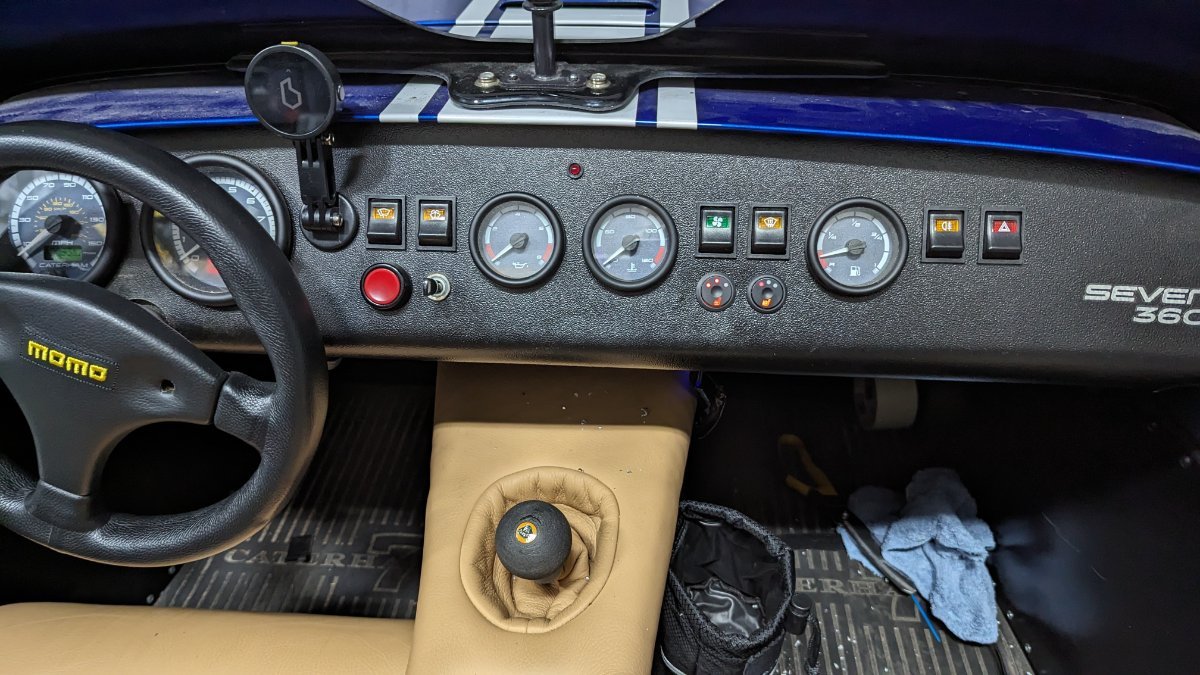
Build update: I mounted the seat heater switches. Final wiring: 12v + ground leads directly from the battery, plus a trigger wire off the fuse panel. The pad leads are very long, ran them under the console all the way back to the seats, then down under the carpet to pop out by the seatbelts. I stuck a terminal block inside my fuse panel cover (RHS footwell, about over a passenger's knee) and wired the 12V + trigger there, and fed off both seats. The excess wire was zip-tied and looped, and the two controllers were bundled in some terrycloth for noise abatement and tucked up there too; plenty of space. The switches are about 12" from the controllers; I drilled out two spots under my fan & windscreen heater buttons. Those two switches connect directly to the controllers. Because I didn't trim the original cabling I have one inline fuse on each side, plus my "main" inline fuse coming off the battery directly. I chose to pull power from the battery because I couldn't decide where to drag an extra 10+A from the fuse panel.

-
Have you figured this out yet? If no, maybe VHB tape backing the zip ties? If it's before the radiator it should stay cool enough, and the tape may be thick enough to handle that rough surface.
-
It's better. Hard to describe, but the press never really gets it right. My only mistake was waiting. Congratulations!
-
Yes, 185 vs 225 is the "staggered" configuration which is mostly standard for the 420/620. I went with 185s all around for longer road trips and to carry a spare. They perform GREAT but the rear arch has a lot of extra space (to accommodate the larger wheels on a staggered setup). The spare hoop itself would have to be updated. It bolts to the chassis, and could probably be made to work, but it wouldn't really make sense to carry a rear-only spare tyre, as the fronts are still the original 13x6 / 185s. At the moment I have the 13x6 spare and I carry a plug kit. If I were to take any long road trips I would probably swap back to the 13x6s in the rear. For around town I could use the spare, but it would put wear on my LSD so I wouldn't want to do it much.
-
I swapped out my factory 13x6 / 185 wheels & tyres with 13x8 / 225s. The new math said 41417 for PPU, and it seems about right at 70mph. I haven't yet screwed with ride height, but I do think I'll need to bring it down a little after this change. Some quick side-by-side photos: original fitment ^^ a little narrow for the wells, which are designed to hold the 13x8" wheels & 225 tyres New fitment: the 13x8 fill the well a little better, which was my goal. as noted I haven't yet tried to exercise them, I assume I'll need to make adjustments to height all around, and maybe my rear ARB to account for the additional grip. THis time of year with cold tires, it's basically ice-skating either way. for anyone curious, my spare is 13x6 and would be for limited use in emergency, I wouldn't want to run the mixed size with an LSD. For a very long trip I'd probably go back to 13x6 all around.
-
I see the oil cooler. Did they also lighten the flywheel? My 2.0 Duratec (360 spec, standard intake w/ plenum) definitely has some intake noise when the butterfly is open, but the intake is on my side (LHS) and exhaust on the other.
-
how do you like the ITBs?
-
Was it painted after welding? It might just need to cook off a little
-
Definitely gotta do a lap around the block, just to be sure
-
oven cleaner was the magic potion for curing chrome motorcycle exhaust. do these get hot enough for that to work?
-
Duratec (2.0 Caterham): coolant tank, level?
Austin David replied to Austin David's topic in General Tech
For the record it's a $8.49 cap (new) from a 2014 Mustang. I'll know in a month if it helps -
Duratec (2.0 Caterham): coolant tank, level?
Austin David replied to Austin David's topic in General Tech
An aftermarket cap costs less than $10, I'll try that first. Tha ks everyone for helping confirm that the cap is being weird and I'm probably not just overfilled. -
Duratec (2.0 Caterham): coolant tank, level?
Austin David replied to Austin David's topic in General Tech
Yup. Almost 6k miles by now, it's great except for the coolant seemingly leaking out around the cap. It does click tight, there's no air in the system, etc. My modine connections were the last to really seal up well, about a year back. -
Duratec (2.0 Caterham): coolant tank, level?
Austin David replied to Austin David's topic in General Tech
in other similar cars (like a 2015 NC with ~ same motor) the tank stays about half full when cold. I guess I'm asking if it's normal for the tank to be mostly-empty when cold, and those marks on the side are because this is an off-the-shelf part that makes more sense in a Focus or something. -
Hi! 2021 Caterham 360, Duratec 2.0. I think it's the same coolant tank as the 420, a pressurized tank up and behind the radiator. My car seems to want to push a little coolant out the top of the tank, past the cap. If I top it up to the min/max level at rest, and bring it to temp, it runs just fine and the level may rise a little, but mostly seems to stay around that max mark. Add a thousand miles and all of a sudden the bottle is mostly empty when cold, and there's residue around the cap. No other leaks on the floor or anywhere I can spot, but clear wetspots on the bottle and below it. The cap remains tight, but there's also residue under it -- clearly a little leak / blow-by. The leak is on the "low" side, RHS. It doesn't take much to top it back up. The motor is running fine, temps are cycling normally, and I have no reason to think it's throwing much more than "a bottle's worth" of coolant. I've repeated this cycle 3 times now, and my only interesting coolant loss is right under that cap, ever time. Is that sort of normal? Do I have a bad-sealing cap?
-
That is nice!
-
@UglyFast @jimmylukeii I just went to the Beacon in Spartanburg, SC. It's ... special. And about 3h from two of us, and maybe 1h from uglyfast? Wanna try and pop in one day? Hopefully a sunny day so I don't have to mount my windscreen.
-
Help with hesitation at high RPMs - fuel starve?
Austin David replied to KnifeySpoony's topic in General Tech
So .... after talking to Mr. KnifeySpooney and admiring his ITB setup, I left the little grommet off my valve cover. Yesterday I decided to put it back because it was on my desk. Today I went to start and ... didn't. Rough start, turned and fired but didn't want to idle. I babied it up into running ROUGH at a normal 1200rpm idle, stinking of fuel, and started diagnosing. First step was removing that grommet. It was fine by the time I had the cover off, but I did confirm that disconnecting any one plug reproduces the issue. I could NOT make it misfire by smushing on the exposed #4 cyl wire, but I assume that was the problem. Just took another little shakedown ride and everything was great. -
420 CSR progress, Purple People Eater ;) 😈
Austin David replied to UglyFast's topic in Build Threads
Looks great! I hope to see it one day. That cage looks like it would require significant contortion to navigate -
Page 181 of the 2015 manual details the dry startup procedure. Basically you want to run the starter without letting it fire, until you start getting pressure. Disconnecting the inertial switch on the right firewall by the brake / clutch reservoir, will cut the fuel pump. If you have a wet engine I wouldn't expect it to take long to build pressure. 15.8) Cranking for oil pressure Before running the engine for the first time it is recommended that the following sequence is carried out. This will ensure that the oil system is capable of delivering lubricant throughout the engine. Apply handbrake and check that the gear lever is in the Neutral position Disconnect the wires from the inertia switch, located on the bulkhead above the ECU Operate the ignition switch to crank the engine over until oil pressure registers on the gauge (oil pressure will be low due to the speed of the engine when turned by the starter motor). NOTE It may be necessary to turn the engine over for 30-40 seconds to achieve oil pressure. Once oil pressure has been achieved, switch OFF ignition and reconnect the inertia switch. Press down on the rubber button on top of the inertia switch to ensure that it has been de- activated.
-
@UglyFastand I met up for a donut this morning in Charleston. He's expecting to have a license plate "any day now" and is sort of on my way up to BRP & Deal's Gap. We gotta get a trip in later this Spring or early Summer! I got a highschooler graduating in May, I think I can sneak a few days away before then, or maybe early June, or later in the summer.