copy.jpg.dd4bdbb41ccb3ea8a585d1ad217ef61b.jpg)
.jpg.da03509438cc84820b8cf5d64db570ab.jpg)
Austin David
-
Posts
422 -
Joined
-
Last visited
Content Type
Profiles
Forums
Store
Articles
Gallery
Events
Library
Everything posted by Austin David
-
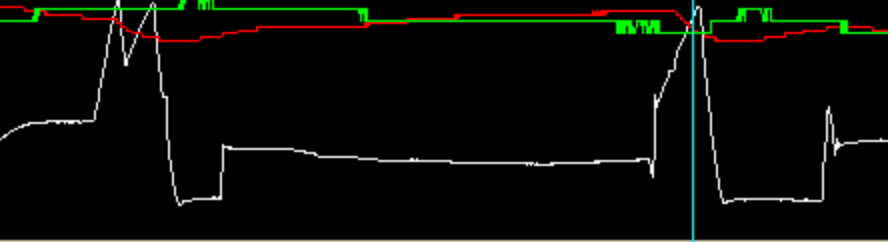
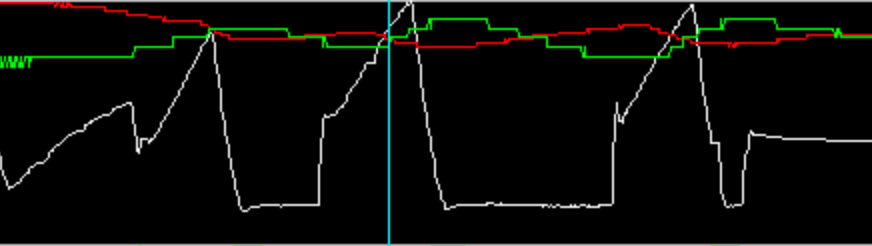
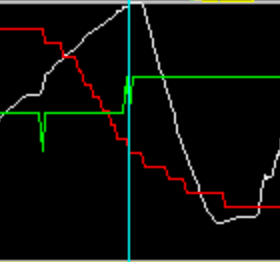
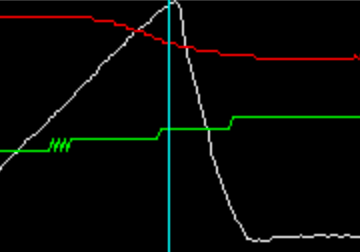
Two similar runs, only difference is "a little tape around the sides" and "no tape at all". Ambient temp about 28C both days (yesterday, today) White: RPM, peaks are just over 7k Red: coolant, peak is about 100C, 1 degree steps Green: IAT, peaks are 48-50C, 1 degree steps No tape: The scale makes it less obvious, but IAT swings wider, AIT actually rises under WOT, and rests about 2-3C higher overall. Tape: Less variable, which includes less drop after WOT, which makes me think the drop is more due to highspeed airflow, and less through the actual intake. AFR and trims are indistinguishable in these two configs. My net conclusion: - hot air is coming up from under the bonnet, seeking the largest opening (the intake cutout), and getting pulled back into the air filter - a little tape around the filter is not bad, and helps a little, like 3C, among an overall creep of about 15-25C heat rise over ambient - blocking that hot air from the engine is possible, and would lead to near-perfect heat exclusion. - the potential gain here is like 2-4 HP. There does not appear to be any other negative impact from this intrusion: the engine runs well, no knock etc. So now my math is whether I want to try and block that airflow from the radiator, and how to do it. Taping the filter is "free", but a more effective solution would probably be a heat barrier ($50), formed around the air filter up to the edge of the chassis and around the bonnet, to help block the leading edge and bottom.

-
.thumb.jpg.885191d302e6c3704c848a8f5ac3a612.jpg)
420S Rainy Season Build in Western Washington
Austin David replied to Timberline's topic in Build Threads
I think we can all safely say that any challenges you find WILL BE surmountable... but it's hard to predict what else you'll discover along the way. -
420S Rainy Season Build in Western Washington
Austin David replied to Timberline's topic in Build Threads
ha, you did a better job than I did. I just made little plug-in extensions. FYI, that double wire is a ground, and one leg goes further down the loom rather than running multiple grounds all the way back to that connector. -
minor update: I cut a few more inches out of the bonnet, with the intent to open about 1/2" in front of the air filter. The air filter is taped "minimally", which basically means up to the hood penetration around trumpets 1-3, and slightly more generous under the hood by #4 but still behind the curve of the air filter. I tried to get some data last night but it didn't collect correctly, BUT watching IAT on the dash I saw that it was holding 15-20C above ambient, and did not materially deflect under high load (WOT @ 7k RPM). This morning I did some more typical commute-style driving and it was consistent, 15-20C above ambient without a lot of deflection. Even with a few miles at 60 mph, very consistent +20C IAT. Ambient about 20C, IAT around 40C (39-41). I grabbed the IR thermometer, and checked temps at idle with the fan running: 50C +/- 1 at the leading edge of the filter, and 30C +/- 1 at the trailing edge. Ambient is 20C still. IAT sensor is in the center of the air filter. the surprises here: more airflow seems to have either made it worse, or definitely has not improved IAT. But this does match observations with bonnet removed or most free-flowing filter, where IAT matches "heat dump from radiator" (coolant down -> IAT up). Also, for anyone finding this thread: I'm not sure what impact IAT has on performance, but internet-sleuthing seems to lean toward 1HP per 5C OR 1% per 10C, "lower is better", and anything over 150F (65C) is bad. So if the +20C difference is stable, I'm well into the range of "this is probably fine", especially in partial throttle.
-
420S Rainy Season Build in Western Washington
Austin David replied to Timberline's topic in Build Threads
I used 18ga. They don't carry much current so it shouldn't matter. They get a little warm, so close to the cooling, but pretty much anything will be OK. I also had to zip tie them in place, they want to wiggle around -
420S Rainy Season Build in Western Washington
Austin David replied to Timberline's topic in Build Threads
I created short splices, with one male/one female spade for the two lines. I've seen other layouts which inverted the submarine from the diagram, so it's over top the coolant hose. I think in that configuration it may reach directly... but the little extensions worked well for me for a few years. FYI the submarine sensor is *just* an external, independent coolant sensor for the gauge in the dash. It's not consulted by the ECU, and isn't even calibrated with it. For now definitely plug it in, but when you get the itch, I like CANchecked gauge. -
you can compare a [Caterham] to every car every made, but not to another [Caterham]. My primary concern is that huge gap at the back of the filter where you might be able to see guts... if you're standing within 3'. Yes, this is NOT A REAL PROBLEM. I'm just trying to figure out the boundary between "you definitely need to cut more" and "now you're just showing off".
-
bonnet OFF, air filter "open" (no tape): IAT is now a function of speed, range was 27-34c, ambient about 20-25c. Very little deflection with RPM. For various reasons I didn't get a lot of data, but the data I do have shows 13.20 and 13.38 at two points, with 1.0 trim -- in line with "a little bit of tape", but without the better heat management. The steps are degrees C, and the rise is about 2-3 C after the radiator starts dumping heat, then tapers back off with the airflow.
-
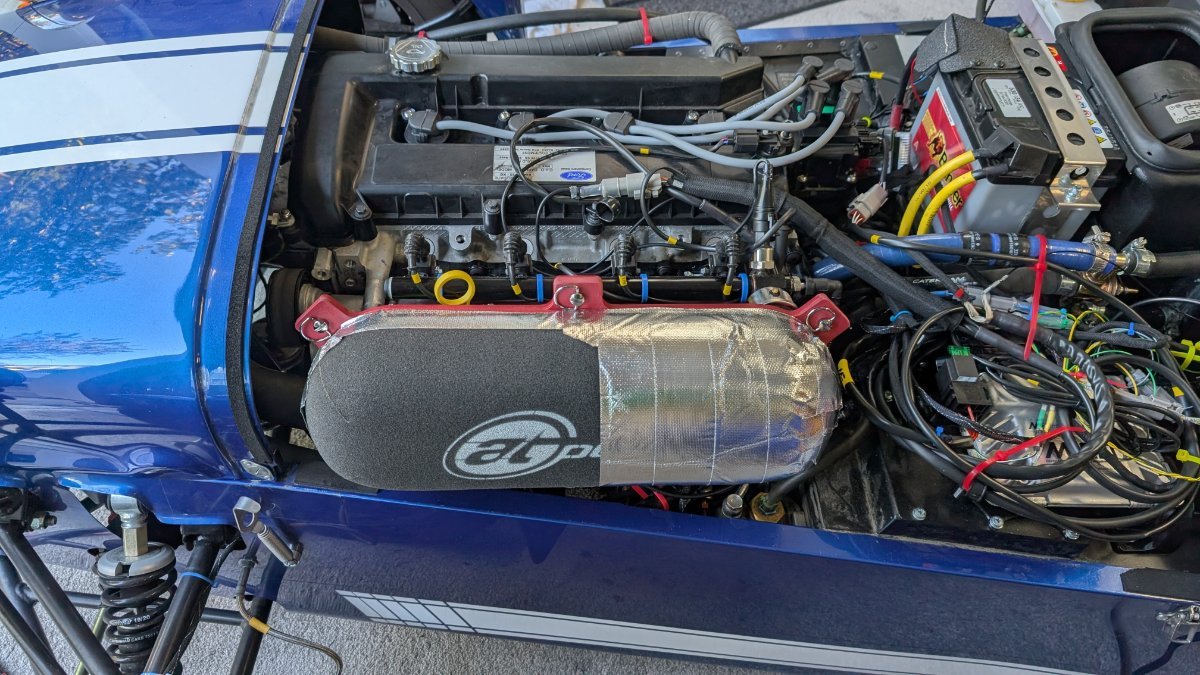
For reference: this got me started, and represents the minimum cutout to fit the bonnet. Cyls 3, 4 are still under hood, only trumpets for 1/2 are exposed. Here's a shot of the fully-taped filter, which mostly matches the above bonnet cut: ignore the wiring and ignition coil, that will eventually come back out. Some details in my build thread. This configuration has the best heat management, but appears to restrict some airflow at WOT. 1-2% average enrichment + 1% fuel trim (out) from ECU. Under throttle the IAT drops back to ambient, reliably. Throttle > 98%, 7k RPM, average AFR is 13.19 + 0.99 fuel trim. Target is 13.2 Finally, a shot of the bonnet as cut right now: You can see the edges of the tape just inside the penetration, and removed up to the trailing side of trumpet #4 under the bonnet. This setup seems to balance heat with much less restriction. 13.16 AFR @ 7k / 99% throttle, 1.0 fuel trim. with tape 100% removed: 13.33 AFR, 1.0 trim -- concluding this runs a little more lean, less restricted. IAT is also 45C vs 25C (with partial tape), not clear how much difference that should make. The AFR differences are definitely subtle. IAT and temperature swings with throttle (not speed) are much more dramatic.
-
It's hard to un-cut, so I've been making progressively larger holes and trying to prove I need more. There aren't any close enough to test, I live in the sticks But I will be testing with zero bonnet, to at least get a baseline set of measurements with zero restrictions
-
I've been replacing my perfectly fine stock Caterham 360 intake with ITBs, and in the process have been figuring out a good balance between mangling my beautiful car, max airflow, and minimum heat intrusion. I happen to have a lot of data available from my ECU, as I'm also tuning it, so I'll share my findings here. It's not what I was expecting. My engine is a "stock" 360 with the milder cams. The entire intake has been removed and replaced with an ITB setup from AT Power, with ECU from ME. In this investigation the most interesting part is that the air filter is a vanilla pipercross-style aluminium backplate + foam filter, and is not isolated from the engine bay. IAT sensor is at the top of the backplate between trumpets 2-3, not far above the throttle cable. For this data (and until otherwise specified) the bonnet is cut from before cyl1 up to about cyl3, where the filter remains under the bonnet-line. Measurement: WOT run in 3rd at 7k RPM, tracking IAT, Coolant, AFR, and lambda trim. AFR is measured at the collector, an average of all 4 cylinders. GENERAL findings: - lots of heat intrusion from the engine bay, like, a LOT. With the filter open, IAT rises about 20C above ambient (25 ambient, 45 IAT) and mostly stays put. No significant drop at WOT, and it stabilizes about 20C over ambient. This was repeated before I started recording, which led me to try blocking engine heat. - taping half the filter (pics below) will totally cure heat intrusion, but restricts airflow a little. More analysis to follow - just taping the sides of the air filter, particularly around the sides behind the horns, MOSTLY cures heat intrusion with measurable, but relatively little air restriction. white: RPM red: coolant temp green: IAT Bonnet in place, no taping on the air filter: - no IAT deflection with airflow - rises continuously, I suspect from the heat dump off the radiator at speed Bonnet in place, air filter taped around the sides + short of #4: IAT drops with airflow Bonnet in place, air filter taped up to cyl 3: note that IAT bottoms out to the minimum value, ambient. This happened at every WOT event
-
420S Rainy Season Build in Western Washington
Austin David replied to Timberline's topic in Build Threads
I was recommended carpet tape, and it was a great call. I've pulled it up at least once to add my seat heater wires. I never used the set screw. "That ain't goin anywhere" works pretty well. Also the tunnel cover is captive while the seats are in, OR while the gear knob is on, OR while the e-brake is down. -
they used a controller because they're (I assume) not running the pump at full blast, AND they don't have any active pressure management. Without more information I could only guess, but I assume the ECU is sending some sort of predictably-variable duty to the pump, like based on injector duty. That's what I'm doing, but I also have some amount of pressure feedback and monitoring.
-
Some minor catch-up to share my joy. First, the good: I've been pulling a lot of logs and I can see (measured) 0.1s between throttle open and RPM leaping. Throttle response is VERY fast at idle, where the original plenum had a noticeable lag. The plenum lag is probably fixable with tune, but not doable on the locked factory ECU. When it works (see below) it does work well. Throttle response is what it should have been from the start, sound is great, and torque is stronger at very high RPM. The stock 360 kinda started falling off at 6500-ish, this tune pulls through to 7k. I have not tested, but there is an ignition cut programmed at 7400. I also got a free* knock sensor, which does seem to work well by default. Very little actual knock, but I've found a couple events including the one I looked for. Learnings: 0) "sharp tools" are important. In this case it means a laptop, software for log analysis, experts ready to help (remote tuner), and literal tools for repinning cables, properly making terminals, etc etc. 1) the ECU probably doesn't "matter". If doing this again, I'd pick my tuner and hardware kit (intakes, fuel management, etc) THEN select an ECU recommended by the tuner. That said, I am getting good support from overseas, though with a lot of overnight-waiting. 2) science is important. This would be easier if I knew what the "baseline" 360S acted like: fuel pressure, AFR at RPM range, etc. The "factory tune" might not be perfect, but with all this new control and measurement I am tempted to make the new tune perfect. Hard to tell how "perfect" it needs to be, to be better than the factory tune 3) there are a lot of variables, and some things that can only be done once (like cutting a hood) and some things that can be re-done without too much cost, like making a custom harness or cutting an air filter backplate. This would have been easier, and maybe 5% more expensive, if I'd planned some of these ahead. Some annoyance, which led to delays but probably not show-stoppers: - alternator electrical noise... and while troubleshooting, seem to have led the ECU to dwelling on plug 2 which fried the driver. Couple days of troubleshooting + offline exchange, but will be getting a new ECU (see above, excellent support from ME) - maybe ignition noise, TBD. infrequent "lost sync" events at ~ 4k RPM. More data required - to work around the fried driver, may (temporarily) run a traditional coilpack + wasted spark setup. I assume I'll eventually go back to COP - assuming the alternator noise persists, I'll go with a 1-wire "Denso" style option. Appears to be a 90mm / "mini race" alternator, they run $150(ish) for 55A or ~75A.
-
420S Rainy Season Build in Western Washington
Austin David replied to Timberline's topic in Build Threads
My 2021 order came with a new motor dated 2017. A 420 would be fresher but these just don't sell that fast. I too had some funny rust I wasn't expecting... After a few miles and rainstorms it seemed to matter less... -
FYI I manually checked timing, the crank sensor appears to be rotated 275*, where the ME map expected 265. I also saw reference to 255 in other docs, so ... reminder to double-check what you think are sensible defaults.
-
needs a good home: 2L Duratec intake parts
Austin David replied to Austin David's topic in Parts For Sale / Wanted
a home has been found -
Push-button replacement for Dzus fasteners on Caterham nose.
Austin David replied to pethier's topic in General Tech
I used a leftover washer from my build for 2 years. I don't pull the nosecone much so it was tolerable. I tried making a tool using a penny but the penny bent (!!). I acquired a larger, hardened washer recently and filed it to the right thickness, but that's not much better than the first washer -- it's hard to align under the cone, and hard to get much torque on it with my knuckles. A few weeks ago I got a "coin" driver; it's easier to turn, but basically has all the same downsides with alignment etc. I may get annoyed enough to try @wdb's butterfly on the bottom. The top fasteners work ok with a washer. -
Leftover parts after an ITB installation, all from a 2021 360S -- 2L Duratec - air box & filter, throttle body w/ TPS, plenum, mounting hardware - fuel rail & injectors - decomposed wiring harness for these (ie mostly the plugs & pigtails) - MB ECU -- locked from Caterham Any / all for the cost of shipping.
-
@wallisek did you get it sorted? there are a few methods, it's annoying but a good excuse to go for a ride. I personally just ran at 70 mph indicated, used a phone GPS app, then did some light math to compute a new PPU. Did that a couple times, it's perfect.
-
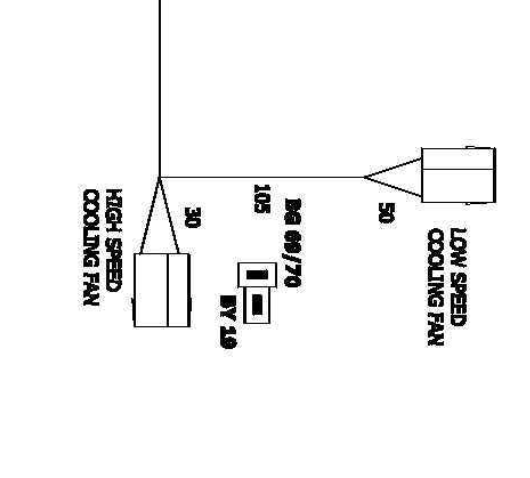
Page 216 in the 2015 manual has this (attached). It shows two plugs so I'm guessing there's a second fan in some version of the car? My fan definitely only plugs into one of those two.
-
awesome! I am by no means an expert but my understanding is that this bumps a 360 up to 420+ spec (420 cams + better intake). Vanilla 420 would be ~ 210HP.
-
you say roller barrels and cams; is that basically the 420S upgrade kit?
-
Is the fan a single- or two-speed fan? I notice the electrical diagram shows two drops for high and low speed, but my fan has only two wire connection and as far as I can tell it's wired up to the cooling fan relay directly, which I assume the former ECU controls/ed with a simple on/off. As in, with the ECU disconnected I can ground the correct relay pin and the fan comes on and sounds fairly loud, and I don't see any obvious second circuit for a higher speed. Car is a 2021 Caterham 360S (Duratec) with new electronics. On OEM electronics it behaved "normally" as in "fan cycles at idle" between 90-95C" and I feel like it was very much on/off but I did not test it before I ripped out the old ECU and harness.
-
ok, for future sleuths: - it's on purpose - it should get hot while the little battery light in the tach is ON -- ignition on/engine off, or alternator no worky - it should not get hot while the engine is running normally (light is not illuminated) - it's there because the LED in the tach doesn't draw enough current on its own, so this will sink a few W (2? 5?) to keep the rest of the system happy. Thanks @sltous, I wasn't able to find that set of articles.