copy.jpg.dd4bdbb41ccb3ea8a585d1ad217ef61b.jpg)
.jpg.da03509438cc84820b8cf5d64db570ab.jpg)
Austin David
-
Posts
422 -
Joined
-
Last visited
Content Type
Profiles
Forums
Store
Articles
Gallery
Events
Library
Everything posted by Austin David
-
https://caterhamparts.co.uk/master-cylinder/601-brake-master-cylinder-lhd-csr-no-reservoir.html this one?
-
Thanks! LMK when you get closer and I can burn you one
-
we'll definitely post plans and an itinerary. would be great to meet you if we can make it happen. Here's a similar ride the local (to me) Bri'ish car club made last year: https://www.britishcarclubcharleston.com/TailOfTheDragon.php -- basically a day out, 2 days around the mountains, and a day back. Looking at maps, I think that's a fairly sensible route; especially if we include cherohala skyway and highlands (which are about 2-3 hours apart). I was kinda thinking of using one lodging for the trip as a "home base", to leave behind luggage and doors and whatnot, but that might lead to a few round trips and more calendar time. If we did end-to-end (carry your doors): start at highlands, NC; drive 1.5hrs via Franklin to Robbinsville, break / fuel / lunch From there up to Tallassee via Deal's Gap and back (1.5 hrs) to Robbinsville then out Cherohala (~ 2 hrs). Overnight around Tellico Plains. A shorter option: Robbinsville -> Tallassee -> Robbinsville -> Tellico Plains -> Robbinsville ~ 185 mi, <5h. Open to suggestions. It's not lost on me that BRP is striking distance, for those of us to the east (if you wiggle the map and squint and obscure facts when discussing this with one's spouse).
-
Is that for the tail lights or the front signals? What PN should I look for? I've been thinking about re-rigging the front-facing signal lights for dual running/signal service. I opted for the LED headlamps, they're fantastic
-
Hm. I'll have to look that up. A neighbor has an old (60s?) Ginetta, but it's a little smaller than that. Jimmy and I are talking bout a ride to TN/NC to look at trees and bendy roads for a day or so. Eyeballing a map, I think you're a ~1/2 day away, same a us (give or take). Drive out one afternoon, overnight #1, ride around for a day, overnight #2, then home on the 3rd day.
-
It's all magic and voodoo. Sounds like you got a weird config delivered, and once that was sorted you're in a good place. You gonna bring it out to deals' gap to meet me and Jimmy in October?
-
I had to use a power bleeder and a lot of pressure (like 100#) to get through some sort of bubble in the rear line. Even now, by feel, they seem softer than I'd expect, but they felt better after bedding. And they definitely stop the car, and modulate well once I take up any slack. I'll flush them later this year when I get bored some weekend.
-
Franklin, NC -> Highlands, NC: ~ 35 mins / 20 mi Cherohala Skyway: Tellico Plains, TN -> Robbinsville, NC: ~ 1.5 hrs / 52 mi Deal's Gap: ? 30 mins / 12 mi Sounds like we could meet up at one end night before, putt around a day, overnight on the other end, head home? I think both endpoints are ~4 hours from either Atlanta or Charleston, fortunately sort of in the middle.
-
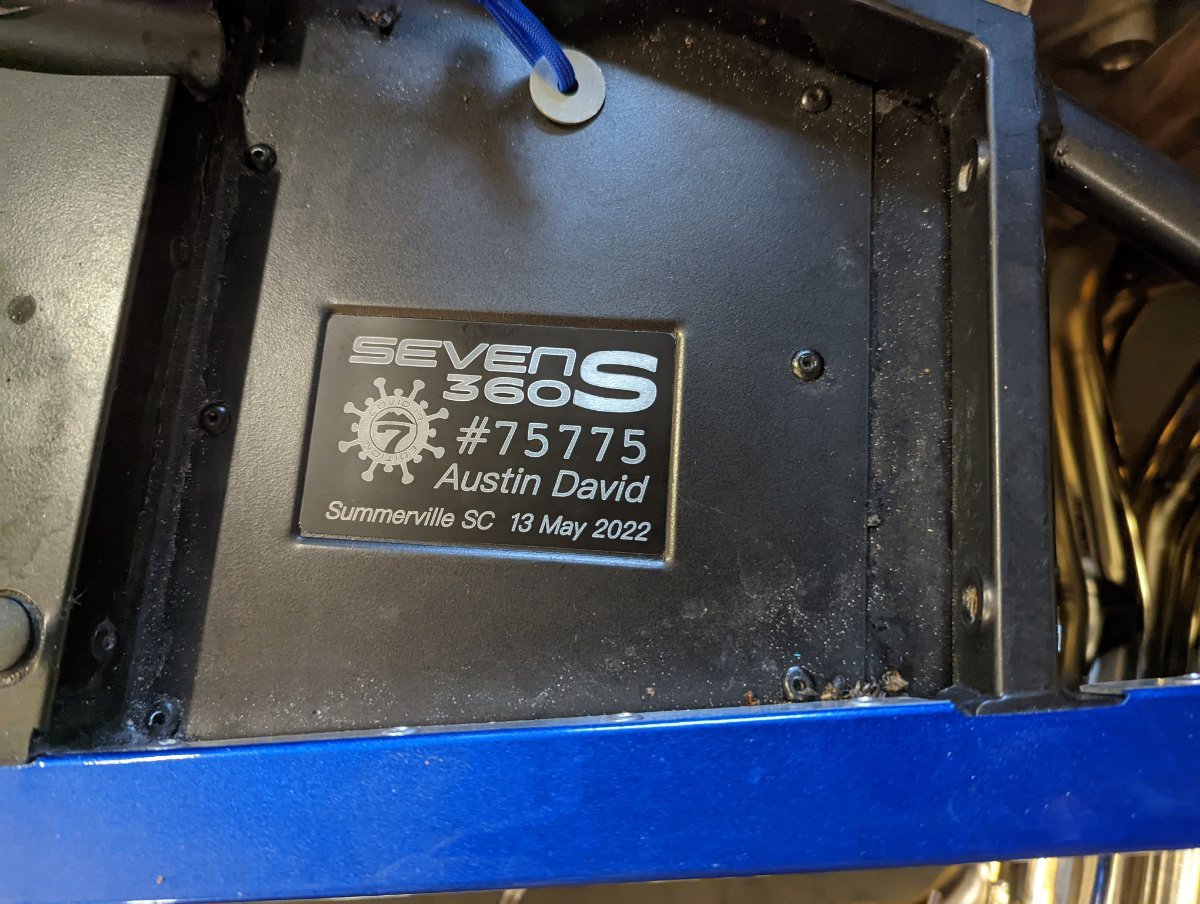
found an indent on the RHS footwell in the engine bay, perfectly-sized for a business card / build plate.

-
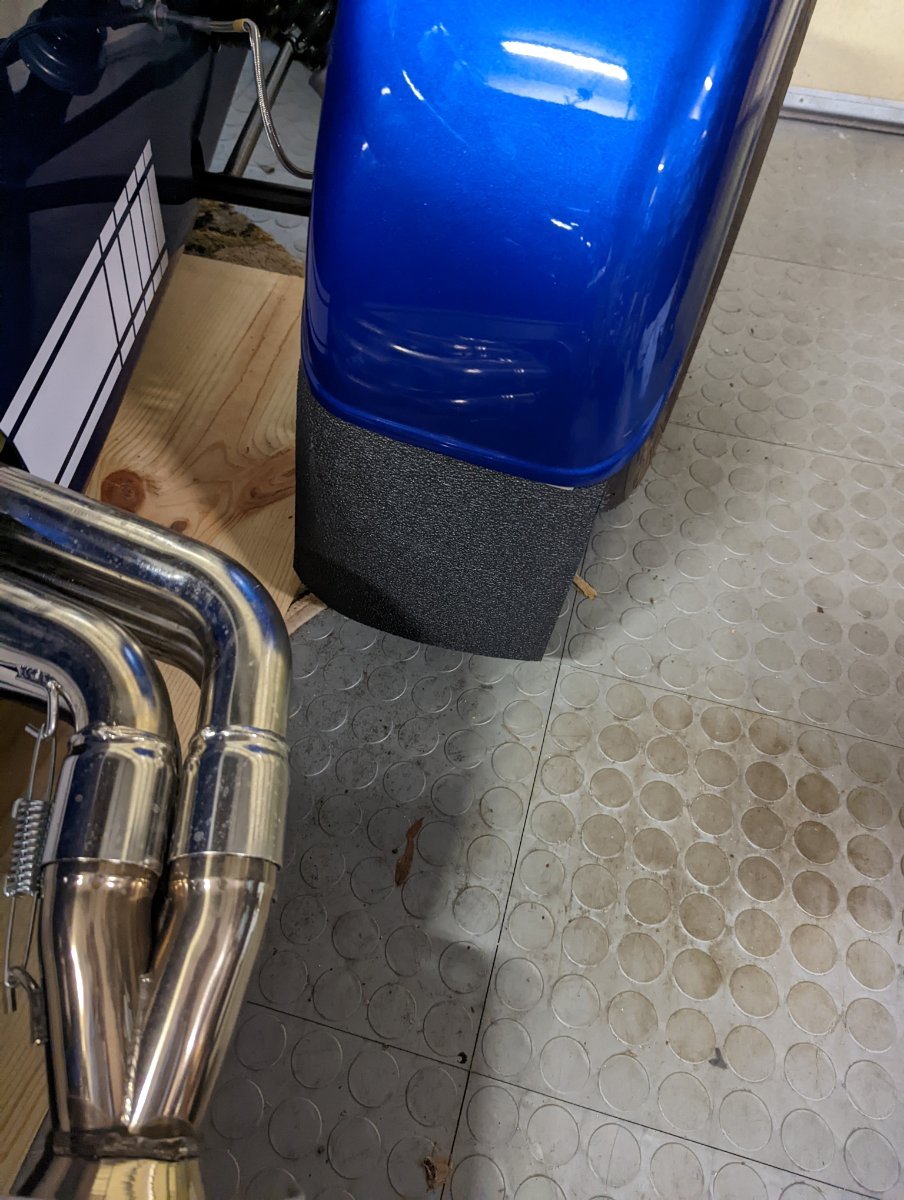
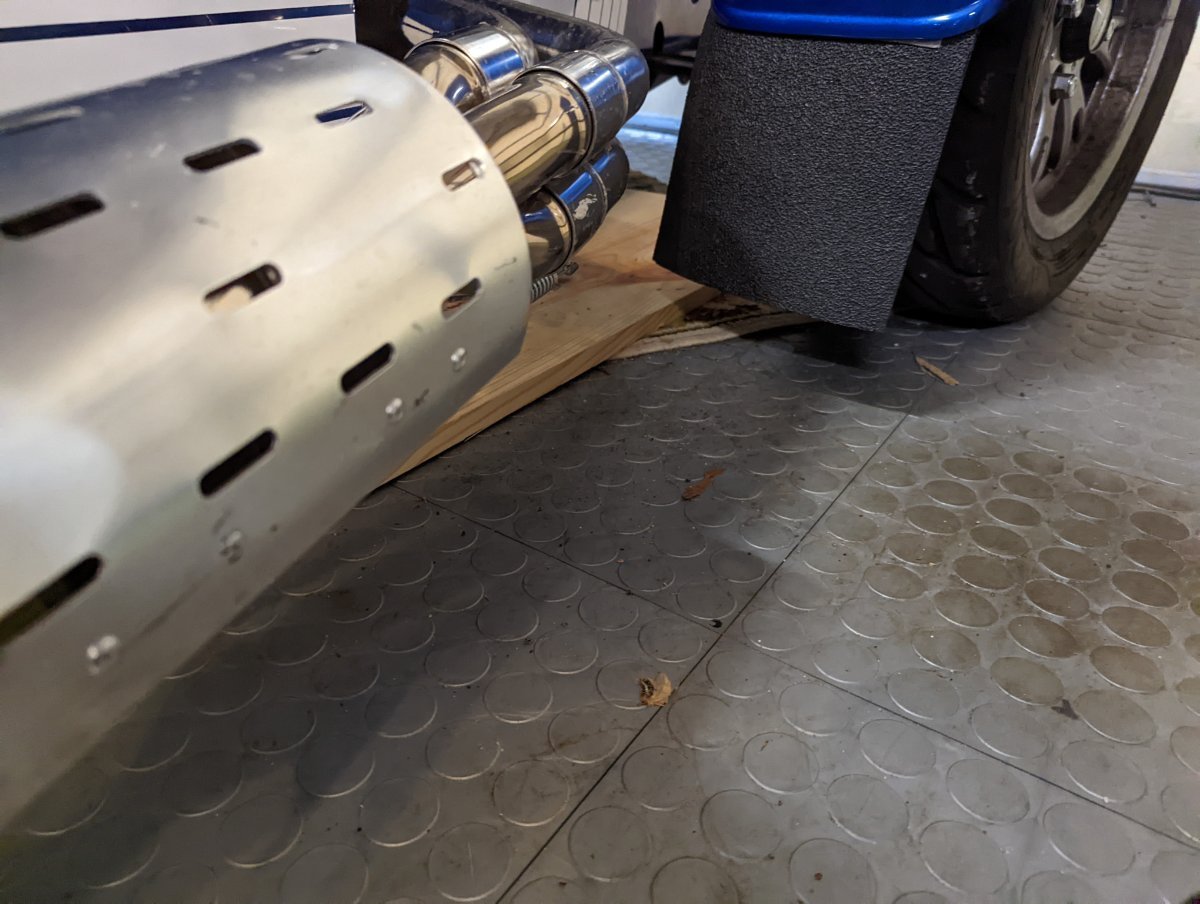
I'm also experimenting with flaps. Some light notes here as things progress. The platform is a newish Caterham, Duratec (360S). I'm using recycled rubber material, about 1/8" thick. I've cut two 8x8" squares, and VHB-taped them to the back inside of the cycle wings. They are pretty flexible. The RHS is long enough that it could hit the primaries, but has not yet been an issue on a few test-rides around town (50mph max, mostly much less). Significant improvement on gravel kick-up. Anecdotally it sounds like less pinging, and empirically I'm picking less up out of the seat (and my shirt / face). If this configuration becomes permanent I may extend the material to fix to the cycle stay, and tap a few screwholes on there for a more permanent mount -- and to offload some pressure from the fiberglass. I'll also round off the corners, of course
-
The Miata came with two versions, apparently the MSM version is better for lowered suspension. Safe to assume Westfield know what they're doing, I was mostly curious. Thanks for detailing the build, it's interesting to watch in real time. Will be *very* interesting when you select a turbo kit
-
are you using the MSM lower tie rod ends? I'm not sure how different the 90 knuckles are... I rebuilt the 4 corners of my 99 NB; my dad got it in '04 with 24k, and I took it at 125k in '12. Rebuilt the corners at 150k and ended up replacing 100% of the hardware. Enough of it was suspicious and the rest was relatively cheap. Compared to coilovers and everything rubber, anyway. Some of those parts like to hold mud & water, I'm not surprised that they're in rough shape after 30 years -- even on a car that was relatively well kept (if well loved).
-
What's your track mileage? 30+? I'm only in my 4th fueling and I think the aeroscreen made it better. If I'm not driving like points are free it's shockingly high. If I drive to match others in Atlanta I'm still north of 30. Mostly I'd want to be sure it's reasonably fueled (like 12-14.7 I assume) and not super rich for no reason. After that I'd hope mileage were largely a function of throttle position...
-
did you see any power-related benefit, or mostly with response and sound? I saw your other post(s) about fuel economy, so not sure if you have other gremlins in there. Mine is pretty thrifty. Also I can SEE my plenum contracting just by blipping the TB at idle. I'm sure there's a fair restriction in the intake. Still on the stock filter, FWIW
-
Hi! I have a new 360S, Duratec w/ wet sump. This is a street car and will be mostly toured / grocery runs. Now that it's barely broke in, I'm thinking about the motor. Curious if anyone has direct before/after experience with ITBs and a sub-420 spec? I've poked around a bit, the upgrade path mostly looks race-oriented with cams and injectors as well as the RBTB or ITB, depending on kit. I assume that will mostly push my torque into higher RPM and let it breathe better... but I also believe that will largely trade some low-end torque for top-end performance. And per grocery thing, I'm not sure I want to make that trade. Any direct experience out there? @KnifeySpoonyshared a little of his experience (esp wrt 420R -> RBTB)
-
Aeroscreen: fitting this is pretty well written up elsewhere, I'll add the things I had to figure out. - removing the windscreen is easy for 2 people, but not hard solo. I loosened both sides, removed one side completely. The screen will stay upright, no problem. Cut the wires (if you ever want to reconnect, cut as close as possible to the spade), then re-attach that side. Repeat on the other side, but leave it loose. Go back to the first side, hold the screen + remove the last 2 bolts, and carefully lift the screen off. I put rags under the loose side "just in case". - mirror placement is sort of a dark art. Having drilled holes I think I got lucky (plus there's some room to adjust). I eyeballed the RHS and made the LHS match. Aesthetically, it may be interesting to have the 3 mirrors all at the same height. To make them symmetric, I measured from the rearview to the center of the sideview mount, and matched on both sides (16" exactly, from opposite edge of rearview -> center of sideview mount). It seems to work, but I'm short half the hardware so only the RHS is mounted until stores opened the next day. - the screen is curved, the mirror mounts are flat. I used VHB tape + thin foam pad (drawer liner) for a sort of makeshift washer, trimmed to fit. This MAY help spread the load a little better, and not deform or crack the screen - there are two open holes on the scuttle, I've used SS washers + two windscreen bolts to fill cover it.
-
I think I'm at 3.9 in my NB. Stock torsen, which is fantastic. But first gear is mostly for show... I thought I saw a 3.6 option, but I don't recall where. I only have 175k on mine so it might be a whole before I wear it out
-
Those specific plugs come up in my ad feed, with all my various searching. Thanks for sharing your experience. What beanie exactly, or is there a term for which I could search? I use a hat or do rag, and tuck a pretty big gaiter under it. This gives a pretty thin layer over my ears, and doesn't do anything to moderate the wind.
-
OK, I've been doing some semi-scientific research, specifically around noise. Summary to date and today's update below. Test platform is my 2021 S3, LHD, exhaust to the right. I assume RHD + RHS exhaust would be different. Also I *always* drive with a tonneau in place. 1) helmet + earplugs are probably best. earplugs are OSHA-rated, 33dB reduction is about as good as you'll get. ANY earplugs will transmit direct pressure (like wind blowing on your ear), the helmet will stop that direct pressure and leave the sound pressure to the plugs. With over 100k on motorcycles and another 20k in a different open cockpit car, I can safely say that full-face helmets are useful for noise suppression, and any 3/4 or half-helmet is of little or no use. 2) after 33dB plugs, Isotunes (isotunes.com) remain the best. They're an OSHA-rated earplug / 25dB reducing. PASSIVE reduction, not active -- they're earplugs which can play music (at limited levels, because OSHA). They work and are hearable at highway speeds with windscreen or aeroscreen. 3) Samsung Galaxy Buds Pro definitely, and any active sound-cancelling system probably, are not particularly effective against direct wind pressure. They work awesome in a noisy-but-calm environment like an airplane, but in a windy car the noise cancelling doesn't really deal with wind. Volume gets drowned out and wind comes through. I've had the same experience with every active noise-cancelling system, but I can't directly speak to airpods. * Windscreen w/o door might be the worst, close competition to this configuration + half hood. * Windscreen + half hood is the worst combination of wind vortex, which conspire to blast wind directly into your left ear, and to a lesser extent the right. Hats are not usable. * Windscreen + side door is better; the incoming rush from the left rear wing is deflected a little (depending on the door). * Aeroscreen is best for noise and windiness. Hats + sunglasses are fine, but for me the wind comes in right about eye/forehead level, so I would always want good eye protection. However the wind deflection doesn't overcome heavy rain. At all. Oh also, if you want to TALK, get a throat mic. Under $20 for wired @ Amazon. I have exhaustively confirmed it works AMAZINGLY WELL at highway speeds, where the best mic-based systems tend to start failing around 25-35 mph.
-
what else do I need, now that I'm investing in three pounds of shipping?
-
I've been chasing low-volume drips. I saw a small puddle (like a teaspoon) this morning. Put on 100 miles, found a few more little spots of residue in a LOT of places that were new. Tightened most of the clamps again for the Nth time. I did cycle the engine and heater a bunch before starting the proper break-in. Nearing 1000 miles I think I'll just touch everything under the hood when I change the oil. Thanks for the tip on the reservoir cap; I have no issues, but I don't want to invite anything. edit: https://caterhamparts.co.uk/master-cylinder/914-brake-master-cylinder-cap-race-no-float-switch.html this one? On a quick search, it seems the problem is "enthusiastic" driving -> slosh -> dribble out a vent/weep hole. The race cap has the bellows to allow for expansion, while maintaining the full seal.
-
I saw that. I have a grinder at home but woulda had to go out to hunt for tiny washers...
-
I did about 700 miles in the last few days, which I'm calling the big shakedown ride. From here I'm calling this complete, though there will always be something to improve or fix. On the ride (specifically, in the last 60 miles) I noticed the temp gauge bouncing a little. Like, very little but it was new behavior. I pulled over and still had coolant, but it was lower than when I left. No other indication of problem. This morning I confirmed the coolant was down below min; I topped it up to max, ran to refuel + check. After 5 miles it's still right where I left it. No OBVIOUS signs of leakage, but there was some wet blue in the front cowl on the left side, so I assume it was dribbling out of the lower radiator hose. I snugged that fitting and the upper slightly. During the trip I kept a close eye on all my parking spots and never saw a drop of any fluids, and with no burping it looks like it didn't spit out too much either. Oil is right where I left it. Brake fluid right where I left it, and no wet spots. Clutch pedal is a little squeaky all of a sudden, but otherwise everything seems to be really happy. Mileage and range are still sort of unknown, but 220 miles => 7 gals consumed. Some afterthoughts about the actual build: - I am glad I went with the S3 & retractible belts. I have to scoot to buckle up, and I definitely shouldn't gain any more weight, but it is VERY COMFORTABLE with 5 hours in seat. 5'8" + 180#, 33" waist. My head brushes the hood if I don't slouch. If I were taller I'd want the lowered floor, and if I were wider I'd want the SV chassis. But I'm not and I am happy with the S3. - I mighta paid more attention to all the checkboxes, but no regrets. Specifically the 360 + wet sump combo appears to be relatively rare, compared to the 420 w/ dry sump. I LIKE the wet sump for fewer tubes, but I don't have a lot of points-of-reference out there. Ground clearance is about the same, except that my leading edge is an oil pan, and the dry sump leading edge is "just" a bell housing. Side note, I do have most of a Pace dry sump kit, not sure it will ever get installed. - I am glad I didn't go for "less torque." Another vote for the 360 is that it's relatively torquey, esp compared to the Zetec lineup. I'm sure the Cat 160 is a fantastic car, but I like my build a lot. And ITBs will go a long way too on this duratec, someday. - I like the ARB, definitely like the option of turning it on/off. I haven't disconnected the rear ARB yet, but at 2/4 (2nd-softest) the car rides VERY flat, but also very comfortable on sh*tty Atlanta roads. I haven't even begun to test limits yet, but casual driving in the 7 is "oh crap" in anything else. Eventually I'll play with tightening / loosening (or disabling), but I'm pleased right now. - Glad I went with the 13" wheels and the spare. The extra sidewall makes for a comfortable ride, not really too harsh but still very communicative. The spare is mostly because 13" tires are impossible to find in the wild, but it also makes the back look nicer in a way I didn't anticipate. And the extra ~ 12" hanging off the back doesn't at all interfere with the "size" of the car, it's still pretty small in my garage. But I was expecting to be able to remove the spare for around-town use, and I don't have a good solution for that. The carrier is bolted on (removable) but the license plate and light are tightly integrated. I'd have to obtain or make a license plate carrier, and a disconnect for the light. Not impossible, but since I kinda like the spare and I don't need to shed the ~ 15#, I won't bother. - Tonneau cover was a deal-breaker for me, and I like it. I honestly do not understand why anyone would NOT use one -- even with passengers, it protects your stuff + interior while parked, and it makes solo driving so much better (esp in winter). Go for the tonneau, and the aeroscreen. Both are easier to do at build-time than trying to fit in later.
-
maybe a little late, but have you driven a powered miata? I have a 99 running about 200whp, and if I could change one thing I'd make the diff a little taller. Shedding half the weight would make me want this even more. I'm only a few hundred miles in my cat (which has the same transmission + similar final ratio), but when touring I also feel like a little lower ratio would be nice. 75mph @ 4k RPM, there's a lot of available power in top gear, but I would also be ok with less power + downshifting...
-
I love the *look* of the brooklands, but from what I've read it buffets more than the "aeroscreen". Any direct experience between the two? I have ~ 870 miles on my windscreen, fitting the aero tonight and intend to put about 100 miles on it tomorrow. For science.
.thumb.jpg.885191d302e6c3704c848a8f5ac3a612.jpg)