MV8
-
Posts
2,303 -
Joined
Content Type
Profiles
Forums
Store
Articles
Gallery
Events
Library
Everything posted by MV8
-
There was a Dan D Radiator Repair in Carabelle but it's long gone. Try Casper in Panama City or Dothan in Dothan. If actually needs a new core (i.e. full of pin holes after cleaning) you may be done as I doubt a new copper core is available.
-
Requires logging into google to view (I don't) but good to hear you've nailed it down. May want to check out the entire ecu harness integrity (i.e. intermittent shorts) before plugging in the new. I'd probably go standalone ignition and carbs or ms if there is a repeat.
-
A source: https://www.radtec.co.uk/shop/makes/caterham/

-
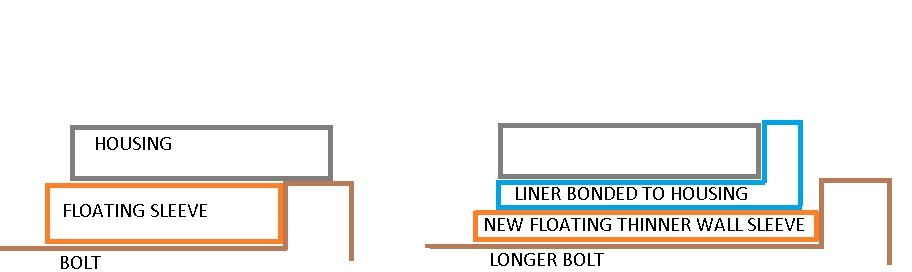
Understood. I've no doubt that replacement with an improved part is the best way to go, using better quality materials and/or increased wall thickness/support/gusseting. My suggestions are only for improving the safety margin and service life of original mounts found to be serviceable as-is or repaired if possible to standard specification. To clarify, I've included a crude drawing. The wall thickness is effectively increased and the liner is steel. I don't know all the oem dimensions or how practical it would be.
-
If the floating sleeve is not rusted to seizing in the housing to cause the failure I described, it could be that the floating sleeve to bore fit is not as close as it should be or the bolt is not as tight as it should be, allowing the sleeve to move vertically in the housing bore with every bump. I see the wall thickness of the housing is less than a 1/4 inch. The floating sleeve od could be reduced enough to make room to fit a fixed liner to the housing. The liner could be flanged to provide more leverage, surface area for the load, and prevent the liner from sliding when tightening the bolt. The bolt would likely need to be longer flanged or not, to move the socket head out of the housing or the od reduced/ground for clearance to the reduced housing bore.
-
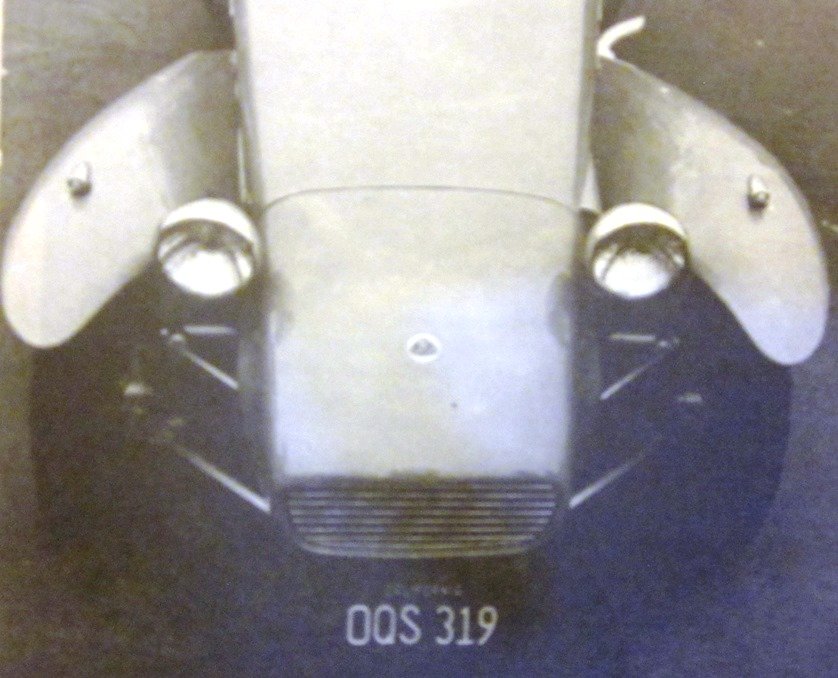
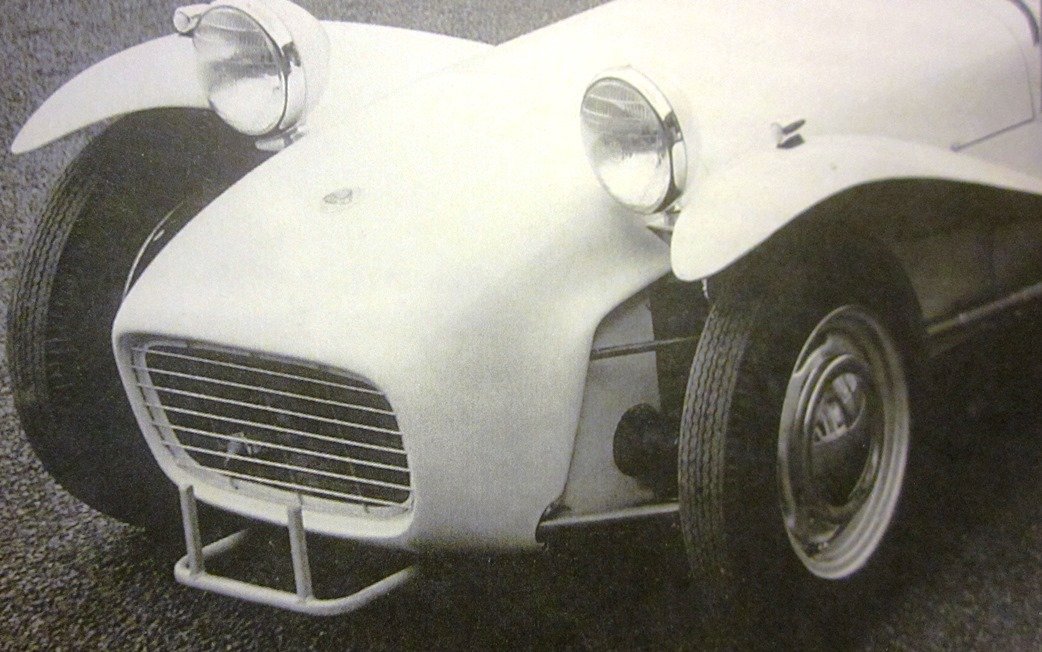
The original type tag mount can also lay the tag back at about 45 degrees like a scoop that doesn't block the nose opening, but it may have just been bent back to that angle in the 1970 article showing the mount. Maybe JB will show the attachment underneath?
-
I'm not familiar with a KCL 1345R. What year model and engine? I'll guess it is a post-2000 340R built for the EU outside the UK ("345") with a K series rover engine. I believe there is a blue wire from the head light switch to the head light relay. Check all the fuses. I spy two relays (probably headlight and indicator) and a flasher. If you remove the two mounting screws for the fuse box (I see one at the bottom), the whole box can be flipped over to reveal where the wires go. The turn signals do not typically have a solid blue wire anywhere in the system, but the system varies with engine and year model.
-

Importing a 2022 Caterham 7 from Canada to the US
MV8 replied to Arahant's topic in General Sevens Discussion
My personal interpretation means little, but I don't see anything preventing that. Section C seems to mean anybody driving back and forth across the border with a current US registration. Been there, done that. There are many reasons a person could have their vehicle seized that have nothing to do with goods, services, or criminal intent. There is a reality show about Canadian Border Patrol. Glad I live here. -
If the sleeve does not float on the mount, when the bolt is tightened to clamp the coilover to the mount, instead of the sleeve sliding in the mount to take up the clearance between the sleeve and the coilover, the mount ear is pulled toward the coilover by the bolt, causing the fatigue and cracking on the outside. Usually, one side of a flanged mount is fixed/rigid to ensure the coilover is located in the right position where the other flange is either flexible (enough to move as needed to take up the clearance needed for R&R of the coilover) or has a floating sleeve like this one does. Here is an example. One side floats while the other side locates: https://www.speedwaymotors.com/Speedway-Weld-On-Lower-Mount-for-Bearing-End-Shocks,3530.html
-
IMHO, it is decent design, but I can see how the floating sleeve side of the mount could seize in the mount ear if not lubricated and crack if the sleeve has to move during reassembly. The sleeve could be separated with a 1/2 x six inch threaded rod, washers and nuts, a couple inches of pipe or thick walled dom to slip over the sleeve and sit against the mount ear, a socket the slightly less than the sleeve od on the opposite side, and a hand torch and/or wd40. Then the ear bore and sleeve can be cleaned with emory cloth and a good copper anti-seize applied to both. Should work better than new.
-
Importing a 2022 Caterham 7 from Canada to the US
MV8 replied to Arahant's topic in General Sevens Discussion
19 CFR, Sec 12.73: § 12.73 Importation of motor vehicles and motor vehicle engines. (a) Applicability of EPA requirements. This section is ancillary to the regulations of the U.S. Environmental Protection Agency (EPA) issued under the Clean Air Act, as amended (42 U.S.C. 7401 et seq.), and found in 40 CFR parts 85, 86, 1036, 1037, and 1068. The EPA regulations should be consulted for more detailed information concerning EPA emission requirements. This section applies to imported motor vehicles; this section also applies to separately imported engines only if they will be installed in highway motorcycles or heavy-duty motor vehicles. All references in this section to “motor vehicles” include these highway motorcycles and heavy-duty engines. Nothing in this section should be construed as limiting or changing in any way the applicability of the EPA regulations. (b) Importation of complying vehicles—(1) Labeled vehicles. Vehicles which in their condition as imported are covered by an EPA certificate of conformity and which bear the manufacturer's label showing such conformity and other EPA-required information will be deemed in compliance with applicable emission requirements for the purpose of CBP admissibility and entry liquidation determinations. This paragraph does not apply to importations of Independent Commercial Importers covered by paragraph (d) of this section. (2) Pending certification. Vehicles otherwise covered by paragraph (b)(1) of this section which were manufactured for compliance with applicable emission requirements, but for which an application for a certificate of conformity is pending with the EPA may be conditionally released from CBP custody pending production of the certificate of conformity within 120 days of release. (c) Importation of vehicles previously in compliance—(1) Vehicles of returning residents. Vehicles of residents returning from Canada, Mexico or other countries as EPA may designate are not covered by this section. (2) Vehicles of commuting nonresidents and tourists. A port director through the issuance of an appropriate means of identification to be affixed to a vehicle may waive all of the requirements of this section for a nonresident regularly crossing the Canadian or Mexican border, or waive the requirements for Mexico or Canadian-registered vehicles of tourists or other travelers. (d) Importation of vehicles by an Independent Commercial Importer (ICI). An ICI is generally an importer that does not have a contract with a foreign or domestic motor vehicle manufacturer for distributing products into the United States market (see 40 CFR 85.1502). ICIs act independently of motor vehicle manufacturers, but are required to bring motor vehicles into compliance with all applicable emissions requirements found in 40 CFR part 86 and any other applicable requirements of the Clean Air Act. Before the vehicle is deemed to be in compliance with applicable emission requirements and finally admitted into the United States, the ICI must keep the vehicle in storage for a 15-business day period. This period follows notice to EPA of completion of the compliance work to give EPA the opportunity to conduct confirmatory testing and inspect the vehicle and records. The 15-business day period is part of the 120-day period in which an ICI must bring the vehicle into compliance with applicable emission requirements. A motor vehicle may also be conditionally admitted by an ICI if it meets the requirements in 40 CFR 85.1505 or 85.1509. Individuals and businesses not entitled to enter nonconforming motor vehicles may arrange for their importation through an ICI certificate holder. In these circumstances, the ICI will not act as an agent or broker for CBP transaction purposes unless it is otherwise licensed or authorized to do so. (e) Exemptions and exclusions from emission requirements based on age of vehicle. The following motor vehicles may be imported by any person and do not have to be shown to be in compliance with emission requirements before they are entitled to admissibility: (1) Gasoline-fueled light-duty trucks and light-duty motor vehicles manufactured before January 1, 1968; (2) Diesel-fueled light-duty motor vehicles manufactured before January 1, 1975; (3) Diesel-fueled light-duty trucks manufactured before January 1, 1976; (4) Highway motorcycles manufactured before January 1, 1978; (5) Gasoline-fueled and diesel-fueled heavy-duty engines manufactured before January 1, 1970; and (6) Motor vehicles not otherwsie exempt from EPA emission requirements and more than 20 years old. Age is determined by subtracting the year of production (as opposed to model year) from the year of importation. The exemption under this subparagraph is available only if the vehicle is imported by an ICI. (f) Exemption for exports. A new motor vehicle intended solely for export to a country not having the same emission standards applicable in the United States is not required to be covered by an EPA certificate of conformity if both the vehicle and its container bear a label or tag indicating that it is intended solely for export. 40 CFR 85.1709. (g) Exemptions for diplomats, foreign military personnel and nonresidents. Subject to the condition that they are not resold in the United States, the following motor vehicles are exempt from applicable emission requirements: (1) A motor vehicle imported solely for the personal use of a nonresident importer or consignee and the use will be for a period not to exceed one year; and (2) A motor vehicle of a member of the armed forces of a foreign country on assignment in the United States, or of a member of the personnel of a foreign government on assignment in the United States or other individual who comes within the class of persons for whom free entry of motor vehicles has been authorized by the Department of State in accordance with general principles of international law. For special documentation requirements see paragraph (i)(6) of this section. (h) Other exemptions and exclusions. EPA regulations in 40 CFR parts 85, 86 and 1068 allow for exempting or excluding vehicles from certification requirements. The following scenarios illustrate several examples of exemptions or exclusions that apply only if prior approval has been obtained in writing from EPA: (1) Importations for repairs. A motor vehicle imported for repairs is any motor vehicle which is imported solely for repairs or alterations and which is not sold, leased, registered or licensed for use or operated on public roads or highways in the United States. 40 CFR 85.1511(b)(1); (2) Importations for testing. A test vehicle is any motor vehicle imported solely for testing. Test vehicles may be operated on and registered for use on public roads or highways provided that the operation is an integral part of the test. 40 CFR 85.1511(b)(2). This exemption is limited to a period not exceeding one year from the date of importation unless a request is made under 40 CFR 85.1705(f) for a one-year extension; (3) Prototype vehicles. A prototype vehicle is any motor vehicle imported for use as a prototype in applying for EPA certification. 40 CFR 85.1511(b)(3) and 85.1706. In the case of an ICI, unless the vehicle is brought into conformity within 180 days from the date of entry it will be exported or otherwise disposed of subject to paragraph (l) of this section; (4) Display vehicles. A display vehicle is any motor vehicle which is imported solely for display and which will not be sold, leased, registered or licensed for use on or operated on the public roads or highways in the United States. 40 CFR 85.1511(b)(4); (5) Racing cars. A racing car is any vehicle that meets one or more of the criteria found at 40 CFR 85.1703(a), and that will not be registered or licensed for use on or operated on public roads or highways in the United States. See also 40 CFR 85.1511(e). (6) National security importations. A national security importation includes any motor vehicle imported for purposes of national security by a manufacturer. 40 CFR 85.1511(c)(1), 85.1702(a)(2) and 85.1708; and (7) Hardship exemption. A hardship exemption includes any motor vehicle imported by anyone qualifying for a hardship exemption. 40 CFR 85.1511(c)(2). (i) Documentation requirements—(1) Exception for certain companies thatmanufacture and import motor vehicles. The special documentation requirements of this paragraph do not apply to the importation of motor vehicles by the company that manufactures the motor vehicles if the motor vehicles are covered by a valid EPA Certificate of Conformity (COC) held by the manufacturer and the motor vehicles are labeled to show compliance with applicable emission requirements pursuant to paragraph (b)(1) of this section. (2) Release. CBP will not release a motor vehicle from custody unless the importer has submitted all documents necessary to demonstrate compliance with all applicable laws and regulations. (3) Required EPA documentation. Unless otherwise exempt, importers of motor vehicles must submit one of the following EPA declaration forms to CBP at the time of entry, or when filing a weekly entry from an FTZ in accordance with § 146.63(c)(1) of this chapter at the time of entry summary: (i) For heavy-duty motor vehicle engines, whether they are installed in a vehicle or separately imported as loose engines, submit EPA Declaration Form 3520–21, “Importation of Engines, Vehicles, and Equipment Subject to Federal Air Pollution Regulations;” (ii) For all other motor vehicles, submit EPA Declaration Form 3520–1, “Importation of Motor Vehicles and Motor Vehicle Engines Subject to Federal Air Pollution Regulations.” (4) Filing method. The EPA declaration forms required to be submitted to CBP pursuant to paragraph (i)(3) of this section must be filed with CBP electronically in the Automated Commercial Environment (ACE) or via any other CBP-authorized electronic data interchange system, or as a paper filing, at the time of entry, or when filing a weekly entry from an FTZ in accordance with § 146.63(c)(1) of this chapter at the time of entry summary. (5) Recordkeeping. Documents supporting the information required in EPA Declaration Form 3520–1 must be retained by the importer for a period of at least five (5) years in accordance with § 163.4 of this chapter and must be provided to CBP upon request. (6) Documentation for diplomatic or foreign military personnel exemption. In order for a diplomat or foreign military personnel to claim an exemption pursuant to paragraph (g)(2) of this section, CBP must receive a Department of State-approved form DS–1504 (“Request for Customs Clearance of Merchandise”) or its electronic equivalent. (j) Release under bond. If an EPA declaration form filed in accordance with paragraph (i)(3) of this section states that the entry is being filed under one or more of the exemptions and exclusions identified in paragraph (h)(1), (2), (3), or (4) of this section, the entry will be accepted only if the importer, consignee, or surety, as appropriate, files a basic importation and entry bond containing the bond conditions set forth in § 113.62 of this chapter, or files electronically in ACE or via any other CBP-authorized electronic data interchange system. The importer or consignee must deliver to CBP, either at the port of entry or electronically, documentation of EPA approval before the exemption or exclusion indicated on the EPA declaration form expires, or before some later deadline specified by the Center director based on good cause. If the EPA approval is not delivered to CBP, either to the port of entry or electronically, within the specified period, the importer or consignee must deliver or cause to be delivered to the port director those vehicles which were released under a bond required by this paragraph (j). In the event that the vehicle or engine is not redelivered within five (5) days following the date the exemption or exclusion indicated on the EPA declaration form expires, or any later deadline specified by the Center director, whichever is later, liquidated damages will be assessed in the full amount of the bond, if it is a single entry bond, or if a continuous bond is used, in the amount that would have been assessed under a single entry bond. (k) Notices of inadmissibility or detention. If a motor vehicle is determined to be inadmissible before or after release from CBP custody, the importer or consignee will be notified in writing of the inadmissibility determination and/or redelivery requirement. However, if a motor vehicle cannot be released from CBP custody merely because the importer has failed to attach to the entry the documentation required by paragraph (i) of this section, the vehicle will be held in detention by the port director for a period not to exceed 30-calendar days after filing of the entry at the risk and expense of the importer pending submission of the missing documentation. An additional 30-calendar day extension may be granted by the port director upon application for good cause shown. If the requisite EPA declaration form required pursuant to paragraph (i)(3) of this section has not been filed within this deadline, which must not exceed 60 days from the date of entry, CBP will issue a notice of inadmissibility. (l) Disposal of vehicles not entitled to admission. A motor vehicle denied admission under any provision of this section will be disposed of in accordance with applicable CBP laws and regulations. However, a motor vehicle or engine will not be disposed of in a manner in which it may ultimately either directly or indirectly reach a consumer in a condition in which it is not in conformity with applicable EPA emission requirements. (m) Prohibited importations. The importation of motor vehicles other than in accordance with this section and the EPA regulations in 40 CFR parts 85, 86, 600, 1036, 1037, and 1068 is prohibited. [T.D. 88–40, 53 FR 26240, July 12, 1988, as amended by T.D. 01–14, 66 FR 8767, Feb. 2, 2001; CBP Dec. 16–26, 81 FR 93015, Dec. 20, 2016; CBP Dec. 16-29, 81 FR 94977, Dec. 27, 2016; CBP Dec. 19-11, 84 FR 46677, Sept. 5, 2019] -
The box levels are great and cheap. The zeroing function is nice too. I buy another every time I misplace mine so now I have three. I use twine/string and jack stands front and rear, across the side walls to where the taught string barely touches.
-
Can somebody measure their early ford cap socket size with a dial caliper? I'm finding 5/16"-8mm sockets on old ford and vw caps. The vw type IV had wires marked 7mm but the sockets are 8mm. I remember everything having thin wires, then the after market kept stepping up the wire gauge but the ends stayed the same; like upgrading to thicker gauge battery cables but the studs are not changed.
-
No adapters are required. Universal 8.0, 8.8, etc kits typically come with both hei stud-cap terminals and pre-hei socket-cap terminals. The terminals are stamped metal. They squeeze into the sockets of the cap and have raised bumps on the ends for retention. There is an adapter to fit hei (stud cap)wires to a socket cap. I'm referring to accel. Maybe you are talking about another brand? I can take pics and provide measurements if that will help.
-
Yes, if a dvm and not an analog meter but the check was in parallel, so the current at the ecu is more than it would be with just the coil connected. How much more and what is safe? Who knows. Worth it for comparison since we have no specifications? I don't know.
-
The wire does not go in the cap. The terminals and boots are sized for the included wire gauge and are either hei (female terminal inside boot for hei stud) or standard (typical female socket distributor cap with male terminal inside boot). There are also specialty boots/terminals available for more modern odd balls like coil packs and deep reach plugs for dohc applications.
-
I assemble my own for a custom fit and since they are not application specific, they are much less expensive. I buy v8 sets with hei and standard terminals. Spiral core is much better/less resistance than traditional carbon and longer lasting. Many choices dirt cheap on summit and ebay. Some come with crimp dies to place in a vice so a crimp tool is not needed. Single crimp is fine. I use silicone spray to install the boots. The dstributor receives the crimped end. Moroso and accel are among the good brands. https://www.summitracing.com/search/department/ignitions-electrical/section/spark-plug-wires-and-accessories/part-type/spark-plug-wire-sets/assembled/no/quantity/sold-as-a-set?N=conductor-style%3Aspiral-core&PageSize=25&SortBy=DisplayPrice&SortOrder=Ascending
-
This looks to be the right part. https://caterhamparts.co.uk/anti-roll-bars/3993-anti-roll-bar-front-live-axle-and-early-de-dion.html
-
It sounds like it started out as a bad coil but became ecu failure from "testing" ecu outputs. The position of the crank and cam help determine which coils are discharging or charging so all the ecu coil trigger outputs would not be expected to be the same or necessarily the same potential as chassis ground when charging. In general, the quickest, easiest thing to do is to swap components from one cylinder to another to see if the problem follows, indicating a bad component is likely.
-
The regulator is a "bypass" type ,"normally closed" (to use an electrical term) without any fuel pressure. "Feed" from the pump maintains system pressure up to the regulator (valve with the vacuum port). Pressure after the valve is minimal depending on the pump capacity, return line restriction, and engine consumption at the moment. The rail needs system pressure, so the "feed" from the pump connects to it. The short pipe from the regulator is the return. Both are typically 8mm-5/16" and use sae J30R9 rubber hose because the higher pressure capacity prevents a pinch/restriction in the return line from blowing a fuel hose. The traditional "dead head" type regulators for carb applications are "normally open" and pinch off flow. For the brakes, I'd replace the proportioning valve with an adjustable valve near the master or driver seat in the rear line and fit a tee near the master for the front circuits.
-
If checking for voltage across the positive and negative terminals with the key on, you are shorting battery voltage through the meter (as a parallel path to the coil) to the ecu coil control leads. Generally much safer to use the continuity/ohms setting on the dvm if you wish to check for shorts with no power applied. You can check the harness for shorts by unplugging the ecu then put the dvm across the harness wire and chassis ground using the continuity setting. Often the dvm lead must be moved to a different socket on the dvm.
-
It is key-on, battery voltage found between the positive coil terminal and chassis ground, not across the coil positive and negative terminals. Positive gets batt volts when the key is in run and crank, while the negative is the control side from the ecu and drives the tachometer, in general.
-
I put a generous loop over the bleeder, fit a box end wrench to the bleeder before attaching the clear hose, mc cover off, hand pump the jar a few times for a few inches of vacuum, then work the wrench back and forth about 45 degrees from lightly closed to the tiny bubble stream sucked into the bleeder seat to the big ones where the applied vacuum level goes away quickly. I don't worry about the tiny bubbles through the bleeder seat as they go directly toward the lower pressure/vacuum. I usually go around at least twice, longest to shortest pipe, checking pedal resistance as I go.
-
It is a 5vdc reference voltage as measured against the third pin. It is just a reference and has a tolerance. Even if it is exactly 5.00 vdc at the pin of the ecu, it won't be the same at each sensor due to wire condition, length, and connections. Close enough to provide a reference back to the ecu. The feedback level that you adjust for will richen or lean but that is not a good way across the board under all conditions. It isn't enough to cause an 800 rpm jump at idle from being slightly off specification. A cts has a similar effect on mixture but it is not linear across the ecu input range. I would not expect oem driveability with such a short runner intake. The service instruction allows you to verify the intake is setup properly.
-
I vacuum bleed with a jar and a hand pump (i.e. one-man bleeder type kit). I have never needed to pressure bleed anything. The brake reservoir is not designed to be under pressure so the pressure should be very little. EDIT: My basic system: https://www.ebay.com/itm/125305492277?_trkparms=amclksrc%3DITM%26aid%3D1110006%26algo%3DHOMESPLICE.SIM%26ao%3D1%26asc%3D253785%26meid%3D9e75ead8602c427788d174c85f5e4bcf%26pid%3D101195%26rk%3D4%26rkt%3D12%26sd%3D285459057887%26itm%3D125305492277%26pmt%3D1%26noa%3D0%26pg%3D2047675%26algv%3DSimplAMLv11WebTrimmedV3MskuWithLambda85KnnRecallV1V4ItemNrtInQueryAndCassiniVisualRankerAndBertRecall%26brand%3DUnbranded&_trksid=p2047675.c101195.m1851&amdata=cksum%3A1253054922779e75ead8602c427788d174c85f5e4bcf|enc%3AAQAIAAABYNaJCFP3eaFlNU%2FMPxRY0TCMczVKEUB5MsBytoCwPnd71M08lfrVO4PuTCchnU42KC4W4fZqxBROE%2BM7tSL%2BgZgL1kWiIUBRsEpydVTA61DhOJDUizwNgM7HKYQEqSaBlLrm23B9JcvAMn6AWsg4aCWpCrvRsWxi2cthWme9zixtOIUjcWLVT%2BeRGGi1XVyzQ5oJDpnIAxpGmwrTl4VoFb9AkziqAAwKcUPeIrQ3YijHY0p4%2Bo%2Fhx5bs9b9eXpAy7fy6GC8YNzaqGvRsIdklxNrLFzkCnsQNKA38vLr6N4Bb%2F2LCrP0Frr%2F85JG8Tu9OUWKACksIalHkvE8eGKsXXaXaiOD0KRrvvwSJ%2FCu5h%2BK1pIu57luOH3L9pwGkIjQN%2Fx%2BZjf7msPcVS9NdFWhwD%2F77s3OnHCEgE6buk96lX5tEKXYc2H3FsLUU%2BklyYyXhB3KnnW0HyXT7JwSeue7lw6c%3D|ampid%3APL_CLK|clp%3A2047675