
oilteq
-
Posts
169 -
Joined
Content Type
Profiles
Forums
Store
Articles
Gallery
Events
Library
Everything posted by oilteq
-
Caterham and Motul have renewed their partnership. Asian publication. https://www.fuelsandlubes.com/caterham-and-motul-extend-performance-focused-partnership/?utm_source=Fuels+%26+Lubes+Online&utm_campaign=1bcdff7b9c-EMAIL_CAMPAIGN_2025_09_23_11_07_COPY_01&utm_medium=email&utm_term=0_-61a8975d47-1210707138&mc_cid=1bcdff7b9c&mc_eid=6d4fdb8a3e
-
Tracsport T9 Semi Helical Gearskit Options
oilteq replied to PJJackson's topic in General Sevens Discussion
Assuming you are using a synthetic 75W-90, you may want to try a conventional GL4 SAE 90 or 80W-90. All three grades have to hit the same SAE 90 window at 100 degrees C, but the petroleum oils are slightly thicker at a typical 150-degree F operating temperature. I talked several people (mostly truck drivers) into such a change, and they tell me their transmission is quieter and has a smoother shift feel. -
Swapped coil packs. No change.
-
I am still going to try to get a better balance, but Vovchandr is right, and 75 degrees is subtle. Are you saying I may not have a problem?
-
Wow. Impressive list. Thank you. New plugs, valve lash is in tolerance on all 16 valves, no measurable oil consumption. I try the easy stuff first, so compression test and swapping coil packs.
-
I have a 2.0 Duratec with Jenvey throttle bodies. Using an infrared thermometer on the header pipes, #3 is about 75 degrees higher than the others. I guessed there might be an air leak and sprayed starter fluid around the intake. No difference. Thinking that the starter fluid on one cylinder may not make a noticeable difference in idle speed, I installed a new intake gasket. Maybe it is fuel—I swapped #1 and #3 injectors. No difference. My next step is to try balancing the air flow with a flow meter like this. https://www.dellortoshop.com/contents/en-us/p290_Synchrometer_airflow_meter_for_Dellorto_DHLA_and_Weber_DCOE.html Am I on the right path, or am I overlooking something simple?
-
Shiny specs would indicate bearing wear. Particles from gear wear are usually dull gray. It won't put any metal back on, but assuming you are using a 75W-90, going to an 80W-90 mineral oil may quiet it down. Gearboxes typically run at around 150 degrees (maybe up to 190 under racing loads) and 80W 90 is a little thicker there.
-
I used 13" wheels on my 2001 Birkin Zetec from Realwheels.com. I think the backspace was 5". Not sure they were street legal, but since they were available with a bead-lock for sprint cars, I assumed they were strong enough. Wish I had kept them. I had to rebalance one of the wheels moving the wheel weight inward to clear the bleeder nipple. I think Toyo Proxies are still available in 225/45/13.
-
It is correct that there are two primary synthetic base oils. One is built up in a reactor and called PAO (polyalphaolefin) or API Group IV. The other is a severely refined mineral oil, API Group III. During the refining process, wax molecules are broken into branched chain paraffins and some of the less stable naphthenic molecules are broken into paraffin molecules. This molecular rearrangement is why the courts decided it could be called synthetic. ZDDP works sacrificially, which is why I want more and avoid extended drain intervals.
-
ZDDP is beneficial any time there is metal to metal contact. Modern passenger cars are required 600 to 800 PPM phosphorus. I want more to protect my cam, especially with a performance cam and its increased pressures. I also want more ZDDP for the timing chain, where some manufacturers have had issues with timing chain stretch. We could also debate oil viscosity. In 2013, when the only viscosity that would work in a Ford was SAE 5W-20 because of their tight tolerances, I called largest Ford dealer in England (Duningham Motors?) and asked what oil grade is recommended in the 2.0 Duratec. I was told SAE 5W-30. I asked about SAE 5W-20. After a long pause he said, "But sir, 5W-20 is not available."
-
Good advice. A small nest of filings is normal. If Shiney bits are in with the gray nest, it is probably from bearings and cause for concern.
-
I have a friend that is planning to drive his 2001 Focus to the junk yard. The unibody is rusting out (salt during Iowa winters), but the 2.0 Zetec is fine at about 150,000 miles. He says he is willing to sell the engine at well below typical prices. I am sure the ECU is also available. There is nothing in this for me. If you are interested, let me know and I will put you in contact with him.
-
- 1
-

-
In 1981 I put "gasohol" (E10) in my 1979 Suzuki 750. It was not long until I had to grind on the clutch for half a block to get it going. I switched back to straight gasoline, and it ran fine within one tankful. The shop said it dried out the O-rings in the carburetors. Gasoline mixed with alcohol becomes more aggressive than either by themselves. As MV8 mentioned, alcohol enleans the air to fuel ratio, but you can compensate by enriching the mixture. With no ECU to change the AFR when burning different fuels, it is often recommended to tune for whatever you choose and stay with it. In my opinion, there is no lead substitute. In 1988, as the wide nozzle system was practically gone, the EPA and USDA reported the results of a joint study Report to the President and Congress on the Need for Leaded Gasoline on the Farm. The pages were not numbered, but I would guess it is about 200 pages long. The intent was to prove that lead substitutes could replace lead. They proved the opposite. They tested products from Du Pont, Polar Molecular, and Lubrizol, which dominated the market and sold to blenders for a hundred different brands of lead substitutes. Lubrizol’s additive was the only one to have a partial success, when used at four times the recommended rate in a 454 with induction hardened seats, but still more valve recession than 0.1 grams of tetraethyl lead per gallon. Gasoline stabilizers are good, but I would stay away from those that claim to stop phase separation. If 10% alcohol does not keep the water suspended, adding a pint of additive in 10 gallons makes little difference. Look at the SDSs and you will find they are mostly alcohol anyway. I would not worry too much about aromatic solvents in pump gasoline because the limit to Reid vapor pressure is regulated. Octane boosters on the other hand, are mostly aromatic solvents and do not raise octane much anyway. I have never experienced it, but excessive vapor pressure in a carbureted engine can cause vapor lock. If avgas or racing fuel is available, I think those are your best choices.
-
3.5" headlights with High/Low beam!
oilteq replied to Stalker LS3's topic in General Sevens Discussion
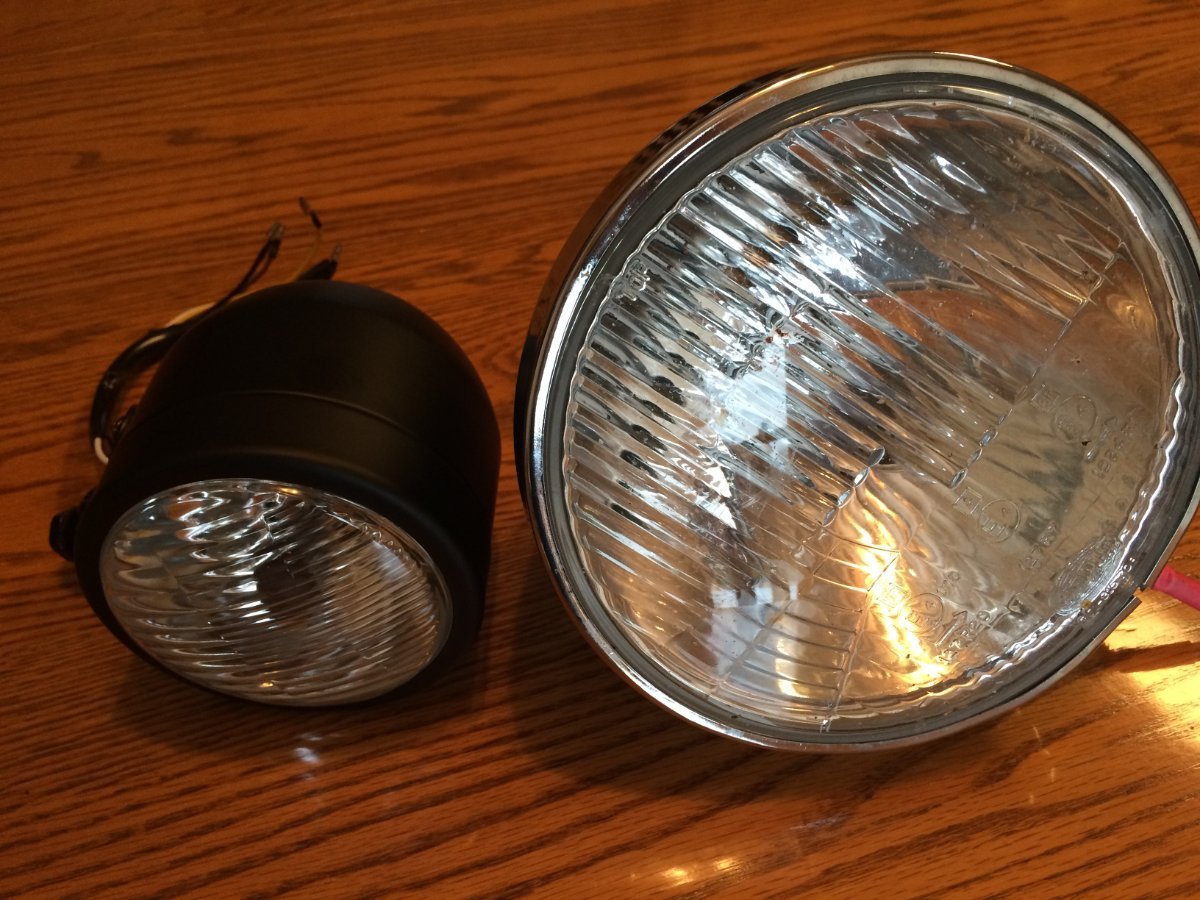
The large headlights that came on my Birkin made it hard to remove the nose if I need to access the radiator or the front of the engine. I rotated them somewhat outward, but after doing so a couple time, one side became loose. So, I opted for smaller lights which gave me plenty of clearance and fixed the problem. They measure 4" in diameter including the housing and 3.5" across the lens. They have low beams and lower beams. I sometimes use the lower beams as driving lights, but they are worthless for lighting up the road. I keep them on high beams on the rare occasions I drive at night and they do a fair job. Stalker, let us know if yours throw out enough lumens.
-
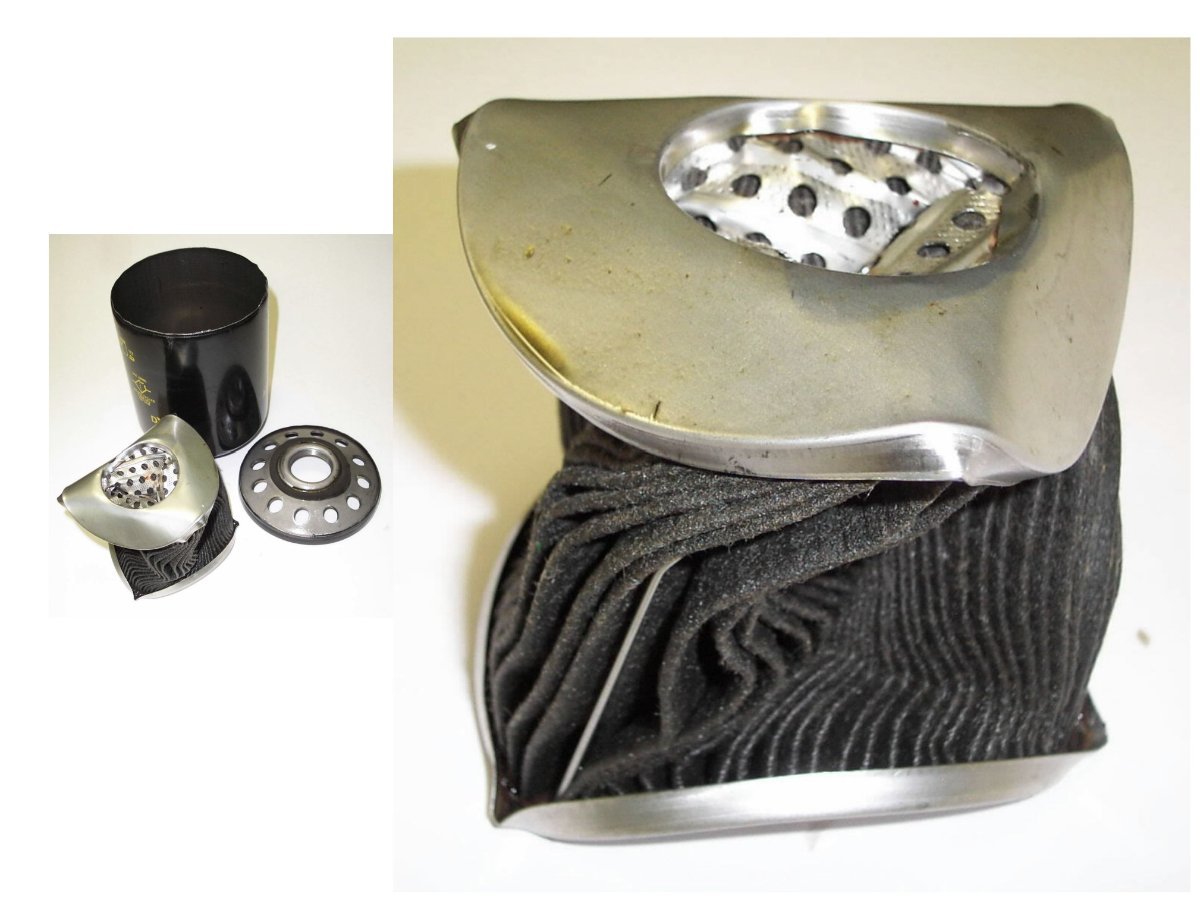
I found this cut apart filter picture that you may find amusing. It is from a pulling tractor where the filter has no bypass and the owner nailed his block bypass shut.
-
I am a fan of synthetic media. Imagine a screen door made with 1-inch cables. The holes are small enough to keep the flyes out, but there are not as many holes due to the size of the cables. Synthetic filters are kind of the opposite. The strands are thinner, so they can get more filtration in the same size can. Several years ago I used a filter cutter to cut the cans off filters from my Toyota MR2 Spider. There was a Fram Tough Guard, Mobil 1, and a Purolator Pure 1 filter. I did not attempt to differentiate the pore size in the media, but the Pure 1 filter claimed to have synthetic media and had twice as many pleats as the other two. I have used Pure 1 filters ever since. By the way, I have cut open quite a few filters. I have seen sludge after the first change in a used car, small amounts of metal from break-in, but never anything in a filter from a healthy engine.
-
I know there is more than one way to skin a cat, but this makes me crazy. The video above says, “Can I suggest that if your system has the Coolant Temperature Correction map as your very first port of call, rather than the absolute last thing you touch, then maybe you could take some notes and give this system a try.” The Haltech manual says “…try to do the majority of your compensation using the coolant temp map and only use the post start map after the coolant temp map is properly programmed.”
-
Thank you Wemdt for the correction maps. What does your Fuel-Post Start Enrich table look like? Are you using the Ignition-Post Start Offset table? When the previous owners of my car had an electrical problem, they would take it to a shop that would bypass the faulty wiring instead of tracking down the problem and fixing it. I took apart the wiring harness and pretty much started over, including rewiring and relocating the ECU. There is no MAP sensor.
-
2.0 Duratec, Jenny throttle bodies, stage II cams. ECU runs off throttle position and rpm. No knock sensor, no barometric pressure, no MAF sensor.
-
Sorry for the slow response--out of town guests and such. I think I have a ~2009 Sport 1000. The Fuel-Coolant Temperature Correction table is present, but has not been filled in. I can test post start enrich, but warmup driving will have to wait. It snowed today and they dumped salt on the roads. Now I have to wait for it to rain again to wash it off.
-
Thank you for the video link. He is using a newer version of the ECU, but the part about the warmup corrections getting baked into the closed loop AFR target was helpful. Because of his comments, I also found that post start enrich can go for up to 10,000 seconds. Again, I am not having a problem with startup. It starts and idles okay. However, the engine is limited to low but increasing RPM until it is at full operating temperature. I will play with the post-start enrich and see if that makes a significant difference. Thanks again.
-
Thank you for your comments. No doubt, part of the problem is that I am my tuner. Cold starting is not a problem. The problem is it runs like crap until it gets to full operating temperature. As I start out on a day with temperatures in the 40s or low 50s, it will cut out at about 2000 RPM. As it warms up, I can get to 2200 RPM before it cuts out. Then 2400 RPM and so forth. It will not give me my full RPM range until the coolant temperature has reached 190, which is about 5 or 6 miles. The first 3 miles are risky because I have no acceleration and am forced to drive at slow speeds on 2-lane blacktops. In looking at the warm up maps in the Haltech 1000, it is obvious they were never given any consideration. As I understand it, timing that is too far advanced at operating temperatures will cause excessive heat and engine knock. In cold weather, the objective is to get some heat into the cylinder. Advancing the timing during warm up speeds up the process. I am changing the cold temperature advance at low RPM, and not at all above 40% throttle. I agree the fuel map needs a little bump in the cold. I am making an adjustment based on coolant temperature. It seems I should also adjust a little, based on air temperature. Coolant temperature changes until full operating temperature is reached. Air temperature stays cold all day. It has been raining here, which is good. It washes the salt off the road and we need the moisture. On the other hand, the road stays wet on cold cloudy days and I have not had a chance to do any testing.
-
Cold air is more dense and carries more oxygen than warm air. What, if any, fuel map corrections are you making. I am on flat ground in the Midwest, so my fuel map runs on throttle position and RPM--no MAF or barometric pressure sensors. My ECU was set up by a guy in Texas, which is probably why the engine runs fine in the summer, but poorly during cold weather warmup. I am making changes to the ignition map and fuel map based on temperature, and thought I should also look at the air temperature. It is interesting to note that after warmup, the engine runs fine, even though the air temperature reading does not move between start up and full operating temperature.
-
Sorry about the slow response, but I would like to add to the discussion about gasoline and additives. Christopher is right about solvency. When 10% ethanol is added to gasoline, the mixture becomes more aggressive than either the alcohol or gasoline alone. Alcohol blends can absorb water. Then when the solvency drops due to lower temperatures, the water/alcohol mixture can fall out of suspension. It is more an issue for boats without evaporative canisters on the fuel tank, and a very humid environment. Not much of a risk for us, unless your fuel supplier is extending his supply with water. Ethanol an oxygenate--carries oxygen into the cylinder with the fuel, enleaning the mixture. If your engine was tuned using alcohol free fuel, using E10 or higher can cause it to knock. If your engine was set on kill, changing to an ethanol blend can cause damage. Stoichiometric AFR for gasoline is 14.7:1 , but ~14.1 for E10. I am very skeptical of lead substitutes and octane boosters. In 1988, as the wide nozzle system was practically gone, the EPA and USDA reported the results of a joint study Report to the President and Congress on the Need for Leaded Gasoline on the Farm. The pages were not numbered, but I would guess it is about 200 pages long. The intent was to prove that lead substitutes could replace lead. They proved the opposite. They tested products from Du Pont, Polar Molecular, and Lubrizol, which dominated the market and sold to blenders for a hundred different brands of lead substitutes. Lubrizol’s additive was the only one to have a partial success, when used at four times the recommended rate in a 454 with induction hardened seats, but still more valve recession than 0.1 grams of tetraethyl lead per gallon. Most octane improvers contain toluene, which is also an aggressive paint thinner. It has a very high octane (~120), but doing a weighted average, you can see a pint bottle in a 25 gallon tank does not really move the needle.
-
Effective wind deflector/buffeting reduction?
oilteq replied to Cueball1's topic in General Sevens Discussion
I love the wind in my hair, up to about 50 MPH. I have the little wind deflectors, but above 60 MPH I take a beating.