
oilteq
-
Posts
169 -
Joined
Content Type
Profiles
Forums
Store
Articles
Gallery
Events
Library
Everything posted by oilteq
-
Never fails... you think you're done.....
oilteq replied to ptegler's topic in General Sevens Discussion
-
Front license plate required in Oregon
oilteq replied to Cueball1's topic in General Sevens Discussion
So, in Maine you have to run a front plate, but racing slicks are okay? -
"...will I have to get under the dash?" Upside down under the dash? Yes, we call it the Lotus position.
-
Silicates are effective in controlling aluminum corrosion. Most U.S. passenger car coolants use silicates and phosphates and I think the name brands would do a good job. HOAT products are convenient if you have a mixed fleet as they also protect against liner cavitation in diesel engines. I think most of the coolants today use some form of organic acid technology (OAT, HOAT, NOAT). I have never seen it in writing, but the voice in my head says mixing a modern OAT coolant with the old green antifreeze using an alkaline corrosion inhibitor results in a mixture with less corrosion inhibition than either of its components.
-
I did not know beans about these engines.
-
Congratulations. I like the curved windshield of the Superformance. I do not know if it helps with buffeting, but it look cool.
-
I assume this picture has made the rounds, but it will still make some of you smile. Colin Chapman was 5'6" (?) and designed every Lotus just to fit himself. Carroll Shelby was bigger.

-
Yes, for 43 years now.
-
Spectrographical oil analysis is performed by burning the oil and reading the frequency and intensity of the light to determine each element and its concentration. The metal has to be vaporized in the flame to get a reading, so only metals up to 6 or 7 microns show up. That is how you can have visible metal and only slightly high readings. Did you check the oil filter for visible debris? Silicon is likely from new gaskets or sealant. If it were from intake air, I would expect iron and chromium to be higher as dirt chews on the cylinders and rings. I assume you are using an SAE 5W-30 or 10W-30. The 1% fuel dilution was enough to drop it into the SAE 20 range; perhaps a mitigating factor in the lead (bearings) reading. If you have changed the stock cam to one with higher performance, it will create more pressure between the cam and cam bucket. If so, I would recommend a diesel engine oil or a racing oil; something with more zinc to protect the cam. Oh, and who are you calling a geek? 😊
-
These guys make custom radiators. I had them make a long filler neck for a previous 7. It was very reasonably priced and they were good to deal with. https://www.griffinrad.com/
-
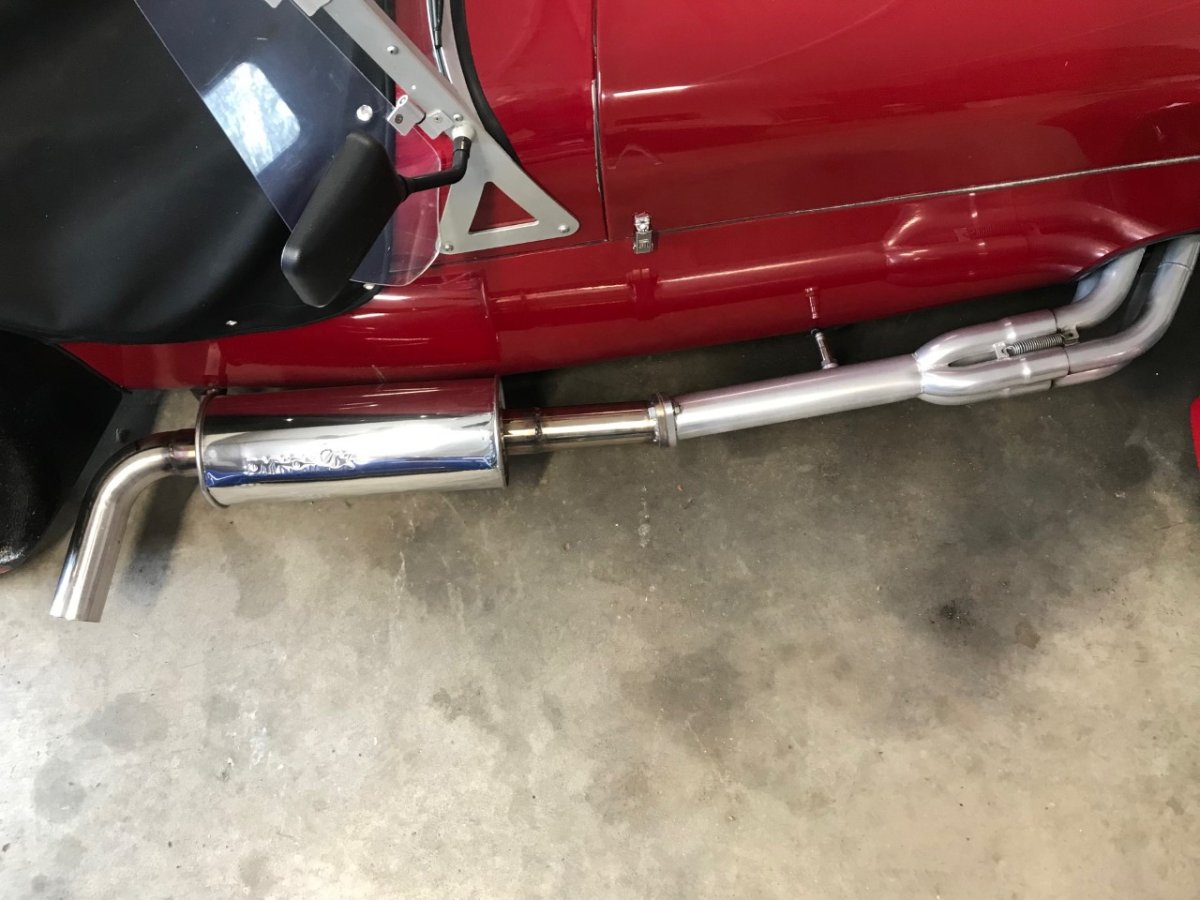
Wow! That will be fun. What size tube comes out of the header, and what are you doing for an exhaust pipe? I have what Dick Brink called a big tube header on my 2.0 Duratec. The ID coming out of the header is 2 3/8', but it was going into the original Birkin exhaust pipe with a 2" ID. I bought a muffler, some stainless tubing, had a flange made, and found a guy that could weld stainless. Now it is 2 3/8" from the collector to the tail piece.
-
The weakness of Comparative Viscosity Charts is they are tied to Viscosity Index—the rate of viscosity change with temperature. The posted chart looks like the typical 95 VI straight viscosity oil. So, comparing SAE grades (100 C test temperature) with ISO grades (40 C test temperature) does not work. I know ISO grades are not used in automotive fluids, but the point is that viscosity is always tied to temperature and VI. A typical transmission will run at 150 F or so. Although SAE 50 engine oil and SAE 90 gear lube may be the same viscosity at 212 F, a synthetic 75W-90 will be significantly thinner at 150 F than a straight 90 petroleum oil. GL5 gear lubes can be aggressive toward yellow metals, so GL4 is preferred if you have bronze syncro gears. I think you will find a straight 90 petroleum oil will quiet it down noticeably, but may make shifting slow during warm-up if you venture out at sub-freezing temperatures.
-
For a smaller mirror on a previous Birkin, I bought a cheap review mirror at Walmart. To test for size, I taped off the part I thought was unnecessary and drove around until I was sure I had the right size. I removed the mirror from its housing and cut (broke) the ends off with a glass cutter. I then took it to a glass and mirror place with huge wet sanding belts to round the edges and achieve the final shape. I cut the mirror housing down and used double sided foam tape to secure the mirror to the housing. I liked it so well, I did the same thing for an Elise and an MR2. Adjustments had to be made carefully, but since my seat is not adjustable, any guest drivers have to be close to my size anyway. I was planning the same fabrication for my current Birkin, but found it was unnecessary. The racing seat touches the floor, so there is only a thin layer of carbon fiber between me and the floor. I am 5' 10" but sit low enough that the mirror does not obstruct my vision.
-
If you are risk averse, you could check the return policy and then order one wheel to verify fitment before ordering the other three. This would probably work better with Real than a UK based vendor. With only 1/16" clearance, make sure the wheel weights are offset from the brakes when balancing.
-
I do not carry a spare tire, giving me a bolt hole that used to secure the spare tire bracket. I used it to secure the license plate bracket. I drilled a hole through a bolt for the wire for the license plate lights. Thinking about how Chapman wanted to use one part to replace three, I used bolts with lights in them. A plastic spacer keeps the plate clear of the body paint. I had a picture of it lit up at night, but I cannot seem to find it. trunk.pdf
-
Getting closer to a purchase. More questions.
oilteq replied to Saudio's topic in General Sevens Discussion
The front fenders are relatively safe. The front tires pick up sand and small rocks and hurl them rearward. The shields on the rear fenders are not just for decoration, and the side panels are in the line of fire when changing directions. -
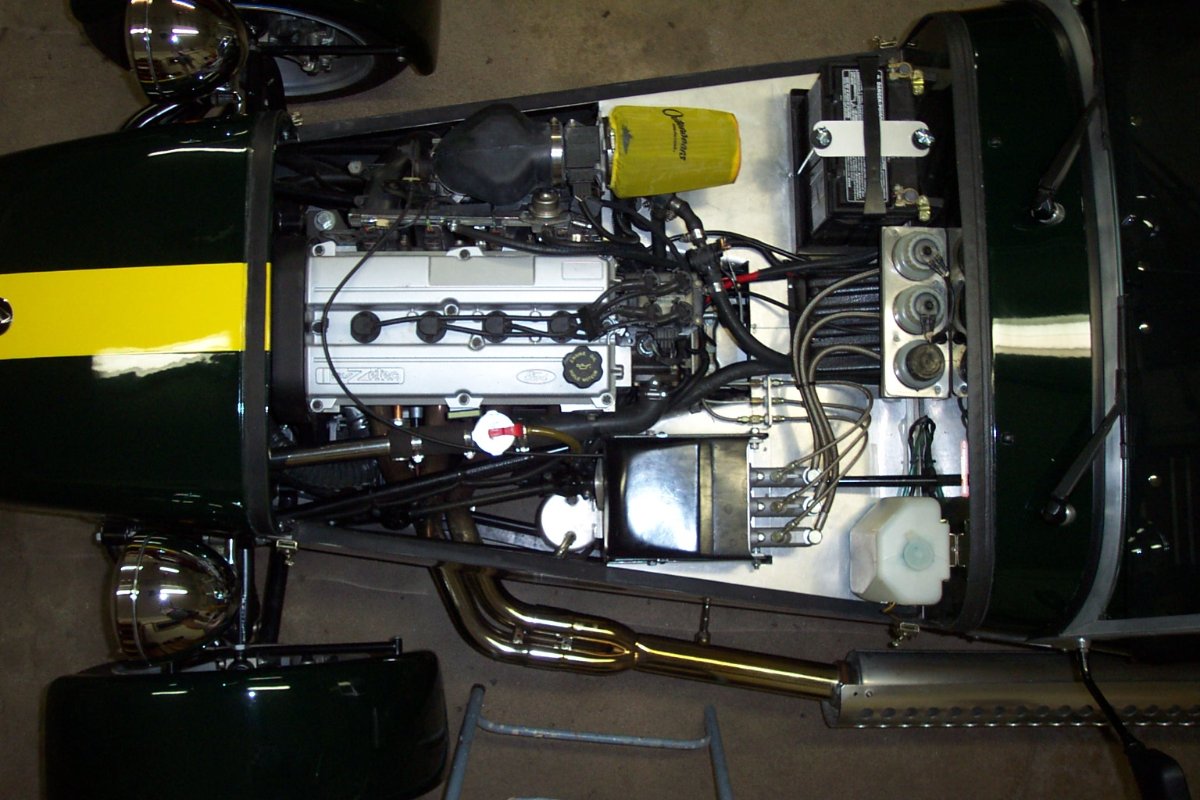
My first Birkin wore an Outerwears intake air filter cover. I still carried a plastic bag in case I had to park in the rain because I made a sub-optimal choice for the location of the ECU. Perhaps a Goretex cover would help with the cabin air?
-
Thank you for the comments. It sounds like 13s are the way to go. I know it sounds wrong, but I do not like really sticky tires on the street. They pick up every little stone and grain of sand and hurl it back, scratching the car and rear fender guards, and getting some of it in the car. So I will keep my dried out 15" tires and look into some 13 inch wheels and tires. It is not the direction I want to take, but I love the roof rack, Bernie.
-
I have always liked the idea of 13” wheels instead of 15” wheels. They put us an inch closer to the ground, lower our gearing, are lighter weight, and the front tires can be wider because they are lower than the fenders. The down side is selection. I am further limited in that I do not have a trailer or a sag wagon/companion, so I have to drive to an autocross. My question is, would I be better off with 13” wheels and a set of Falkens or Toyo Proxies, or is it better to go with 15” wheels and figure out something with fenders to fit wider tires?
-
I just finished watching "Shelby American" on Netflix. The interview with Shelby employee, John Morton, was in front of a red, white, and blue Lotus 7.
-
Leaky Gearbox - Superformance S1 (Zetec w/ Ford Type 9)
oilteq replied to Driven's topic in General Tech
I used Quantum Mechanics for parts on one Birkin transmission, and for the whole transmission on another Birkin. I wish his parts and shop were cleaner, but overall good experiences. -
There is not a lot of data on HP vs viscosity, but with government mandates, there is a lot of data for fuel economy vs viscosity. So, if fuel economy is a good proxy for HP… The gains to be had by using a lower viscosity oil come from fluid efficiency, not mechanical efficiency. There is just less parasitic drag from pumping and churning. Although friction modifiers help, the big gains come from lower viscosity. The biggest gains in fuel economy come at low loads, where the energy required to pump the oil through the engine is a greater percentage of the total energy consumed. At WOT, pumping and churning is a smaller portion of the total energy used, and therefore much less of an influence on fuel economy. I think there is a trade-off between sealing the rings and lower viscosity. Too thick, and you waste energy circulating the oil through the engine. Too thin, and combustion gasses blow by the rings instead of converting that energy to the flywheel. The sweet spot would vary somewhat with oil formulation, but I am thinking primarily with the engine (tolerances, combustion pressure, rings, pump, and windage). If I am right, modified engines, especially those with higher compression or forced induction, would benefit from a thicker oil than the stock engines they are based on. Blaine
-
Mike, as fate would have it, a stock car racer pointed me to this dyno testing. https://crateinsider.com/oil-testing-data-by-hendren-racing-engines/ What stuck out for me was the oil generating the highest torque and hp numbers was the thickest of those tested (loaded test?). They compared an SAE 10W-40 with SAE 0W-20s and 10W-30s. A stock car crate engine may have no relevance here, but it does support my claim that there is more to it than reducing viscous drag.
-
i have used 15W-40, but I have 10W-30 in it now. If I were going to use it on the track, I would probably use 20W-50. Not all engines response to thinner oils with more power. In those engines, I think a better ring seal produces enough more power to overcome the additional drag. I know it sounds like heresy, but I have seen some engines make more power on mineral oil, which wets out the metal a little better than synthetics. But those are extreme engines. Honda is experimenting with 0W-12 and 0W-8 grades in their quest for better fuel economy.
-
You may find the attached copy of Ford recommendations interesting. In September of 2009, I had one guy too many tell me that Ford has such tight tolerances that SAE 5W-20 was the only oil that works. So, I contacted the biggest Ford dealer in England, and asked what viscosity is required to support the warranty in the 2.3 Duratec Focus. He told me 0W-40. I asked about 5W-20, and after a long pause he said with his British accent, “But sir, 5W-20 is not available.” Then he told me who to contact to get the attached recommendations. Although the 2.3 Duratec had been in Europe for a couple of years, it was new in the U.S. I called my local Ford dealer and asked what viscosity grade is recommended. They had not yet received a Focus with the 2.3, so he had to look it up and call me back. When he did, he verified SAE 5W-20. My contention is that thin oils have a lot more to do with fuel economy than wear. Engine Oil Scan.PDF