MV8
-
Posts
2,303 -
Joined
Content Type
Profiles
Forums
Store
Articles
Gallery
Events
Library
Everything posted by MV8
-
I think you may have used a hose that was nicked. Hard to say when you didn't post any pics or part numbers. I use standard universal push lock hose with standard barbs and clamps or push lock fittings for oil and fuel vent and replace the hot oil hose every few years when it starts getting stiff. Since the lines and cooler are higher than the pan, I would expect a pressure delay to refill the system on a cold start. Oil level will be that much lower in the pan in normal operation if maintained to full mark cold.
-

First Breakdown, (going to a British car show)
MV8 replied to theDreamer's topic in General Sevens Discussion
That cable does not look like an original type. The shank of the swedged fork end should be thicker than the width of the slot in the fork between the larger insertion hole and the smaller seat hole. I suggest fitting a common, 1/2-3/4" long bolt similar in size to the id of the insertion hole (3/8"?) with a nylock nut so this does not happen again. Aside from the shank issue, the setup you have may be better than the original cable design. The morse cable type end at the pedal prevents the typical cable failure point. -
I was asked to share the following and I'm sure many of you know these things already: Not just checks but any mail (including ballots). The internal surveillance is better now but you still see mail being dumped by mail carriers that had better things to do. Don't leave valuable package returns in your box for pickup either. Sometimes they disappear forever, even if it was the mail person that actually picked it up and not a "porch pirate". Drop your packages at the post office. You can also call USPS to ensure your mail has not been forwarded to another address or your address changed. They do notify to confirm a change request (by mail) but that can be intercepted (they know when to expect it) then all your mail goes to them. Opt out of paper mailing of statements that can be downloaded to your pc, printed, then the electronic file deleted. You should also check periodically that no numbers have been added to your cell service. This can be done by insiders at the service or someone with enough of your information to convince the service. Next step is to "sim swap" your actually number to their phone number on your account(they already have access right?) and now the phone used to authenticate your accounts is in their hands, and they can wipe you out financially. I know someone this has happened to. Passwords should be long giberish with improper spelling. 2nd tier questions that are setup (i.e. your favorite dog, school, Mom's maiden name, etc) should have made-up answers, not your actual info but you would need to be good at keep up with all that with paper, not an electronic file on your computer that can be remotely accessed. Don't have cameras inside your home in sensitive areas with wifi access (includes your cell phone). Don't install "aps" you don't need, talk about your trip on social media AFTER you get back, not before. The list goes on. Just precautions, like wearing a seat belt. Nothing is perfect.
-
In addition to Andy's recommendations, I would recheck the firing order on the coil and if that is ok, pull all the plugs, then rotated the crank a couple turns, to see if any liquid comes pouring out of a plug hole. I'm not sure why a 90's ecu would need to be updated when fitting an identical sensor but I don't know much at all about the Rover ecu. What steps did you take to update the ecu? Did you attempt to start with the new sensor and the old ecu cal? Can you fall back to the last cal?
-
Sending you a PM. I'm hesitant to publicly share how bad guys do things.
-
Without platen is the better performance design. Cable and hydraulic can have either PP type. The release bearing, spacer if needed and appropriate height carrier must match the PP design. The fork for cable and hydraulic are the same on the release bearing end. The platen type is the older design that is heavier with more inertial and more expensive to make, and requires a rounded/donut faced release bearing.
-
No need to pull the pump again. Did you ever remove the oil cooler sandwich adapter from the pump as I've suggested a couple times? There may be some debris out of the oil cooler or piece of old hose between the two. It is a good practice to take a few pictures when you are taking things apart to keep in a file on the hard drive (or "cloud" if using your phone); at least until the issue is sorted out.
-
Caterham Cars, Ltd. is a low volume manufacturer registered with NHTSA.
-
The relief valve was working before. Put the pump back together as it was, put it back on the car, leave off the oil cooler adapter, filter, and bucket. Spin the starter. If oil pumps out, install the filter and bucket and spin again looking for indicated pressure. With a cooler, the oil must fill the system then the filter bucket before reaching the pressure port for indicating.
-
Are you saying you did not clean everything and spin the motor to find the leak before taking it apart? A stuck or leaking relief valve does not cause an oil leak outside of the crankcase.
-
'60's Chrysler Tech video but the fundamentals apply:
-
I suspect a hardened, rubber oil cooler hose was moved around in the course of maintenance and cracked. Hoses should be soft. You can fit the "push lock" hose to standard barbs and use clamps. I expect you need 1/2" hose or you can remove the cooler. To confirm, remove the nose and leave it off for now. Clean everything. Top off oil. Run a jumper to the starter solenoid to control the starter. Spin the engine for 5 seconds while observing or remove the oil cooler sandwich to bypass the cooler circuit and look for oil pressure rise on the gauge. If no leaks at all or pressure on the gauge, pull the pump and inspect the gear. I don't know if it has a roll pin or just a press fit to the shaft. It could be you picked up a solid in the pump around the filter that was not sealing, which could lock the pump and break the gear or pin but that doesn't explain the leak. I doubt that is the case and it is just an oil cooler line. You've come a long way with this car. Don't give up now so close to it being useful.
-
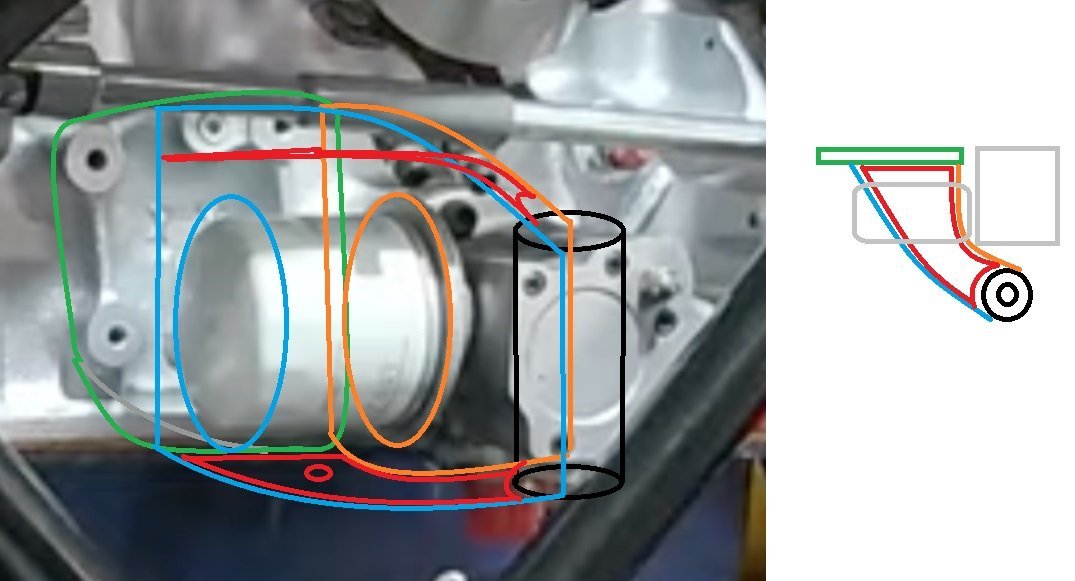
Here is a crude pic of what I described.

-
I can see how it can be done, and more robust than the typical mount, but I've not seen any examples. I can use mspaint to draw on the pics to show the general idea if you'd like. The base plate on the block is oversize, with the bottom edge near the pan rail and the upper higher as well, space permitting. The tube that attaches the mount to the chassis rubber is also longer by an inch or so with a longer bolt. Bent tubes would not be fitted, using 0.100-0.125" x 6" or so common steel strip/plate instead. The plates are parallel at the base plate as far apart as a socket on the mounting hardware will allow, are bent to fit without the filter in place, then boxed with strip along the top and bottom for a asymmetrical "dog leg" tube mount. The opening for the filter to fit through is then cut out with plasma (can't be cut when flat since it will be in the curve). A tube can be rolled to fit the opening for the filter but I don't think it would be needed.
-
If determined to use the filter pump on the side, a mount can be made that would still provide filter access using a socket-type filter wrench. These days, there may be a way to have the area scanned with the filter pump installed and scan the existing bracket, then email the files to a techy fabricator to make the mount.
-
I was referring to watching the gauge while touching the lead to ground (briefly) but I think that maybe your tank and sender are fine (guessing 10/80 empty/full), just not compatible with your specific Smiths fuel gauge (guessing 240/20 empty/full). I would ask the tank supplier for more info on the sender full-empty ohms and what gauge it is supposed to work with. You could also test your gauge with a potentiometer (like an old car stereo volume control). They typically have three leads, cost about $10 and come listed for different total resistance values. You can use this to determine what the gauge needs resistance-wise to read full and empty. You may need to replace the gauge . That sender is not like the oem S4 sender in how it fits the tank. Not a problem, but it tells me it may be a universal sender and ohm swing. It is also possible to calibrate the new sender to work with the old gauge.
-
Those aluminum fenders are very specific for your application. Custom made ($$$) or something can be adapted and both sides replaced to match. You might consider a fiberglass replacement. Off the shelf fenders could be sectioned and welded together. The compound curved outer lip is the hard part to get right.
-
Disconnect the lead to the sender. Turn the key on, note the level indication, then touch the lead to ground watching the gauge. Does it swing? You could also remove the sender from the tank, add a ground clip to the assembly, connect the lead, turn the key on, then swing the float while watching the gauge.
-
Try a quick double pump and see if it will fall into gear. If so, probably the master internal seals failing.
-
Using traditional oil (not synthetic), if the normal oil pressure falls off within 3000 miles, consider an oil cooler or switch to synthetic. You can always add a temporary oil temp gauge under the dash if curious. It should be hotter than coolant but not so hot as to break down. A sandwich cooler that plumbs into the heater circuit fittings is a good compromise that does not need a thermostat, minimal pressure drop, and is very compact/clean. There are sandwich adapters that can be used to add the oil temp fitting so no mods.
-
Also, dry or binding at the pilot or warped clutch or pp can get hot and have a similar situ. I think you said you loosened the pp at one point during the initial slave R&R? Evenly loosened in a cross pattern at little at a time or did you loosen asymmetrically?
-
yes or other sealer like Senc said and anti-sieze on the threads.
-
I use vaseline to prime oil pumps when they are not in the pan. Packed in the pump between the gears. No need for blue loctite. Just a finger wipe of sealer spread out thin with no excess. Clean surfaces with acetone.
-
I'd remove the cooler. The adapter that holds a sandwich adapter on is usually just an extension on the original threads with a flange under the hex and a gasket that is a standard oil filter seal or an o ring. Remove the hex extension the filter screws on to and it should be back to original. You should see a little more oil pressure as well and sooner on startup.
-
With a hydraulic clutch system, the "height" adjustment of the slave is based on a new clutch where the bearing will be with one full stroke of the master used (I won't go into the more critical setup of the newer oem slave bearings with a green boot that are spring loaded). When properly adjusted, the bearing can be pulled away from the PP fingers around 1/8 to 1/4". This clearance is necessary for the clutch to be self adjusting, since the PP fingers move away from the flywheel as the clutch wears/thins. The hydraulics take up the clearance and the bearing stays in contact with the PP fingers. If this were a CAT converted from a cable with an external slave, the fork spring would be retained and the standard bearing used to maintain a gap needed to prevent premature bearing wear, but this is a SAAB system. Any internal slave will have a bearing that stays in contact with the PP fingers all the time since there is no way to add a return spring (plus constant contact is better in several ways). In closing, if the replacement's height is too low, then the clutch would not release fully and cause grinding inside the transmission when trying to shift. If it is too high, then the clutch would have a shorter life, slipping sooner.