JohnCh
-
Posts
3,406 -
Joined
-
Last visited
Content Type
Profiles
Forums
Store
Articles
Gallery
Events
Library
Everything posted by JohnCh
-

Super Stalker V6 and 2.73 gears for Road Racing
JohnCh replied to searya's topic in General Sevens Discussion
Are you only concerned with track days, or do you use the car on the street? If the latter, I'd wonder if increasing the diff ratio by that much would dull the fun? I did a quick search and found a couple of mentions of 0.80 ratio 5th gears available. That would give you a slightly taller gear than 4th with the 2.73 (146mph) and provide a far more reasonable gap on the upshift to 5th. 1.00 to 0.63 is enormous! -John -
Ah, now I understand your user name! Congrats on the purchase. No pressure, but we love build threads on the forum and we're happy to help from afar -John
-
I believe the common way to do this with wasted spark Zetecs is to tap into the same 12v+ that feeds the coil pack. If that's the case, tracing that wire to the source might be pretty easy and fully contained under bonnet. Hope it's easy to find and easy to fix! -John
-
Assuming there are no other issues (cranks, has spark, fuel pump runs, etc) and you've confirmed no power to all injectors with a multimeter, I'd start by tracing the common 12v+ wire that feeds the injectors. It could be as simple as that wire was disconnected from the source, or there is corrosion or a break within the insulation. Hopefully it's not the DTA, but I've heard of ECUs in se7ens succumbing to vibration over time and breaking solder joints. -John
-
Congrats to you both! It looks like a very nice car with great equipment. -John
-
Greg, one tip with cold starts on a Lithium battery: turn on the headlights for about 10 seconds before attempting the start. This puts some heat in the battery prior to engaging the starter motor and was recommended by the manufacturer of my battery. It seems to work well in mid 30F weather. When I researched Lithium batteries several years ago, it became apparent that you can't easily compare specs with SLA or AGM batteries. First, the discharge properties are very different. A SLA can be discharged about 30% before voltage starts to fall off, the AGM about 50%, and the Lithium about 80% (some claim up to 95%). This means that although a Lithium battery may have a lower AH rate than an AGM, the actual usable capacity could be higher. e.g. AGM rated 15 AH may have 7.5 AH available (15 x 0.5) whereas a Lithium rated at 10 AH may have 8 AH available. Second, the CCA test was developed for lead acid batteries and can't be safely completed by a Lithium. This page has a good explanation, but the short version is Lithium batteries can't discharging that fast without going bang. I've read that because of this, CCA ratings for Lithium batteries are either extrapolations or pure fabrication. PCA may be a different story since that is a 5 second test. -John
-
It looks like COVID is impacting my ability to run the new engine on a dyno. This is less of a concern for the injection map, which I can get pretty close through data logging, and more a concern with the ignition map. Given timing was intentionally set conservatively to account for the increase in compression ratio, I know there is room for improvement in that map, but my ECU's inability to natively work with a knock sensor means I don't have a safe way to experiment on the street. Does anyone know of a standalone knock sensor that does logging I could investigate? Alternatively any experience with the standalone units that simply flash a light as detonation is sensed? At this point I'm less concerned with establishing a final full throttle, high rpm ignition map, and more concerned with optimizing light to medium throttle below 5000 rpm, so I suspect that type of simpler system could suffice. Although as this thread proves, I've been wrong before. BTW drivability is great. If someone were to tell me that the injection and ignition map were already optimized, I'd have no reason to disbelieve them, but since I know that's not the case, I'd love to see if timing changes could bump up the low end or improve part throttle acceleration. Thanks, John
-
Please tell me you brought the video gear? I would love to hear that straight six running up to 8000rpm! Is that the factory air filtration setup or did they use a cold air induction box? -John
-
Do you think she will be more upset by the amount of money you spent on the car, or the fact that you have secret money? :jester: When it comes to spending on the cars, I'm a big believer in embracing ignorance. -John
-
The engine isn't even broken in yet and you're already thinking about upgrades. That's the se7en spirit! -John
-
It seems it would be easy to make a set cut down from side curtains so they retain the factory attachment points and can be opened via the hinges to aid access. Not that I'm volunteering to perform that experiment. Pokey, need a winter project? -John
-
Sometimes form needs to follow function Does anyone here use half doors? I've heard that they do a good job of reducing turbulence and they should help keep things out of the car. -John
-
Harry's Garage also has a great piece with Murray. I'm generally not a fan of supercars, but the original F1 and this car are exceptions. If I had bought Amazon stock when it IPO'd in '97, or had the good sense to be born into extreme wealth, I would be on the waiting list. -John
-
I also have a Ballistic that replaced a PC680. After about 3 years of use, the battery started to have an occasional issue holding a charge for more than 2-3 weeks and was proactively replaced given Ballistic was having a sale at the time. That second Ballistic is still going strong more than 5 years later, but it is kept on a conditioner in the winter when the car sees intermittent use. It's interesting to have a battery that is easily picked up with just two fingers, yet is capable of starting the car after it's sat outside overnight in mid 30F weather. When this battery eventually dies, another Lithium unit will replace it. I'm a convert. -John
-
Best way to polish / restore the carbon fiber dash?
JohnCh replied to justinmarshall's topic in General Sevens Discussion
The Aristowax showed up Saturday. It does add a visible shine to the carbon fiber, and although I doubt it will last long, particularly on the seats, it is very easy to apply: spray on, wipe off, have a beer. And I like beer, so I'm fine with repeating that process often. -John -
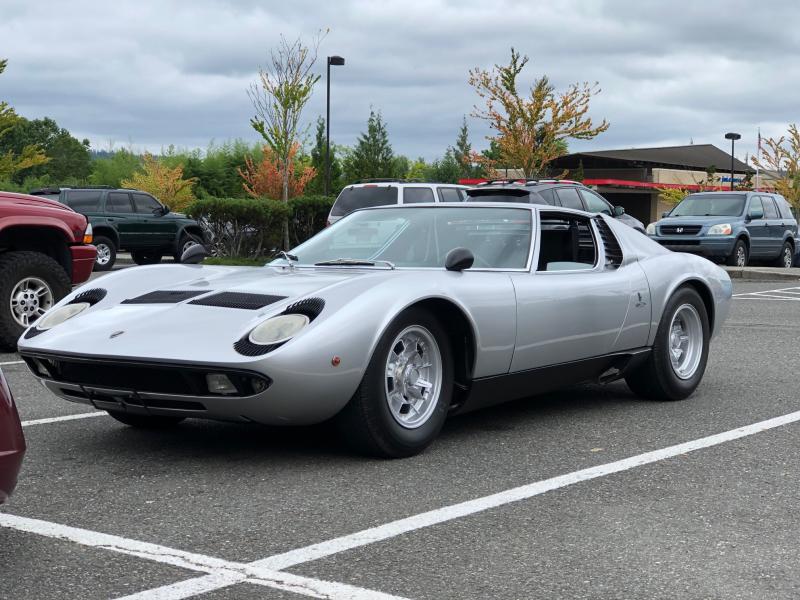
Bob, I used to live in SB. By any chance are you referring to Ward Memorial Blvd? For the rest of you, it's effectively a freeway with no onramps for quite a stretch. Perfect for high speed testing. Not that I ever did that... I was taken for a spirited ride in '67 Miura back in the mid 80's. I still remember the howl of the engine as the car approached redline in third gear, and the sight of the triple choke Webers filling up half the view out the rear window. Good stuff! -John
-
I finally had time to do a little data logging and tuning this morning. On the way home from the baseline run to establish how far off the current injection map is from target, I caught up to a beautiful Miura S that had turned down my street. It's one of my favorite cars, so I carried on past my driveway and followed him for 5 miles until he turned into the local supermarket. We had a short chat after which the phone came out and pictures were taken. (cue Mike or Sean to make the obligatory Stalker joke ) Had a bit of a concern though when leaving the lot. I nailed it down the access road that leads to the main road, but as I approached the stop sign and threw in the clutch, the engine switched off. It fired back up immediately and continued to run flawlessly, but that's a potential concern. The map was unsurprisingly lean, so after looking through the logs I made some changes and headed back out. Much better, and according to the subsequent logs, much closer to target. Taking the car up to 7500rpm revealed it has exactly the character I was after. It reminds me of an old 911, just a hell of a lot faster. No sudden feeling that the engine has come on the cam, rather a relentless increase in power the higher up the tach it goes. Can't wait to get this thing on the dyno to dial in the timing and optimize the injection map. -John

-
How much room do you need to free up? Massive Performance makes a low profile filler cap that might be enough. There may be similar options available from others or you could have someone 3D print a cap that provides necessary clearance. -John
-
Sigma Engine - Questions About MAP Sensors
JohnCh replied to Squeegee's topic in General Sevens Discussion
Just did a little digging and it appears the 310 uses the stock Ford intake with a MAF sensor, so it looks like the MAP is definitely intended as a barometric sensor. -John -
Sigma Engine - Questions About MAP Sensors
JohnCh replied to Squeegee's topic in General Sevens Discussion
I'm not sure how the Sigma is set up in the 310. An ECU can be setup to use a MAP sensor as you indicate, and what I referenced earlier with air density within the intake. However, if you are running a Throttle Position Sensor, which many people do, you can then use a MAP sensor as a barometric sensor to identify the ambient air density -- i.e. altitude. The ECU then compares this reading to sea level and adjusts the fueling table based on a look up table. This is helpful if you tour and go through mountain passes -- or if you live in the mountains and head down to the seashore. I B Sevener is using the MAP sensor (or at least the pictured MAP sensor) in that capacity. If it were determining the air density within the intake to establish A/F based on amount of air passing through the throttle, then the vacuum port would need to be attached to the intake. -John -
Sigma Engine - Questions About MAP Sensors
JohnCh replied to Squeegee's topic in General Sevens Discussion
Dave, is the MAP sensor used as a barometric sensor to adjust for elevation changes, or is it in lieu of a Throttle Position Sensor to feed intake air density information to the ECU for A/F ratios? I B Sevener's setup is the former and why it can be left open to atmosphere. -John -
See this thread on BlatChat. It has the settings for a stock Supersprint (post #2) and feedback from folks on issues they've chased and what jetting worked best. -John
-
Someone here may know the correct jetting for the Supersprint spec engine. If not, I'd try BlatChat for that info. Someone in your car's past may have tried to "improve" things by playing around with chokes, various jets, or emulsion tubes, and screwed things up. I've even heard from someone who discovered a random PO had changed the emulsion tube in just one carb, creating a mismatch. Always good to know if your starting point is correct. -John
-
I've had three cars with DCOEs, including a Crossflow similar to yours (1700cc, Kent 234 cam). None of them had the issue you describe. The closest was a built Alfa that used new casting DCOEs with progression holes that didn't work well with the engine, and would go through a rich/lean/rich cycle when cruising around 3000rpm. Have you already verified the basic settings are correct? Float height, various jets and emulsion tubes? Have you synchronized the carbs? Checked for air leaks when they attach to the manifold? Confirmed timing is correct? Occam's Razor doesn't seem to apply to DCOEs, so even if you find several of these things out of whack, you could still need a rebuild. -John
-
If the JPG files are under 2mb, please send me a PM and I'll see if I can figure out what's going on. Thanks, John