MV8
-
Posts
2,303 -
Joined
Content Type
Profiles
Forums
Store
Articles
Gallery
Events
Library
Everything posted by MV8
-
SCAM. Anybody can create an advertisement for something they don't have. Plenty of classic sevens out there that are available in-person from folks with valid id matching ownership. https://www.simplesevens.org/2138/2138.htm
-
2mm is unusually thick. Dorman sells a copper brake washer 10 pack (HW9453-10) that is listed as 0.393" x 0.67" x 1.63mm or you could try washers made for 10mm brake banjo fittings.
-
I believe the rear is an Avon ZZS 245-40-15.
-
Turns out I have a 24wx25l and 24x30 with the standard horizontal rib roof that uses standard 5 rib, 3 foot wide panels. I found there are a lot of places that have the roller for forming the galvalume panels (comes in a big roll in all the normal colors in either 26 or 29ga) to custom length at a cost of about $2/linear foot (half the Lowes and HD box store prices), so not that expensive to fully enclose what I have and fit take-off garage doors and a new entry door. I think I may order another 24x25 but fully enclosed and framed out for two 10wx8h doors and a 3x7 entry, then fit my old 24x25 frame against it and reskin for a 24x50 that is half garage, half three sided carport. The panel have held up very well but since I'm taking the carports down to move, I don't care to fill all the holes that probably won't line up again when assembled on a proper slab. Too many options make me a "deer in the headlights". I like the idea of the quonsets but see the issues. The tube carports have been great for my climate. I found these Wayne Dalton garage doors at Lowes that are perfect for my needs. A 16x7 is about $250 where the next step up is over $1000. They are only an inch thick; made of a steel and foam core composite so very light. I expect the springs are not as good as the standard door so I will grease everything well and set the spring tension on the low side. Similar idea in vinyl and sheathing https://www.youtube.com/watch?v=Pez_69LkldQ How the door goes up: https://www.youtube.com/watch?v=IgE-hPXz3iU
-
I anneal them too if I need to reuse them; using a hand torch and hanging the washers on a piece of stainless safety wire. I was in the same boat initially, thinking of ferrous metals but I didn't find any difference in hardness from cooling methods. I quench because it is so much fun (I take it where I can get it).
-
Hi Kevin. It's been sold again but the seller or the listing agent may have contact info available. Not sure how old the listing is. https://classiccars.com/listings/view/882296/1966-lotus-super-seven-for-sale-in-scottsdale-arizona-85260
-
The sealing washer won't have a close fit to the fitting since it necks down in the seal seat area. It looks like the copper washer spec'd by AP is 14.2x10.2x2.0mm but the amazon washer should be fine. AP adapter fitting CP-2554-108, M10-1.0 flat seal to 3/8-24UNF 37deg. Paint masking tape the nut and washer to the end of a paint stick. Pre-fit the bolt by breaking through the tape into the nut before installation. After a full turn, tear off the tape and stick.
-
I wasn't saying there was a problem on the old pressure plate. Regarding the dash, 3m auto trim double sided tape is very strong and thin. You could fit matching patches or recover the whole panel, then drill the screw holes and anything else you want to keep in the same spot from the front. May want to make a sun visor for the new cluster since it is an open roof car.
-
I wonder how well the german 2800 v6 would fit. They were last installed in the 83-84 ranger pickups but with a fixed timing electronic distributor and feedback two barrel. Holley two barrel and earlier flyweight distrbutor are a direct swap. None had hydraulic cams.
-
Possibly. The haltech has a few programmable digital outputs (DPOs) that can be setup to have the check engine light come on for a period of time at start up and/or key on-not running, but the particulars or if it would actually come on to warn you about an internal error would be in the programming manual which I have not seen. I also don't know your schematics as those are not freely available on newer machines from CAT. There is no need to remove the original ecu. Disabling the check engine light can be as simple as removing the bulb. I don't know what instruments you have. Traditionally ecus have their own dedicated sensors and the gauges have their own sensors. The instrument determines if you need a separate sensor for the gauge. I'm sure haltech has a temp gauge that can be driven by the haltech ecu based on the haltech temp sensor. Do you have separate individual instruments or a single module cluster that contain multiple instruments? Some pics of your car dash and engine bay might help. I'm in the dark. I think I would leave the cat ecu installed, remove the check engine bulb, and maybe use DPOs to control the cooling fan relay(s) on (10 deg above thermostat open temp) and off (5-10 deg below on) temps and speeds, add an over temp and low oil pressure warning light/buzzer, and perhaps a shift light.
-
I've had a few of the 30x30 or so metal tube carports over the years. I'm looking at have a 30x40 or so two or three bay built after I grade and build a pad for it this year. Any recommendations?
-
The explanation makes sense except that it isn't "piggybacking" to use the old ecu just for the gauges. The haltech is standalone. I would just disable the check engine light or switch to a standalone temp gauge. The check engine light doesn't mean anything coming from an ecu that isn't running anything but the gauges. "piggybacking" would be an add-on that manipulates the original ecu in some way for tuning or whatever.
-

-
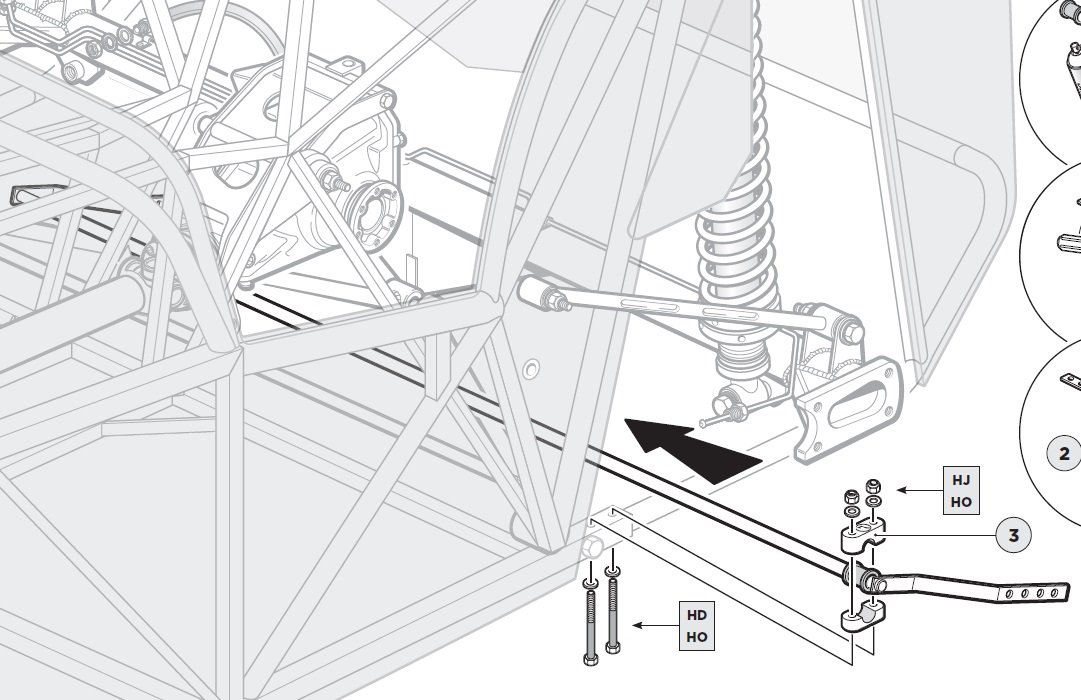
The bar rotates in saddles above the lower chassis rails.
-
No personal experience with this. I guess the arm of the arb is what fouls the exhaust. One could take the normal arb, shorten the arms a couple holes so they can clear the outer cv boot, then make a new drop link bracket or swap sides maybe, putting the drop link bracket connection at the top instead of the bottom of the ears. This would make the bar arms about level at ride height to clear the exhaust.
-
https://caterhamparts.co.uk/63-anti-roll-bars?p=2 https://caterhamparts.co.uk/53-dampers?orderby=price&orderway=desc&orderway=desc
-
Big pot of hot water (no need to boil) for the seal and some gloves. Warm kettle backup or a hair dryer. It is easy to do damage with a good heat gun. Constantly moving/waving for uniform heating.
-
My buddy had an 80s Dodge Colt GTS Turbo with the twin stick (8spd) and about 100hp. Fun can be had daily and safely on public roads while ringing the life out of micromachines. My awd Talon TSi was not as much fun.
-
Hi Bill, if you are referring to the rolled edge toward the driver, you could roll a steel wire in, bend the scuttle to shape, then remove the wire.
-
The one I used on the geo is too big: https://www.championradiators.com/Ford-Econoline-van-radiator-1960-1965 If you don't want to do any fiberglass work on the nose, then consider a civic racing radiator mounted sideways, with the filler hole plugged or a very high pressure cap installed and a bleeder port for the upper corner air pocket: https://www.ebay.com/itm/275578653192?hash=item4029c48a08:g:7vMAAOSweqJbGim5&amdata=enc%3AAQAHAAAAoPZgUZxrLY%2BOkwNC94gXdA%2FqXYdUj1CA5kgpkeJ3VG1AWtIOGwrhUPavjoUz%2BjWe0aLu42FrSjCDn7bUwTvx1uSUco%2Bck%2B%2FArjsgDwfPvRX09apI0Ncqo8vPyoLgNJKjvX43uKg41L%2FVRI%2FGk9FrPMm6pYGqjJ%2FxpElsbceoq1%2FZ9McJRurcUXVjBsApqll06149eHmpFy%2F62KjMIPfJPLw%3D%7Ctkp%3ABk9SR9qbpb6lYQ This will provide a cross flow and more vertical mounting plus the hose fittings won't hit the chassis rails, but you will need to cut off the original lower rad mount. The bleeder can be a screw or schrader valve. After topping at the high point, anything that you can open until it leaks to purge air, then retop. Deralle 18214 14 inch fan: https://www.ebay.com/itm/174928209972?epid=1239200797&hash=item28ba88a834:g:EGoAAOSwb6phN6tT&amdata=enc%3AAQAHAAAAoAS1IpcBfmq70g%2FXfvby1hbDHVmq353M%2FjB%2FRlYJYHyC5r1%2F1KbOZGFWFQVom0blbz3uIKoHUNtrYLviW1qT0yHht%2BTkh09XwkpYEkUlbC2ZYUWnKp4l9gjpo8n7I5lgbLp32EnXIjclebgUBgozIYMzodlxvSoegbnv1ZDNSSaAneXmZXjDPUKh%2Bh8aZ22LahzhlSNDbP2cfl36Ob1ytKU%3D|tkp%3ABk9SR8jn_7-lYQ
-
Here is how I sandwiched a trans cooler with a fabbed mount behind the bumper, ac condenser, and a champion rad in a geo tracker with a gm v6 swap. Wife wanted an automatic. The pusher is the only fan and a very high output two speed Hayden 3700 if memory serves) but the best fans are thick.
-
I believe I have every book on building Seven replicas. The top two imho are Jim Dudley's/ Veloce Publishing "How to build a Tiger Avon or GTA" and Chris Gibbs /Haynes "Build your own sportscar". The least useful is Tanner's book but all of them provide some information not covered elsewhere. Information is gold. There are a number of general plans of different sizes to accommodate different drive trains. Some single donor vehicles include miata, s10, dakota, pinto, mustang, etc.
-
Should be dual controls and the pilot normally flies back seat. If you can taxi without ground looping, you can probably fly it.
-

The Regular Summary of Classified Ads of Se7ens Found For Sale
MV8 replied to Croc's topic in Cars For Sale
Looks like they used thinner wall tube to keep the weight down then fit thicker wall ends to accept threads. They even scalloped the thin tube ends so it would be less likely to crack at the welds. The best way to do it imho. -
Pockets caused by a particular application are a separate issue that can be addressed a number of ways, but an expansion tank is just an air pocket attached to the pressure side that gives expansion space for heated coolant without leaving the pressure side. Oems do not always have extra ports on the tank but some have many.