MV8
-
Posts
2,297 -
Joined
Content Type
Profiles
Forums
Store
Articles
Gallery
Events
Library
Everything posted by MV8
-

Caterham doesn't make any of its parts
MV8 replied to Vovchandr's topic in General Sevens Discussion
Thanks for sharing the pics. The issue is the neck of the banjo is much too short compared to the replacement MK4 flex line. The ones I've seen offered don't have any bend either. You could fit standard, replacement MK4 hoses or keep the universal hoses and replace the caliper mounting bolt with a socket cap screw and appropriate od and id, thick washer (versus a typical socket cap screw washer). Universal banjos can be found with a longer neck but usually do not have a square shoulder to prevent rotation, needing a clamp to the caliper near the banjo. It's hard to tell from the pics but if you could bend it a bit down and inboard fully clamped at the banjo as I described, it may clear the original hardware. -
Electronic rodent repellant devices
MV8 replied to coffee break's topic in General Sevens Discussion
I've used moth balls but they don't last very long. -
The Regular Summary of Classified Ads of Se7ens Found For Sale
MV8 replied to Croc's topic in Cars For Sale
This is not a race and that is no cat, nor does it claim to be. It is far too easy to judge builds that started with a pre-internet knowlege base plan; especially when the design goals do not mirror our own. I would not build the same car today that I would have in the 80s, but I would appreciate that build all the same. -
Caterham doesn't make any of its parts
MV8 replied to Vovchandr's topic in General Sevens Discussion
GTI, sometimes replacement hoses with metal sections of steel tubing are slightly bent. Assuming the hose is mounted the right way round with the lip around the edge of the caliper body, fully tighten the caliper to the upright and the banjo to spec, then tap the metal crimp sleeve with a hammer handle a few times so it just touches the caliper body below the caliper mounting bolt. -
Some originals Sevens were fiat twin cam powered: https://www.classicandsportscar.com/features/your-classic-lotus-seven-fiat-twin-cam
-
That's why I mentioned "works properly" because a vent line with fuel in it doesn't vent. It will push the fuel out to the ground if the delta is great enough. The loops are essentially the same as a P trap on a sink preventing vapors from escaping the septic tank. The tank must vent out for thermal expansion and in to allow fuel to leave the tank to reach the engine. The details of actual use and conditions will determine the balance and how effective it is at keeping fuel from being pushed out of the hose on to the ground. An evap system does not have to be bulky, ugly, or complicated. The simplest system removes the odor, reduces moisture collection from using ethanol blends, and cuts fuel evaporation emission by about half. For a passive purge evap system, assuming a filler cap that normally only vents into the tank, you need: 1) a small charcoal canister 2) a roll over/pressure check valve with a hose fitting 3) a 5/16 fuel hose between them 4) a 5/8 heater hose on the atmo side 5) To keep out water and bugs, some window screen and zip tie to hold it on or a breather like you have on the other end of the canister that cannot let bugs and water enter the can. That's all it takes. Weight is minimal. No engine driven purge. Direct tank mount: https://www.fisheriessupply.com/perko-tank-mounted-fuel-tank-vent-line-valves-epa-compliant/0588f00 No tank mod inline fuel/air sep/surge tank: https://www.fisheriessupply.com/perko-air-fuel-separator-epa-compliant/0488001 A 1/2 liter can that will last as long as you keep water and fuel out of it: https://www.fisheriessupply.com/perko-marine-carbon-canisters-epa-compliant/0486005035 It is best to have the can above the vent valve or separator. For no tank mods, a line off the tank vent horizontal to a corner to put the separator as high as practical near a coilover, then down to a low mount canister should prevent any fuel reaching the can. Since this is not a required system, you can use whatever you want. For lower cost, automotive valves, a diy surge and can could be used. The can is just that; charcoal aquarium pellets with filter material on each end to keep the bits from migrating out and a spring loaded plate to keep them compacted so they don't move back and forth from vehicle motion and abrade/crumble into powder. Auto cans typically have a plug in the purge line somewhere with a tiny hole to limit the amount of engine driven vacuum applied to purge so that could be removed and left open to passive purge with water and bug protection.
-
I expect it is probably a kit from the UK. Maybe a Robin Hood or Tiger? Those look like standard fiat 124 70's ball joints. The bushings may be nylon versions of triumph spitfire bushes. I recognize there are many members of both forums.
-
Another alternative to a lot of fuel hose is to use a jeep roll over valve (YJ or CJ) or expansion tank (like geo tracker). It would be compact and effective at about $25 for rollover and slosh from cornering, plus break the vacuum so fuel could drain back from gravity in the straight versus sitting in the loops to be pushed out at the next corner. However, if working properly, none of these prevent venting and a fuel smell in the garage. To prevent fumes, if you can prevent any fuel from leaking out the vent pipe under any conditions, a small charcoal canister could added at the end of the hose then as you empty the tank, fumes collected in the can are pulled back into the tank from the vacuum (must have sealed filler cap). Not as effective as vacuum purging through a hose restrictor but better than nothing. Look at commercial landscaping equipment or carbed 70-80s oem cans for sufficient tank capacity. Any liquid fuel reaching the can will solidify the pellets and ruin the can.
-
A sliding door with a control cable on the firewall, shelf, or on each side of the tunnel would be practical and plenty of heat from a much hotter source that warms up much quicker than coolant.
-
For flat tappets, I use rotella conventional diesel oil changed every 3000 miles. Extending change intervals because syn doesn't break down as quickly is not as good even if just the filter is changed every 3000. The filter still passes smaller material collecting in the oil and can bypass the filter entirely if cold enough.
-
That would be replaced as part of a clutch service. The work is the same so you might as well ask for that. https://www.kampena.com/ Road trip? Maybe they know somebody in socal.
-
What is the back story? Which bearing is bad? How many miles (commute/weekend touring/track) since you became aware of the issue? Have you checked the oil level in the trans? What oil type and weight was used to fill? Drained and changed or topped off? Leaks? Under what conditions does the bearing make noise? It is much easier and faster to find a shop to swap transmissions. No multi-shop coordination or waiting on parts that may be difficult to find or get here, tying up shop space that will factor into the cost and the keys are back in your hand a day later. Have the original rebuilt and tuck it away. Good spares are worth the lost space. Maybe this one is still available? https://www.2040-parts.com/ford-t9-t-9-type-9-5-speed-transmission-i2258014/ As for rebuilding, try the mechs at a local, manual trans specialty shop (like porsche) for a weekend side job. It isn't rocket science but they need to have gear box experience. I'd avoid rebuilder factories but you might try Weller in Fontana. If I could not find a reasonable $$$ spare, I'd convert to some other type of overdrive trans depending on what compatible bellhousing would be available to make it work. Plenty of better, more common transmissions out there.
-
The tire and axle ratios were just an example where a 23 tooth driven would work. Rereading, I don't think I was clear about that. I'd rather have longer legs for a touring car to get on the highway; probably around 3:1 is a good compromise with no overdrive considering 13 or 14 inch tires. If you mostly stay on an island versus interstate highways where everyone is going about 70+, Consider something numerically higher for more torque multiplication. Imho, it really needs overdrive to do everything well with tiny tires and push rods.
-
The same could be said of any ignition system that is left connected to the battery. Power should always be controlled by the key for the coil and the trigger. If it were not, the engine would never stop. Alternators that have been mis-wired can back feed the system so when the key is off, the engine continues to run off alternator output.
-
Cams with more overlap (where intake and exhaust valves are partially open) have numerically lower manifold vacuum at idle with the same compression ratio. Timing advance increases vacuum for any cam spec. Too much advance and the engine will stall with any load, surge, or ping so like any timing curve, it is something that needs to be dialed in by controlling the total (limiting the travel at the plate or the can) and adjusting the preload to control at what level of vac it starts. More vac, more port velocity is available, carbs are more responsive, etc.
-
Don't buy anything yet as these parts may not be the best choice depending on a few variables. Ford gear housing to gm cable adapter ($16): https://www.ebay.com/itm/Ford-speedometer-sender-adapter-change-GM-to-Ford-type-/261007138948 GM 90 deg drive, 1:1 ratio ($52): https://www.ebay.com/itm/325356595192?hash=item4bc0c3a7f8:g:TWMAAOSwtlhWFouF&amdata=enc%3AAQAHAAAAsFdvds12uqTAgGmE8W28O%2B3RjAcjNYJ79r%2Fyx8eoeuU0bxigrze%2BWUHPisOaE%2Fnrjw4ETpP75cGn%2BMD0%2FVz4bvzq41f6Nrxunaa7k57CnD52Nmu4VjwbbK4rlD49KYk2iczf5RVdYmGwurYR%2FxP1TeNun9czlMPyKdw6gHpZLUhe8aPqFlAvq0OGwKpl4MVRJzlxJtE%2B%2BFsbWnHiuh%2BilSD%2F2FzWJp3O51BKGCYNdoNn%7Ctkp%3ABk9SR5anu-bvYA Your existing driven gear is white which indicates 17 or 23 teeth so the drive gear in the trans is probably 6 teeth. 6/17= 0.353:1. If you have a 4:1 diff and 185-60-13 tires, that ratio would be as close as you can get with a 1:1 angle drive at the limit of adjustment and reliability with oem gears (truck like axle with tiny tires) but the ratio could be adjusted in part or whole with the angle drive. To check the cable direction of rotation, install the old drive and rotate the input shaft clockwise as viewed from the front in gear. The driven gear looks like standard rotation for a common driver's side cable output but there are reverse rotation driven and drive gears depending on application. The cortina speedometer itself may be reverse rotation. Angle drive adapters can also reverse rotation. I expect your speedo is standard cw cable rotation. You can check this with a drill and a short piece of vacuum hose to slip over the cable end or, if the cable is straight for low friction simply rotate the cable end with your fingers while observing the speedo needle direction of movement. A pic of the drive gear on the trans would help too.
-
Those are standard domestic ford parts (a bonus imho for adapting and calibration). I guess your speedo uses a gm cable. I've spliced different mfg cable types together (most recently suzuki cable and speedo to gm) but you won't need to do that. Axle ratio and rear tire size? What color is the gear on the trans output? Count the teeth straight across the gear horizontally? Probably 6-7 teeth?
-
Avast me hearty! That be a fuel primer bulb. Arrrgh...
-
Dwell is how long the points can stay closed to charge the coil primary. With a fixed cam and point design, the dwell is determined by the point gap setting. The feeler should barely drag when perfectly square to the point surfaces and the points transfer material from each other in use that can be filed off and the gap reset for more life.
-
If one arm is bent, you can have a fab shop use the good side to make a mirrored arm. They may be able to rebuild the bent one.
-
There is a driven gear to engage the output shaft that comes in different tooth counts/colors to match the axle ratio and tire size to turn the cable 1000rpm at 60mph for calibration, a drive gear housing to hold the driven gear and seal the opening which needs to be an adapter with threads added to engage the angle drive, a fork to hold the housing on the trans, then a 90 degree angle drive box. The only special part is the angle box. I don't know what they normal driven gear tooth count is or if there were different ratio angle drive boxes used. The driven gears, housing adapter, and angle drive are shown on this page: https://kelvedonlotus.co.uk/product-category/ford-2000e-gearbox/gear-box/page/8/ Domestically, angle and straight ratio changing or rotation reversing boxes are available for custom ordering but would probably require a custom driven gear housing adapter to install.
-
If you'd like more info, check out the motortrend link posted above. I don't think ford originally installed vac adv on the kent for emissions or mpg. Chapman decided not to connect it for whatever reason. Ported vacuum instead of full manifold vacuum to a vac adv is the result of emissions compliance. Running more advance (without pinging) is a driveability improvement up to a point.
-
The carb type is not a factor. The right answer is whatever you want to do. Good enough is just that. This is not a race.
-
No old covid mask to strap on the front for temp fix? This car (and filter) has been through a lot with the PO(s). It looks like aggressive cleaning and possibly a passer-by poking his fingers in there (neighbor's child named Dennis?). Unoiled makes the filter less effective but has no effect on foam wear. No damage from ingesting the small amount of missing foam, but you could fit screens to the trumpets if it is a concern. Foam filters normally are fully supported inside and have a protective mesh over the top that would have prevented this failure. Piper cross is a supplier for a replacement but likely just as delicate. Borla makes a well designed carbon air box but that is all it is and would put the filter outside the bonnet. I'd make a K&N type (unpleated if keeping sausage shape) replacement. I'm surprised nobody is making one for this.
-
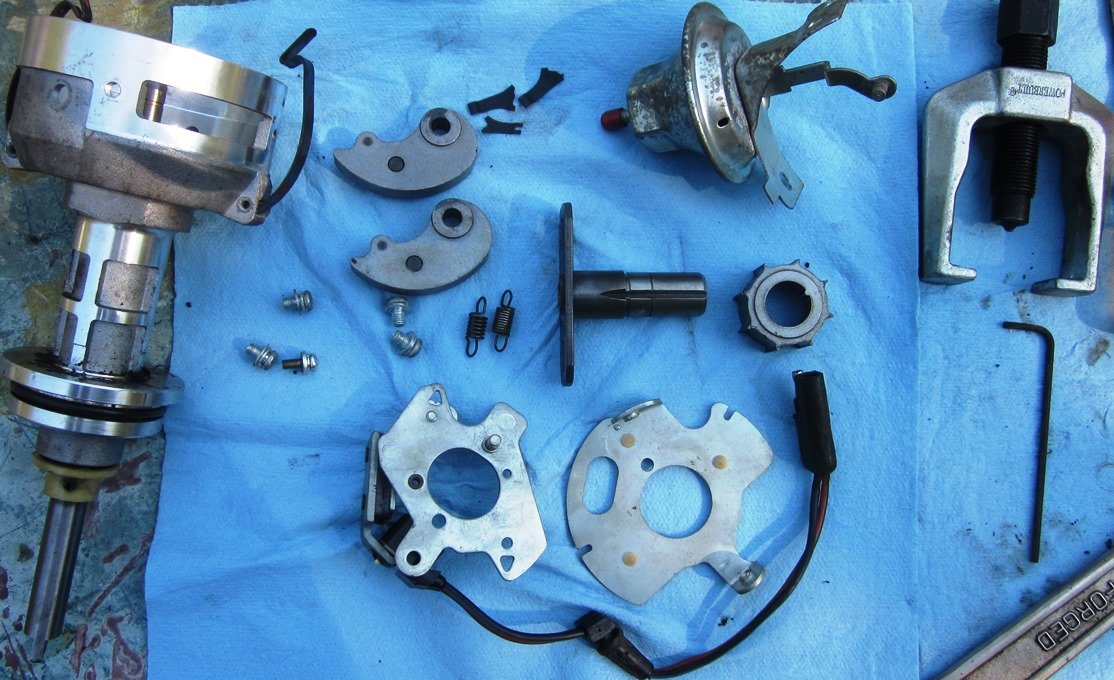
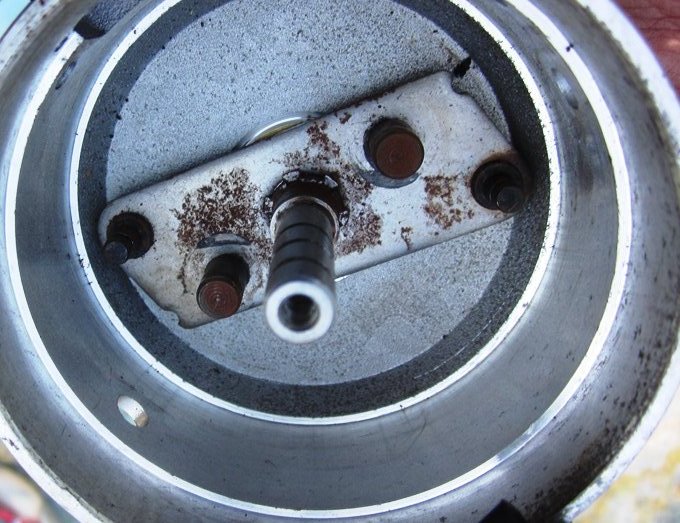
I'm definitely not a points man. I was a diehard XP fan until it was total incompatible for web use. I prefer an oem type distributor with vac and fly wt. If there is no direct fit oem electronic application to retrofit, I would use a drop in point conversion retaining the fly and vac. Here is a pic of the internals on my chinese mopar distributor. The china vac adv was junk/leaking, breaker plate clip broken in three pieces, with rust everywhere and no grease (mostly cleaned up in pic for clear coat and grease). My point in sharing is the simplicity. I used a $10, 70's chevy HEI distributor internal 4 pin module/amplifier on a chunk of aluminum as a heat sink. If I were trying to make the most of sidedraught with no common manifold across the cylinders to provide vacuum, I'd drill the boss built into each carb manifold to press in a 1/8 brass or steel tube for a vacuum port, tee them together and connect to the vac adv. I've not seen any lotus dual sidedraught intakes that did not have the prevision cast into the manifold on one runner of each manifold. The vacuum tubes are available with a bead from companies that repair carburetors (see link) or one could buy tube stock from a company like mcmaster and turn as needed for a light press fit based on the hole made by the drill size and/or use a retaining compound (maybe have a machine shop do it). Rotary file the inside of the runner if the tube protrudes. Another option would be a 1/4 thick shim base for the carbs that has a port, so no mods but the carbs would stick out another 1/4 inch plus an extra gasket. One could completely hide the ports by drilling the bottom but then fuel could leak into the vac adv when not running.